Or maybe just release regional skin pack? It’s better and easier, than making up regional units with different stats.
2 Likes
Swords bows xbows are common weapons and every culture used them.Knights makes more sense to replace as every culture would have nobels or elite cavalry under them.ideally boyar should also become a regional knight.
2 handed swords arent that universal
Personally, I’m not really in favor of adding more heavy cavalry UUs at Castles. There are already plenty in the game. If more were to be introduced, new gimmickly mechanics would need to be considered.
By the way I’m even concerned about seeing a design where the UU at Castles is a heavy cavalry, possibly leading to making Knights awful or directly get removed from Stables. That would actually be inaccurate for civs that widely use heavy cavalry.
Yeah. If they could only have one UU, I’d even prioritize choosing the War Bull. If I remember correctly, the local Sanga cattle breed has very distinctive thick, long horns. Getting charged by horns like that would be no joke.
The question remains: were throwing knives really such an important weapon in those regions? In regions like the Sahel, the most iconic military unit is cavalry. However, Bantu Africa did not use cavalry basically, so in the game they would have one fewer gameplay option than other civs. If I were to introduce a throwing-knife African unit into the game, I would be inclined to assign it to the Bantu peoples. Of course, I mean under the premise that there is a certain degree of historical basis.
If the question were not so specific, it can be noted that there were groups in regions where Bantu languages were widespread that did use throwing knives, such as in northern Congo. Don’t get me wrong, I’m not saying they were Bantu in terms of ancestry, but their culture was heavily influenced by Bantu peoples, and if they were to appear in the game, they would very likely be represented by the Bantu/Kongolese.
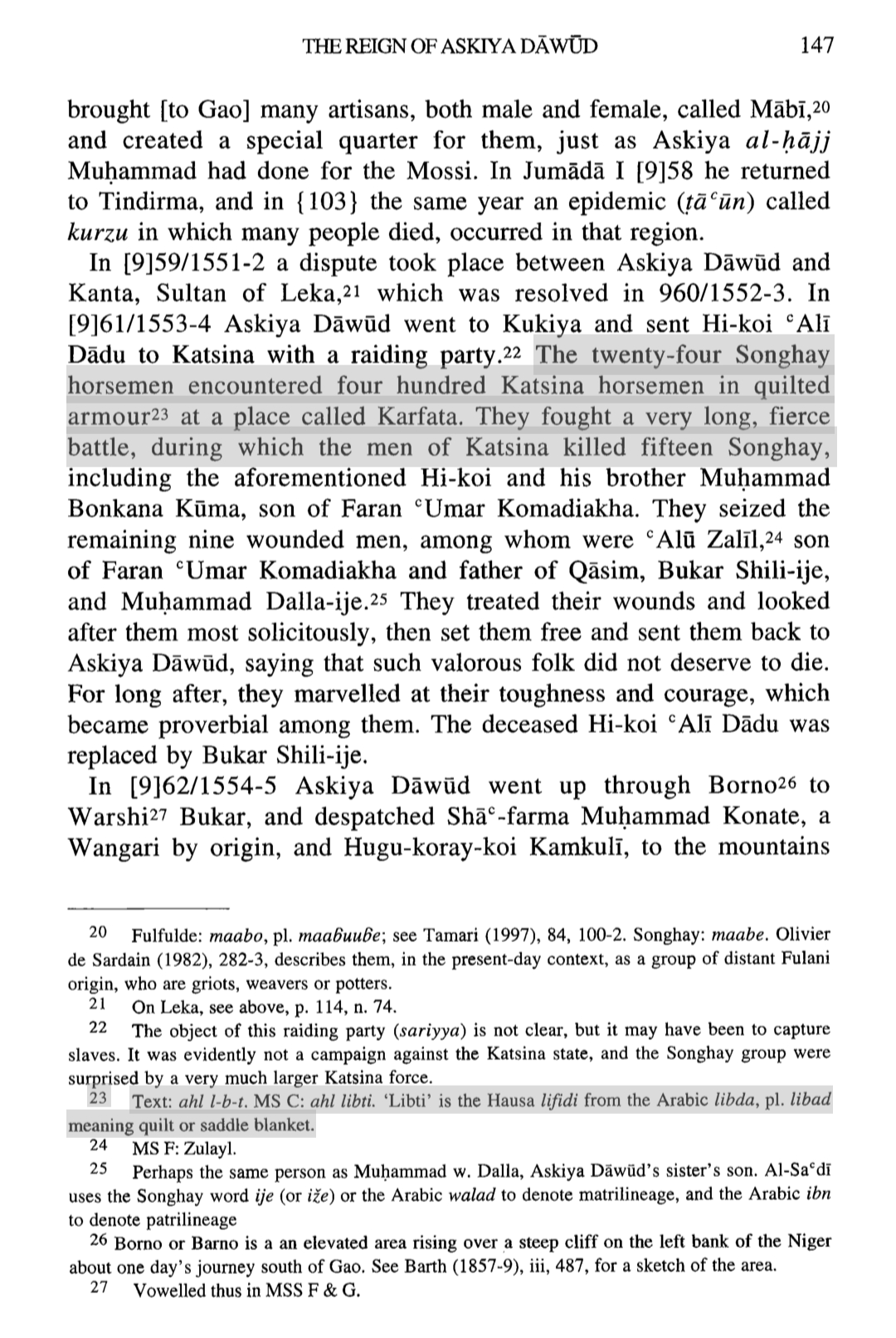
What can be said is that Malian and Songhai cavalry likely also used quilted armors, even though strictly speaking their names or forms were not lifidi.
If you’ve checked my own African civ concepts, you’ll see this is reflected: the Lifidi Cavalry line is unqiue to the Kanuri, while the Songhai has a civ bonus that allows infantry upgrades (including Gambeson) to also improves melee cavalry. The reason I stated in this thread that they could also serve as regional units is simply to say that I think, if new regional units are desired, doing so wouldn’t be unacceptable.
This has nothing to do with metallurgy. My point is not whether they were capable, but whether they actually did it widely.
When you consider that I actually envision the Kanuri civ representing the Kanem–Bornu Empire and also the Hausa city-states, you can understand why I say only this civ had produced iron cuirasses by their own. If Malian and Songhai cavalry ever wore cuirasses, it might likey have been obtained through trade.
I have also criticized the bad designs that they make a civ overly inaccurate, but I wouldn’t demand such a high level of accuracy. 11
Personally, if a civ named A covers or represents A, B, and C, then I think the characteristics of B and C can also be featured in that civ’s design, rather than only the specific those of A. It’s like the Manipuri are not Burmese, but the Burmese civ in the game includes them, so the presence of Arambai and Manipur Cavalry is acceptable to me.
In my civ concepts, he Lifidi Cavalry I proposed was originally intended as a UU line instead of a regional unit line, and apart from Kanuri having access to it, other civs still access the Knight and Cavalier. Even in that concept, the Lifidi Cavalry line isn’t necessary, because Kanuri already has the unique unit “Cima” (camel lancer unit) at Castles and the unique upgrade “Ribat.” replacing Guard Tower.
However, I would question whether Steppe Lancers can serve the same role as Knights. The way they are used and the timing of their use differ from Knights. While Knights are considered effective against archers, Steppe Lancers are weak to archers. In fact, the lack of heavy cavalry in Stables for the Jurchens and Khitans is one of the reasons these civs have been criticized for accuracy, and it also reduces their flexibility for gameplay, which can easily lead to balance issues.
3 Likes
Everyone is worried about the odea of nobility on armored horseman status being played by a knight bur how many civilizations actually used big old two handed zweihander type weapons?
1 Like
That’s why instead of regional units replacing standard ones, we should just get a DLC with optional regional skins for normal units…
1 Like
It’s just a suggestion. I wanted to fill it with a historical title for the possible UU, so I thought of a knight, but there are other titles and there may be other UUs.
As a second UU I would accept it, it would be interesting. But if we can only have one, I don’t see why we would have an animal unit instead of a human one, like all the other civs.
The cattle shield appears to have been a desperate measure from a divided and totally unprepared Songhai. There were other battles of Sunni Ali and Askia Muhammad and none of them mention this tactic.
I’ve only been “stuck” on this because I believe I can find more information about more really unique units/weapons for the Bantu. But if I’m wrong, I don’t see a problem in giving them this unit. It’s not too far off if we look at the map.
There are also club throwers or poison archers for the Bantu — the latter so ubiquitous in sub-Saharan Africa that it could even be a shared technology. Songhai and Mali also used poison javelineers.
Well, as I said, it’s impossible to say for sure without new archaeological excavations. Not only do historical texts not describe that armor for Songhai and Mali, but they also mention an episode where Hausa cavalry dressed in Lifidi defeated Songhai cavalry without it. Given that the supposed origin of Lifidi is in the 14th century or earlier, Mali and Songhai must have decided not to use them, the reasons being a mystery
(Also, others, like the Jolof and Mossi further west, seem not to have even used mail, only shields and/or various fabrics wrapped in layers around the body.)
But, of course, fun comes first. So, depending on how many DLCs there are and which civs are included, I wouldn’t worry too much about that historical detail either.
I see now, it was a translation problem on my end. It makes sense.
I just think it would be better to separate the Hausa from the Kanuri for the campaign reasons I mentioned above.
Yes, I also think that certain civs could cover more than one people; I even think that units could represent peoples that wouldn’t guarantee having a civ—like the nomadic Tuareg are represented by the Camel Archer. However, this must be done carefully so we don’t have a version 2.0 of the Khitanguts. Mali and Songhai, and Hausa and Bornu, although they all inhabit the Sahel and have similarities in combat, are not the same. Their languages aren’t even related to each other.
Cavalry had a very late impact in Mali, hence they are more notable for their thousands of archers. Songhai and Bornu are the most well-known for their cavalry, with Songhai being the expansive (light cavalry and war canoes) and Bornu the defensive (castles and light infantry), and both using Tuareg camel riders. The Hausa to the south, further from the desert and closer to the tsetse fly zone, did not use camels in war, had less cavalry than the others, but had (more) heavy infantry wearing lifidi.
Yeah, I’ll try to tone it down a bit XD but it’s just that medieval warfare has become my hyperfocus. I discovered, for example, that in the Bornu region they used spears with multiple points (bidents, tridents, etc) in warfare. When I finish reading, I’ll share it here on the forum.
1 Like
I’m not 100% on Benin, I thought I heard most of their relevance came later, but I would love those other 3 civs, and maybe go Songhai or something for the 4th.
I agree with this
Where did you hear this from? If they do I hope we get an Andalusians civ (IMO i’d be fine leaving Saracens as is and just adding Andalusians to represent Iberian Muslims. Most of the other split options for Saracens are political divisions as opposed to ethno/cultural ones, which wouldn’t fit well, let’s not replicate 3k’s issues)
It is possible, but I think there is a lot more available for African civs than South American, and I would hope that they wouldn’t do that, and would at least do 2; one for Sahel and one for East and Sub-Saharan Africa. Sub-Saharan Africa is a bit better of an option for umbrellas (I think Kongolese and Swahilis would be good options, paired with Somalis and perhaps the Ethiopian/Nubian rework people have talked about for the non-Sahel DLC) and then a second DLC having a few Sahel civs and tack Andalusians on to it as well. (they fit better tacked on to an Africa DLC than Portos did IMO)
Had to do a bit more research before I responded to this, but yeah I like this on the whole! Only one i’m not 100% on is Ghanaians, while Malians aren’t a great umbrella for all of W. Africa, I think Ghanaians can be covered under Malians at least I think they could do it across 3 DLCs (probably ideal, but maybe a bit too long) or 2 DLCs.
3-way split:
E. Africa: Somalis, Nubians, Kanembu (rework Ethiopians here)
S. Africa: Kongolese, Shonas, Swahili
W. Africa: Edo, Songhai, Hausa (Rework Malians here)
2-way split:
W. Africa: Edo, Songhai, Hausa, Kanembu (rework Malians here, maybe also toss the Andalusians in (maybe call them Moors, but Andalusians is better) but that’s moreso my pet idea)
Sub-Saharan/E. Africa: Nubians, Somalis, Shonas, Swahili, Kongolese (rework Ethiopians here)
While I would love to see all of these civs you list (other than maybe Ghanaians) if they only want to do 2 DLCs but 5 civs in each is too much then i’d maybe boil it down to this:
W. Africa: Edo, Hausa, Kanembu (I like Songhai but I could see them being left under the Malian umbrella far more than the other 3) (rework Malians here)
Sub-Saharan/E. Africa: Somalis, Swahili, Kongolese (rework Ethiopians here) (It was a struggle for me to chose between Somalis and Nubians as to which one to remove. Ended up chosing Somalis just because it seems like there is more recorded conflict in that area during the Medieval period, but i’d love them to stretch it to 4 civs and include Nubians too, they have a lot of potential as well) (I like Shonas but I think for the southern region Swahlis and Kongolese are more important as umbrellas)
My ideal would be the first option, take 3 DLCs of 3 civs each for Africa to really do it right and fill it out properly, in a way that they don’t overwhelm themselves with too many civs per and half-do one or more of them.
With the 3 DLCs with 3 civs each they could also add more architecture packs as well. Perhaps in the E. Africa DLC they add an E. African architecture shared by Ethiopians, Somalis, and Nubians (perhaps Kanembu keeps the W. African (current) architecture) In the S. Africa DLC they could add a Subsaharan architecture shared by the Kongolese and Shona maybe…? (probably not ideal, but i’m trying to not go too nuts) while the Swahili get the E. African architecture, and in the W. Africa DLC Hausa and Songhai get the existant W. Africa architecture and Edo gets the Subsaharan architecture. I suppose you could split the civs by architecture as well so each DLC gets its own architecture (so Nubians, Somalis, Swahilis in one DLC, Kongolese, Shona, Edo in one DLC, and Songhai, Hausa, Kanembu in one DLC, but I think my first split proposal fits better for regions, even if the architecture used might not be the same across each DLC)
I’ve seen proposals to use Beninese as an umbrella for Igbos and Yorubas, who did have relevance during medieval era, but I don’t know enough about the cultures there to say whether it’d be a decent umbrella or another Khitangut blunder.
If I consider history, campaign potential, military etc. this would be my priority list:
- Somalis
- Songhai
- Kanembu
- Nubians
- Swahili
- Kongolese
- Hausa
- Shonas
- Ghanaians
- Beninese
They were called Soninke iirc.
Have you considered geographical location? Based on the new South American DLC, the developers are trying to cover areas not yet represented by existing civilizations. We can now say that South America has a civilization in the north, south, east, and west. I think this is one of the reasons why Chimu wasn’t chosen for this DLC (another one being the lack of a solid campaign).
If that is any indication africa only lacks south representing civi or civis.
i posted it in a comment if you read a bit further
here it’s again https://www.youtube.com/watch?v=S8P3DGd8uKk
Ok. what are your thoughts on my ideas for splitting them out into thematic DLCs out of curiosity?
In general i’d probably agree with this ordering, but I might bump Beninese a bit higher, and while I agree Somalis are a good one to add, i’m not sure that they’re #1 in my book, so i’m curious about your reasoning on that one.
I made the same 3-way split years ago, when I was more active on the forum. It makes the most sense.
Overall I’d say West Africa would be Malians, Ghanaians, Hausa, Songhai and Kanembu. East Africa would be Nubians, Ethiopians and Somalis. South Africa would be Beninese (thematically), Kongolese and Shonas. Swahili would be a mix of South and East African regions.
- The Somali-Ethiopian war in the 16th century is the best recorded war in African history for the game’s timeframe.
- There are various sultanates such as Adal, Ajuran, Ifat and Mogadishu that have very well recorded history
- They had the best navy in all of Africa, building colonies in the Maldives and South Africa + they joined the Ottoman expedition to Java with their own ships
- Their military was modern, they even had gunpowder
Yes, in fact the Ethiophian-Adal War appears in AoE 3 in a historical battle playing as the Portuguese…
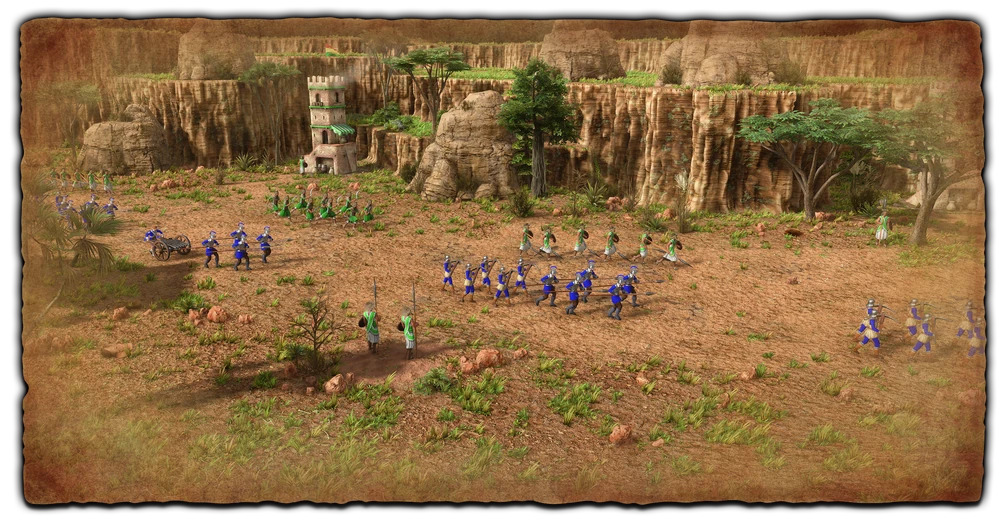
Following in the footsteps of his famous father, Vasco da Gama, Christopher da Gama, traveled east seeking riches and adventure. On the East African coast, he learned that Ethiopia had been nearly conquered by the Somali Adal Sultanate. Da Gama set out to find and rescue the Ethiopian Emperor and help him retake his empire.