On the Disproportionate Gather Rate of the Folwark and the Danish Late-Game Economy

I have been analyzing the gather rates of the Folwark. Initially, it has a base gather rate identical to that of the Rice Paddy; however, when it gains its specializations, this tends to increase by 38% (to 0.69)


, putting it close to the European Mill, but without the walking penalty or intermittent gathering that the Mill suffers from. This essentially makes it a Rice Paddy with the base gather rate of a European Mill. It is precisely this mechanic that makes the Polish economy truly monstrous once all upgrades are researched.

Home City Upgrades:

  • Agrarian Reforms: +0.3

  • Sustainable Agriculture: +0.15

Unique Upgrades:

  • Seed Drill: +0.15

  • Artificial Fertilizer: +0.3

Sejm:

  • KÄ™sgaila Agriculture: +0.05

  • Sanguszko Agriculture: +0.15

  • Ostrogski Agriculture: +0.3

Considering all these upgrades, a villager’s final gather rate is approximately 1.66 (rounded).

Per minute, with 99 villagers, the food output is: $60 \times 99 \times 1.659 \approx 9836.64/min food.
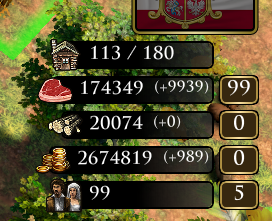
In that regard, the gather rate is significantly higher than the standard rate for any other civilization. As a result, even though Poland lacks Economic Theory and Refrigeration, it achieves an absurd amount of food gathering—on par with Germany using Settler Wagons.

Furthermore, its second broken feature is Kiełbasa, which makes livestock booming completely automatic. This pushes their economy to even more disproportionate levels: literally every Folwark generates a gather rate of 20 food/s, meaning each of these buildings contributes even more than a Settler Wagon.

To top it off, Wódka Distillery grants an additional 10% coin trickle based on the Folwark’s food gather rate. Combined with the Grain Export card, you don’t even need to worry about your economy regardless of how many units you lose.

Balance Proposals for Poland

  • Building Base Rate: The best way to address this would be nerfing the Folwark’s gather rate to 0.52 or 0.55. This way it scales progressively without becoming overtuned due to the lack of walking time present in European Mills.

  • Card Adjustment: It would be worth tuning the Agrarian Reforms card from 0.3 / -0.5 down to 0.2 / -0.35 for Folwark (or Mill in the Danish case), hunting, and fishing gathering.

  • Livestock Mechanics (KieĹ‚basa): The Folwark’s gather rate on livestock should be adjusted so that micro-heavy livestock booming civs (like the British, Chinese, Haudenosaunee, and recently the Danes) feel properly rewarded. Perhaps using the Japanese Shrine gather rate as a baseline—setting the building’s livestock gather rate to the equivalent of 10% of a villager—so the Folwark doesn’t inject massive amounts of resources every time it harvests pigs.

  • WĂłdka Distillery: Should generate coin based on the base gather rate or be adjusted to 2–5% of the food gathered at the Folwark, preventing this passive income from allowing the Polish player to rely on a single building to gather two resources at once.


Denmark Analysis

In the case of Denmark, its settlers benefit from the following improvements to mill gathering:

  • Economic Theory: +0.1

  • Agrarian Reforms: +0.3

  • Refrigeration: +0.2

  • Seed Drill: +0.15

  • Artificial Fertilizer: +0.3

  • Capitol: +0.5

  • Church Card (Struensee Reforms): +0.1

They end up with a higher gather rate than the Russians, even when Russia sends all Mill upgrades (Food Silos, Sustainable Agriculture, Economic Theory, and Refrigeration).

This wouldn’t be as severe if they didn’t also have two extra advantages: the 4 Sámi Noaidi shipment and solid livestock cards (Fulling Mills, Stockyards, and Ranching), plus Fur Trade to convert food into 1.2x its value in coin. This means the Danish civilization benefits from one of the strongest Mill gather rates in the game paired with near-perfect livestock booming, granting them a massive economy (on top of the Custom House shipments providing 1,200 resources).

Balance Proposals for Denmark

To leave the Danes with a strong but not overwhelming economy (and given that their military isn’t as dominant as Poland’s, making these changes manageable), one or a combination of the following rebalances could be applied:

  • Reduce their villager build limit to 80–85.

  • Remove either the Fur Trade or Fulling Mills card.

3 Likes

For some reason DE devs are giving every single civ fur trade (best kind of trading card) or equivalent: lakota, inca, USA, danish, polish

And dont get started on the infinite ones. At least the actual fur trade is a one time card.

And of course it had to be a civ with factories and artillery :roll_eyes:

1 Like

Don’t you know how Greenland was financed?

Walrus Ivory…Danes having Fur Trade is perfectly legit, also they were big wool users so fulling mills makes perfect sense..

Though I do think that Livestock should be a tad more useful even when uncarded, I think hunting techs should also increase livestock harvesting speed; and cows should be available as a researching upgrade in either fortress or industrial age.

Fulling is wool related…nothing to do with food…If Livestock harvesting is buffed by upgrades that allows fulling mills to give wood or coin when livestock is harvested.

2 Likes

I think that since Fur Trade is too central to their identity, just limiting the number of settlers should be enough. Maybe should work, 80 settler+4 Sámi Noaidi + cowing+ furtrade and the nerf to agrarian reforms.

Again i am not seeing the issue with the agrarian power house of the time that was the PLC having great farmers. I see the issue with a passive Herd eco without drawbacks like the mexicans which sacrifice cow passive gathering with barbacao, whilest allowing manuall training of pigs.

Contrary, nerfing regular agriculture would force PLC players even more into the absurdity that is the sausage card which in turn i reckon would beat this eco by allowing you to move 20 settlers to coin instead, making you even more pop efficent, or wood, which would then stack with: Banner cards, unit / building cards/ Settler / Building cards.

As for the danes, i see no reason for a nerf yet, seeing as they perform currently… horrendously, which is surprising seeing as they are a permanent intel spain with an actual good choice of RG units.

Removing Fur Trade is safer for 1v1 and team. Then maybe start with 90 vills. Not sure they are good enough to remove almost 20% of their eco given that they can’t probably can’t be expected to take 3 livestock cards into team games.

Edit: Danes win rate in 1v1 (I think it was) is super low. WR is normally a poor metric for balancing a civ off of, as the ELO system pushes everyone towards 50% but it’s enough of an outlier to say there is almost certainly something wrong there. I get that Danes are an issue in treaty, but you need to be careful with things that will impact sup/maybe team sup here. At least with Poland they are looking op everywhere so nerfs can be made to impact both modes.

Balance >>>>>>>> historical flavour

Just keep agrarian folwarks the same base gather rate so every tech dont stack so much in the lategame.

2 Likes

Dane’s Economy isn’t anything too special…though sending cards…is what any civ can do the more eco cards you send the fewer military cards.

And has everybody forgotten that Portuguese already had Agrarian Reforms?

Every Civ can have an absurd economy if you send enough cards…My only concern is that Poles don’t need any cards to pull far ahead at least when it comes to food.

Farming Fulwarks are better than mills in output,
They also have additional upgrades at the Sejm
Pigs start at 100 food so you don’t actually lose food waiting for them to fatten.

No, polish are their own tier right now, a comcerning one. And yes, they need too little effort to get there.

A civ with 2 factories shouldnt have villagers gathering coins while farming (99Ă—0.17 =16,83 = 2.35 extra factories on coins), just ridicoulous.

Ivory isn’t fur so I don’t know how that’s a justification for the card.

An Ivory Trade card similar to Lakota’s Great Hunter could be interesting. Have it send a fraction of coin for each food gathered from hunts and give a gold trickle while hunting. It could even be shared with an African civ.

1 Like

Why not add the same wandering as Mills as way to nerf it? That could be combined with adding a villager speed penalty as a caveat to some of their cards that improve gathering. Slower villagers would amplify the inefficiency of wandering as well as making them less efficient overall.

Agrarian Reforms - Change from +30% farming / -50% hunting to +25% farming, -40% hunting, and -10% villager speed. I think a speed reduction makes sense for a policy restricting peasants to farming estates.

Wódka Distillery - Add -15% villager speed to the effect. Villagers aren’t quite as nimble when they’re drunk so a speed penalty makes sense here.

For the building auto-gather livestock cards like Kiełbasa and Barbacoa the gather rate should be something like 50-25% of a Villager’s gather rate to offset the ease of automation. That would also mean slightly more decays while gathering too.

The base folwark is already fairly well balanced; it has the same gathering rate as a rice paddy or a farm. The problem lies with the specialization. Currently, it provides a 38% increase in gathering rate for free (if you go with Logistics in Age II). Making it work the way you suggest would therefore be quite counterproductive, since they would simply go back to their baseline gathering rate. I also assume they would run into the same problems as mills, where villagers can get stuck in the middle of the building. I think the specialization should instead provide a 0.05–0.1 increase over the folwark’s baseline gathering rate when it is not specialized.

I find it difficult to see how that card could work or be balanced. I was thinking the bonus should be capped at 0.2, while the hunting penalty should be limited to -0.2, since it currently gives you the equivalent of two standard European mill cards at the cost of sacrificing hunting gather rates. I think the idea is good and well suited for the Poles, since it encourages players to use the folwark and gives them that agricultural identity from the start.

That’s precisely the problem with the Danes: they have too many economic cards, although each one does have a certain historical flavor to it, to some extent.

The Danes aren’t that problematic in Treaty. Their economy might be a bit too strong, but their army is fairly decent, at least to some extent. Perhaps capping their villager count at 80 could be an option, as long as they receive some buffs for 1v1.

Under what circumstances would you ever be using an unupgraded one for any prolonged period? For all intents and purposes the farming one is all that matters to the food gathering rate.

Adding wandering makes the base version slightly bad, but it’s super cheap and also a House so it is fine if it’s not as good as a Rice Paddy. I could see maybe having the farming upgrade be only +35% so it is in line with a Mill. But otherwise I think adding wandering and adjusting down a few gather rate cards would be more than enough.

1 Like

Under that assumption, the base collection rate should be lowered to 0.37, and with the specialization, it would rise to 0.5—the standard base rate for all resource-gathering buildings (considering the efective gathering rate from european mill). It could be work.

I think you’re right; I hadn’t considered that the folwark comprises both a house and a mill. So, your proposal to worsen the base rate is much more viable.

I added some emphasis. If you believe that first sentence, why are you suggesting nerfing their vill cap by nearly 20% still???
I suggested 90 which at least for Sup arguably fits given that you save card slots from crates (giving you more options) and have some tax income, and removing fur trade because fur trade is almost never used in Sup. If you were saying Poland should go to 80 vill cap at least that would make some sense (I’ve actually suggested it), but for Denmark that seems nonsensical.

Edit: btw, civs with “extra eco” like Shrines, Banks, etc normally have vill pops roughly aligning with the amount of extra eco they get (or a tad lower). I don’t believe the Tax income is worth anything close to 19 vills.

1 Like

My god man reducing vills movement speed from cards is horrible horrible horrible idea it would make it so much harder for vills to get to safety from attacks.

Slowing vills down is probably not a good idea when you can simply adjust the amounts various cards improve gathering speed.

I have been playing a lot of Danes in Comp Stomps and they should not be getting such a villager reduction and right now Danes need a boost somewhere with them struggling in 1v1 games not a civilization nerf like that.

1 Like

When I say that the Danes are not as big of a problem, I’m not saying there isn’t a problem—there certainly is. What I mean is that, although their economy is massive, their army isn’t ridiculously powerful by comparison. The main issue lies in the sheer size of their economy and how it allows them to sustain constant military production, rather than their units being individually overpowered.

What I’m saying is that reducing the villager count and the potential 1v1 Supremacy buffs—which I assume and fully expect they’ll receive—are two independent changes that can be implemented simultaneously. There’s no need to choose one over the other. That’s what balancing is all about. The problem lies in having a cowing strategy combined with a 10% higher gathering rate than the Russians. That’s the real issue. At the same time, I do recognize that the presence of these cards gives Denmark a certain identity. Honestly, I can’t think of another solution at the moment beyond reducing their villager count, without removing cards like Refrigeration or Economic Theory, which would be even more catastrophic for Supremacy. The problem with reducing Poland’s villager count is that their army is more powerful than Denmark’s. Given that this could potentially create a “Mexico 2.0,” I don’t think it would be a viable long-term solution.