Fair enough. I feel like it’s something I’ve seen a lot though – things like X should be a different civ from Y because they spoke a different language. Meanwhile, Britons represent both English and Welsh, who spoke different languages, but who are otherwise both represented very well by the same civ.
2 Likes
Oh, that’s an interesting idea! My Melanesians concept was based on Fiji with the UUs, Wonder, Castle, bonuses, and coat of arms, as a rival to the Polynesians, but the idea of having them represent Maluku is an interesting one. They could be in the Malay campaign.
estimates of the population range from ~26-50k people
do you mean the Tui Manuʻa Confederacy? that was based on the Manuʻa Islands, which have a whopping 1400 people on them.
as mentioned above the Tu’i Tonga empire’s capital was only about 8000 people at its peak.
even the smallest currently included civs (armenia ~1million, Burgundy 500k in the duchy of Burgundy 3million in the state of Burgundy, Georgia 2-3million, with over 100k in Tblisi) outnumber these civs with a factor of over 10:1. And even for these civs there was already lots of criticism of “why are we adding duchies and small kingdoms to aoe2?”
agreed.
as the title of the game says, it’s a game about empires. I don’t want duchies, tribes or chieftains. The game should include the world powers of the time.
I am not saying that the art, culture, etc of these places should be ignored. I am saying that they have no place in a wargame, because it breaks any kind of suspension of disbelief to include them on even footing with the empires which are included.
they controlled barely any land, had orders of magnitude smaller population. the entire population of Polynesia, Micronesia and Melanesia barely exceeded 1 million in the middle ages.
1 Like
The game must have a really loose definition of empire then, since it launched with Celts
I’m not sure Minoans from AoE1 qualify either.
Celts aren’t really a medieval people to begin with, so their inclusion in aoe2 was always strange. Their lack of a unified state or an empire in their name makes them even stranger. But old mistakes don’t justify new ones.
Minoan Crete was long considered to have been a major power in the Aegean, but I don’t know much about them or aoe1 in general tbh.
1 Like
??? what do you mean they aren’t a medieval people? Poor naming choice aside, I’m pretty sure Celtic people still existed in the middle ages.
As much as I dislike Celts as depicted, I’m pretty sure the bigger mistake was naming the series Age of Empires, especially since it leads to people like you arguing what an empire is (and the factions are not called Empires, but Civilizations).
1 Like
I once thought a Carib concept with a UT that would give female Villagers an archer attack (and only the females).
I don’t remember why but it was because of something I read in this book (a must read for early colonial native armies)
1 Like
And yet, they had culture, organization, militaries, conflict, heroes, states, and empires, despite being so much smaller. They weren’t nothing, there wasn’t nothing, there was something, and it was affecting the world. They absolutely could compete with the empires of the time because they were literally coterminous with them- in another sense, they were competing with the other empires of the time, even without direct contact. And besides, in a game where the population cap is 500, who the hell cares whether one civ had 100,000 people and another had 50,000,000? By every sensible metric these are absolutely their own distinct civilizations, and they absolutely are civilizations regardless, and they are positively medieval civilizations.
4 Likes
True. The Austronesians, ancestors of the Polynesians and others, actually likely gave Arabs their sail technology. There’s also evidence of Polynesian contact with South America. I don’t know much about contact with other parts of the world, but those two examples alone are quite notable.
1 Like
We are getting closer to aoe3 time frame so maybe this would be an option for an mississippian civi?
1 Like
I don’t think it’s completely impossible for Oceania to have its own civ. However, there might not be multiple civs there. For example, there could be only the Polynesians, with this single civ representing the entire region.
It may feel sparse for a continent to have only one civ, but if we consider Oceania and the Americas together as a “New World” region, and note that Oceania has a smaller population and less detailed historical information compared to the Americas, assigning one slot of the New World to cover them might not be an unreasonable approach.
In my view, North America and Oceania are both low priorities, as long as there are solid candidates from the Old World, as well as Mesoamerican and Andean civs.
1 Like
If that ends up being the case, they’ll probably have the new South American architecture. It does somewhat resemble Polynesian architecture, after all.
for several of the “empires” you listed there are serious doubt if “empire” is the right term.
By the same logic the North Sentinel islanders could be added to the game.
did they have organized armies? in no way could they have gone toe-to-toe with the actual empires currently represented in the game.
In what way did they compete with the other empires? They didn’t compete over land, trade routes, people, power or resources. They didn’t because they were largely unknown to the rest of the world.
it’s called an abstraction. a villager in aoe2 doesn’t represent a single person. a single person doesn’t build a castle or a wonder.
Oceania had < 2 million people (including Australia) in it before Europeans arrived, the Americas had over 100 million people. Oceania was (and still is) populated incredibly sparsely.
Oceania’s population only exceeded 2 million in the late 19th century.
1 Like
As someone who have always wanted more Native Americans, African civs and a less Eurocentric game, I only support Polynesians as a single umbrella civilization.
Yes, I was thinking the campaign would be like Hiawatha being 70 years old, in 1595, narrating the story of when he was a 17-year-old teenager and saw his people fight against Jacques Carter’s French expedition in 1542. Then, in 1545, he saw his village razed by the antagonist, the cruel leader Onondaga Tadodaho, and saw his beloved Minehaha killed. He then fled to a nearby village where he met Deganawida (a Haudenosaune monk) (actually a Huron prophet from further north) who proposed uniting all the Haudenosaune into a single confederation. He accepted, and as the missions progressed, more and more villages joined Hiawatha and Deganawida to defeat Tadodaho, until in the final mission, in 1580, Tadodaho was finally defeated and asked to stop fighting and meet with our protagonists in his village (here the player must escort him to the (village). Finally, the three agree to form the Haudenosaunee Confederacy, and in the final cinematic, a weary Hiawatha says that although happy to have unified his people after a long life of struggle, he doubts he will live long enough to defend them from the “peoples across the sea,” with an image of Samuel de Champlain appearing as the final image (Samuel de Champlain arrived in that region in 1609, 14 years after Hiwatha’s death, where he allied himself with the Huron, from where Deganawida was, to confront the Haudenosaunee and the British in what would become the Beaver Wars, lasting for almost the entire 17th century)…
Yes, it’s a good option, and yes, the Cherokee were part of the Mississippians, so it would be a Mississippian historical battle…
Yes, they are very good options, at least for a pack of historical North American battles (Puebloans, Mississippians and Haudenosaunee) and yes, Juan de Oñate is a bit late, but hey, 3 years isn’t going to be the end of the world…
Yes, I always thought of Pocahontas as the protagonist of some historical Haudenosaunee battle for AoE 3… but yes, her father’s reign was during the last years of AoE 2 and the beginning of AoE 3 (if you consider that AoE 3 fully begins in 1600 with the Japanese campaign and already in Europe with the Thirty Years’ War in 1618)…
Yes, of course… I don’t know about the Caribbean civilization… maybe they’d reuse the Muisca architecture… and yes, I also didn’t think the Tupi would make the cut to be a civilization in AoE 2 (it was always said that they could be a fixed civilization for a South American DLC like this one for AoE 3 along with the Incas and Mapuches back in 2007 before TAD came out, or 2008 after its release, and then obviously with the release of 3DE along with the Mapuches, since the Incas were included at launch with DE, with some South American DLC in 2021-2022 before TAR came out and after KotM)… oh well, they’ll remain on the back burner for years and years…
Yes, the DLC has to focus solely on the 16th century before or right around the arrival of the Europeans (1527/1540-1598/1607), because anything else would be venturing into Age of Empires III territory, and the developers don’t want to hear about that after the controversy following the cancellation of the Baltic DLC…
Not that I recall…
It would be better for the Mississippians, since the Cherokee are descended from the Mississippians…
Yes, she could also be another heroine in the Mississippi campaign against Hernando de Soto…
Yes, I was also thinking of including her in Hiawatha’s campaign, but I couldn’t remember her name…it would be when Hiawatha arrived in the village that he would meet both of them, Deganawida and Jigonsahee.
Yes, she could appear in a Tangaxuan II campaign, since she was his daughter…
Yes, that sounds good to me, although aren’t the Haida relatively late?.. I can’t find anything about them before 1774… I know they fought against the Russians, but that was at the beginning of the 19th century (1804-1811), and that would be more for Age of Empires 3…
Yes, basically at that time they were all part of the Mississippians, and then after 1600 they separated when, for example, the Lakota moved towards the Great Plains where we see them in Age of Empires 3 in the Ice (1756) and Shadow (1866-1876) campaigns…
Yes, I knew something about it… and it’s sad… they’re an interesting people (their architecture is similar to Malian one’s) and it’s a shame that things like this prevent them from being known in the mainstream…
Yes, something like that. The theme would be roughly the same as the names and areas of the civilizations… Puebloans would be the southwestern US, Mississippians the central and southeastern US, and the Iroquois/Hauds the northern and northeastern US… For the Vikings, it would be to include the Inuit/Thule as a nod to Canada… Their architecture would basically be made of ice, but I don’t know how to adapt it to AoE 2 (would the buildings only cost stone, since they can’t gather wood?)… Infantry and archers would only cost food, and techs only gold…
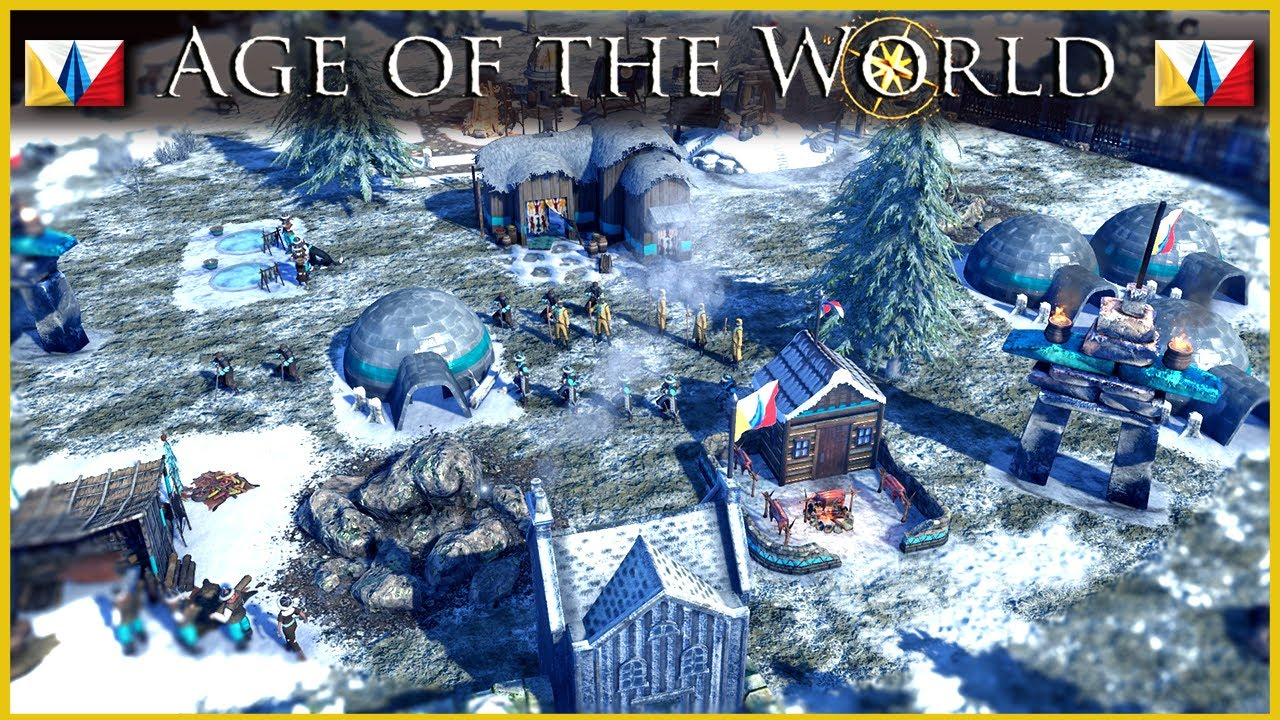
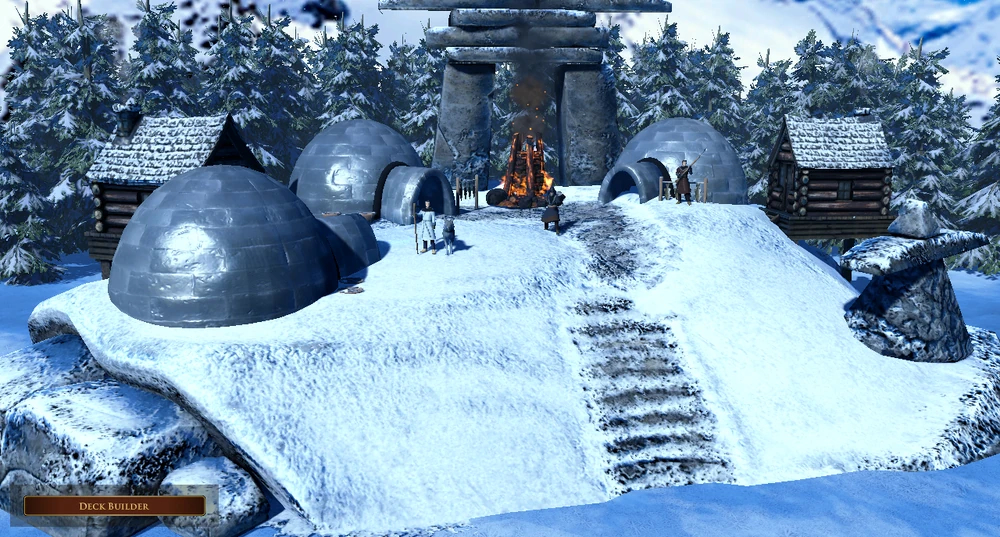
Image of the Inuit from the Age of the World 3DE mod as a concept…
Yes, basically the history of the civilization in the game would be 1142-1580: “In 1142, the Haudenosaunee, as a result of a lunar eclipse that same year, settled in the Ohio Valley. Then, 400 years later, in 1542, Jacques Cartier’s French expedition settled in the region, and there were several clashes between the two peoples. These clashes were observed by a young teenager known as Hiawatha, who, fleeing the cruel Tadodaho who had ravaged his village, arrived at the village of Jigonsahee and the Huron prophet, Deganawida, who asked him to help them defeat Tadodaho and build the Haudenosaunee Confederacy. After many battles, in 1580, the three defeated Tadodaho and united all the peoples of the region into the Haudenosaunee Confederacy, which in the following decades allied itself with the British to fight against the French and their forces.” Huron allies in what became known as the Beaver Wars"…
For example, this is the history section of the Haudenosaunee Civ in AoE 3:
"The late sixteenth century confederation of five (later six) tribes into the Haudenosaunee League in upstate New York created the most dominant native force in the northeast United States and eastern Canada. At the height of their empire in the late seventeenth century, they held sway over lands stretching from the Chesapeake Bay to the Mississippi and Illinois Rivers, and from Kentucky to Ontario. They are notable for many achievements, including their political system of checks and balances. The central law of their confederacy was to never war with each other. Against enemies, however, they usually presented a united political and military front.
The Haudenosaunee population had boomed following the adoption of agriculture in the fourteenth century, and they settled in villages of distinctive wood-framed and bark-covered longhouses. The first Europeans they encountered were the French, fighting against them in support of other tribes along the St. Lawrence. The Haudenosaunee in turn traded for weapons with the Dutch of New Amsterdam. A series of wars followed, mostly over the fur trade. The Haudenosaunee were often in the middle when France and Britain engaged in their periodic wars.
By the later eighteenth century the Haudenosaunee were being pressured by English settlers moving west from the coast and down the Ohio River Valley. When the American Revolution broke out in 1776, the Haudenosaunee tried to remain neutral, but the league finally splintered and tribes fought on both sides. In 1779 George Washington sent three columns into Haudenosaunee territory, burning forty villages, and driving most of them into Canada. The millions of acres the Haudenosaunee once held in New York were reduced to a few small reservations, which they still hold today."
Not necessarily, you have the Tongans who, between 900 and 1500, conquered all the islands in the region, reaching their peak in 1200, and then their decline began until the Tongan empire split after a civil war in the mid-16th or 17th century…
Yes, I would add the Filipinos, but simply because of their somewhat violent encounter with Magellan and Elcano in 1521, although they could also be included in a SEA DLC with Siamese and Mons…
Yes, the Celts are a remnant of what they couldn’t include in Rise of Rome due to time constraints, so they included them in AoE 2… the Celts in AoE 2 represent the Scots and Irish between 400 and 1600, before becoming the British alongside the English in 1606 in AoE 3… but the prime of the Celts were the continental Celts in Antiquity (they are the Celts we see in AoE Online with Boudicca and all the rest)…
Yes, the Minoans are there because of the ancient Minoan civilization, the Palace of Knossos, and the myth of the Cretan labyrinth… but it’s good that they’re in the game, since last July, the palace was named a World Heritage Site by UNESCO along with other sites of Minoan culture, but after that, little else… later, Crete was occupied by the Dorians between the Dark and Archaic periods (1100-700 BC), and by the Classical period, it had a war with Sparta (346-343 BC), a decade before the Macedonian conquest. Then they had two more wars between Gortyna and Knossos (221 and 121 BC). By Roman times, Knossos was sacked by the Romans in 63 BC, refounded as a Roman colony in 36 AD by Emperor Augustus, and during the time of Nero, Claudius was deified there… and by what would be Age of Empires 2, the Byzantines built a basilica in Knossos in the 6th century, and after the Arab conquest in 824, Knossos gradually lost importance in favor of the Byzantine city of Heraklion, until it fell into oblivion.
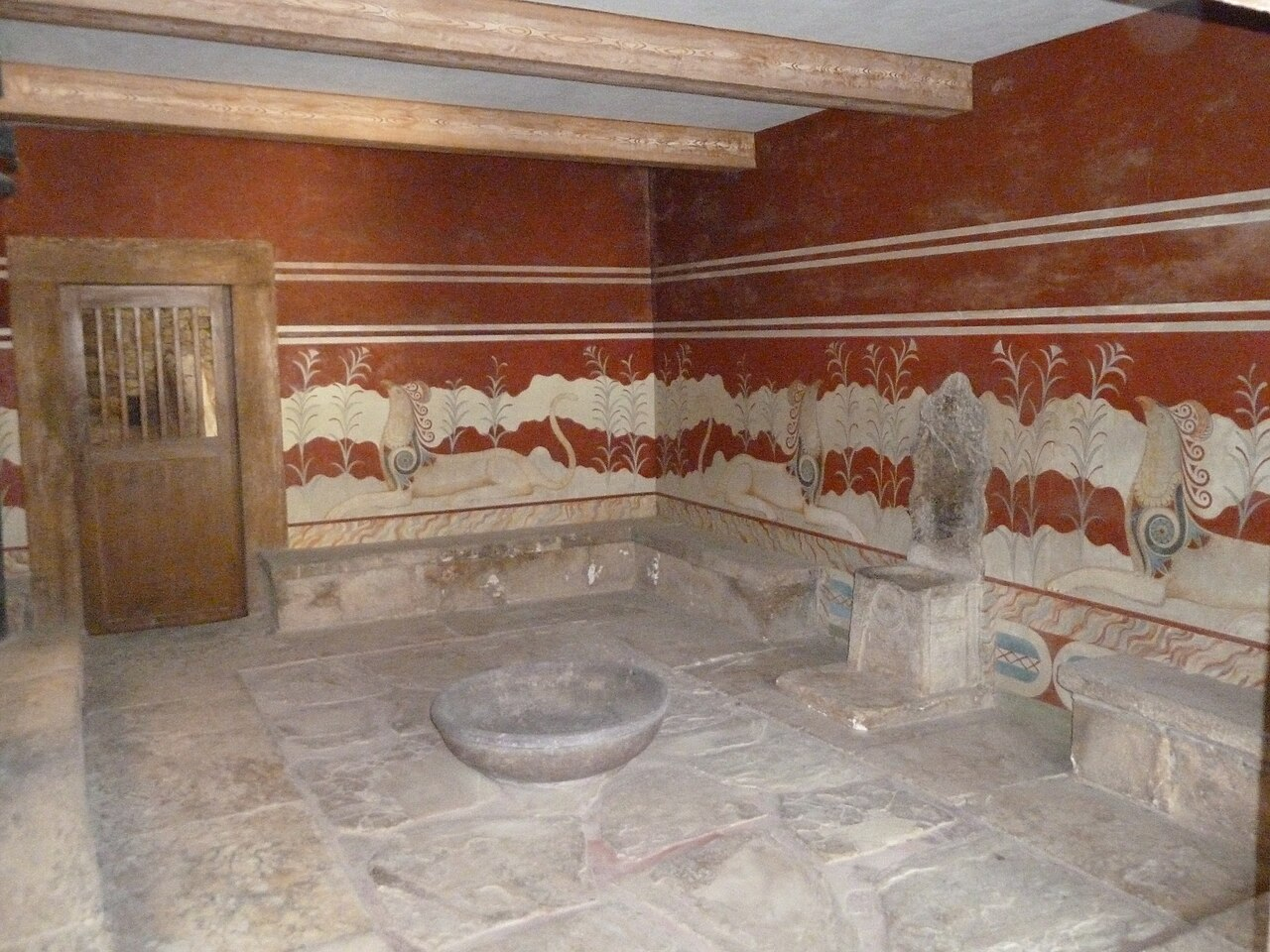
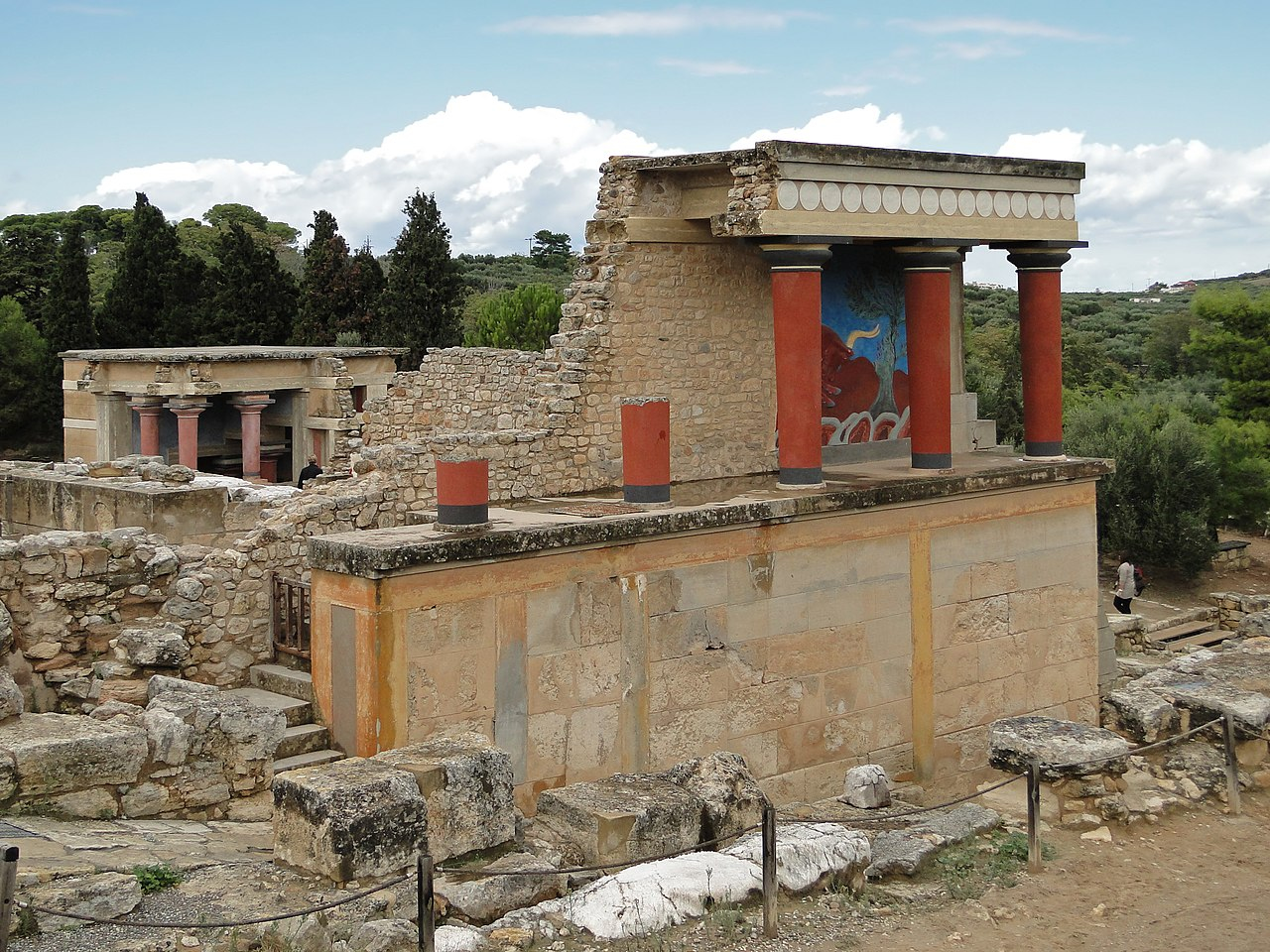
Yes, it should have been called Age of Civilizations, but Age of Empires isn’t bad in itself since it encompasses a “historical age of empires” (whether ancient, medieval, colonial, or at one point even considered modern), and beyond the fact that many of the civilizations in the saga weren’t empires per se (Minoans in AoE 1, the barbarian and nomadic civilizations except the Mongols in AoE 2 and 4, the Lakota and Haud in AoE 3, the Celts and Norse in AoM/AoEO)…
Yes, ultimately you could give it a technology tree similar to AoE 1 but in AoE 2…
Yes, the Incas during the time of Tupac Yupanqui (r. 1471-1493) reached Rapa Nui and Easter Island (which were inhabited, surprise, by Polynesians)…if it weren’t for the Spanish conquest, surely during the reign of Atahualpa, the Incas would have traded with the Polynesian islands and even the Spanish Philippines…
Yes, as long as it stays between 1500 and 1600, it can be…
Yes, Tupi architecture is similar to Polynesian architecture; it even reminded me of Maori architecture, but that’s too late for the game…
1 Like
I came to a similar conclusion last year when I thought about the name of this game. The sentence “Age of Empires” refers to a period of time, hence the word “Age”, and the word “Empires” specifies this period. Therefore I understand the title as the period of time when there was empires. This explains why the civs in the game represents not only empires but also kingdoms, confederations, unions, duchies, nations, tribes, cultures, etc.
This could be an interesting topic for another post if there isn’t any yet.
2 Likes
We can presume Yap was almost certainly in contact with the Filipinos, particularly in the south. They in turn were in contact with Tonga, who in turn was in contact with Marquesas, who in turn was in contact with Rapa Nui, who in turn was in contact with the Inca. A complete chain across the ocean of interaction that connects to both the old and new worlds. Contact is a two-way street and, yes, would absolutely mean that there was, even if not military conflict, competition over resources. The fact that they interacted internally as well as externally should mean nothing-
in another sense, The Iroquois would be a fine addition too, despite the fact they mostly kept to themselves in New York. Because they were in contact with other nearby groups. In the game as is, well, just, enlighten me: What other civs were the Celts- who we understand to be Ireland and Scotland- fighting with in this time period? A colony in France? Constant invasions by the English? Ah, and brief conflict with the Vikings. So, they interact consistently with only three other civs and are completely locked in Northern Europe. And yet, I think they absolutely belong! Even without having Empires, which, aside from arguably Dal Riata, they just didn’t have in the period. This is Because, despite playing mostly in their own sphere, they’re still important in that sphere, that location, at that time and place, and they are absolutely medieval, and they are absolutely a civilization.
And, no, the Sentinelese aren’t a civilization because they literally aren’t, as far as we can tell. No Agricultural system, and no indication of division of labor. Something that the Polynesians, Micronesians, and even Melanesians all exhibit just fine.
A historical Civilization needs Agriculture, some location of central control (Not exactly a city, but something like a city), division of labor, and hierarchy (Or more accurately, they need someone who is capable of leadership not in but of the community). The Sentinelese don’t exhibit all of these. But the Tongans, Samoans, and so on, positively do.
The Medieval period is better understood as a “proto-global” period. There are civilizations all over the world, and while contact is sporadic and not as developed as the global period, it is there. You could hypothetically circumnavigate the globe without leaving organized society. Now, if you’d really like to say these aren’t civilizations for some other reason, then please, for the love of God, read a book or something.
Now, “Empire” is a perfectly reasonable term once when define Empire. “Multiple national identities under the domination, economic or military, of one national identity that is in power over all the other groups”. Done, and, yes, Tonga, Samoa, and Yap all qualify. Tonga had the Fijians and Uveans under their control, Samoa had the Tongans themselves beat for a time, and Yap had most of the rest of Micronesia under their thumb, and likely stretched to Palau too.
As for abstraction… Fine, then, let’s take our European civs as a baseline! So, the Carolingian Empire had 10,000,000 people living in it. Tang China had 50,000,000 people. So, since a villager doesn’t represent literally one villager, but some thousands, and since we’re still pretending this is a function of population, exactly why shouldn’t China have a total population cap five times everyone else?
The point of the abstraction is to provide a level playing field and keep the game accessible and manageable. Frankly… it’s just another point in the favor of even smaller civs
2 Likes
I am growing tired of this pointless discussion, so I’ll only respond to the main points:
there is no academic consensus on whether or not there was contact between polynesians and any American peoples. so you shouldn’t present this as fact.
to aoe3? yes. to aoe2? no. 1450+ CE is too late for aoe2.
they fought wars against Denmark and Norway. Additionally they fought as allies of the French in the 100 years war. Anyway they were in touch and even intermarried with royal houses all across Europe. As part of the catholic church they were in touch with the pope, and as such there were also cursaders from Scotland and Ireland.
So in short, Celts (one of the weirdest civs added to aoe2) were still in touch with way more other civs than any of the oceanian civs you are suggesting taht should be added.
a civilization in aoe2 also needs an army.
that’s a factor of 5x, so still within an order of magnitude. while these Polynesian “empires” are smaller by a factor of 100x. so two orders of magnitude difference. is this really that hard to understand?
not to mention the difference in tech level
1 Like
Tech level is regardless: Are they civilizations or not? Are they medieval or not? Did they fight or not? Yes, yes, and yes. To say otherwise is, at its very best, completely and utterly ignorant.
Also, Iroquois aren’t only around since 1450, that’s only one proposed date. It’s quite possible the confederation formed earlier- again, the 1142 date for the foundation of the confederacy is quite promising.
Exactly, it’s more of a general term; that’s why the civilizations we play with are called “civilizations” and not “empires”… in AoM it’s the same; they are “civilizations” that worship major gods (Zeus, Hades, Thor, Odin, Ra, Isis, Kronos, Gaia, Shennong, Fu Xi, Amaterasu, Susanoo, etc.) distributed in “pantheons” or “cultures” (Greek, Norse, Egyptian, Atlantean, Chinese, Japanese)…
True, but more or less the same applies to the Aztecs and Incas… I agree that these new civilizations (Tupi, Mapuche) were more suited to Age of Empires 3 because of the colonial context (the Muisca might fit into Age of Empires 2 since they disappeared in 1537, but the Tupi and Mapuche lasted for centuries afterward)…
Yes, it’s between 1142 and 1580, with 1450 as an intermediate date…