Perhaps using quotation marks (“Baray-koi”) or other command codes will yield better results on Google.
Anyway, I found it in the book “Timbuktu and the Songhai Empire” by historian John Hunwick; the address for the free PDF is in my doc above.
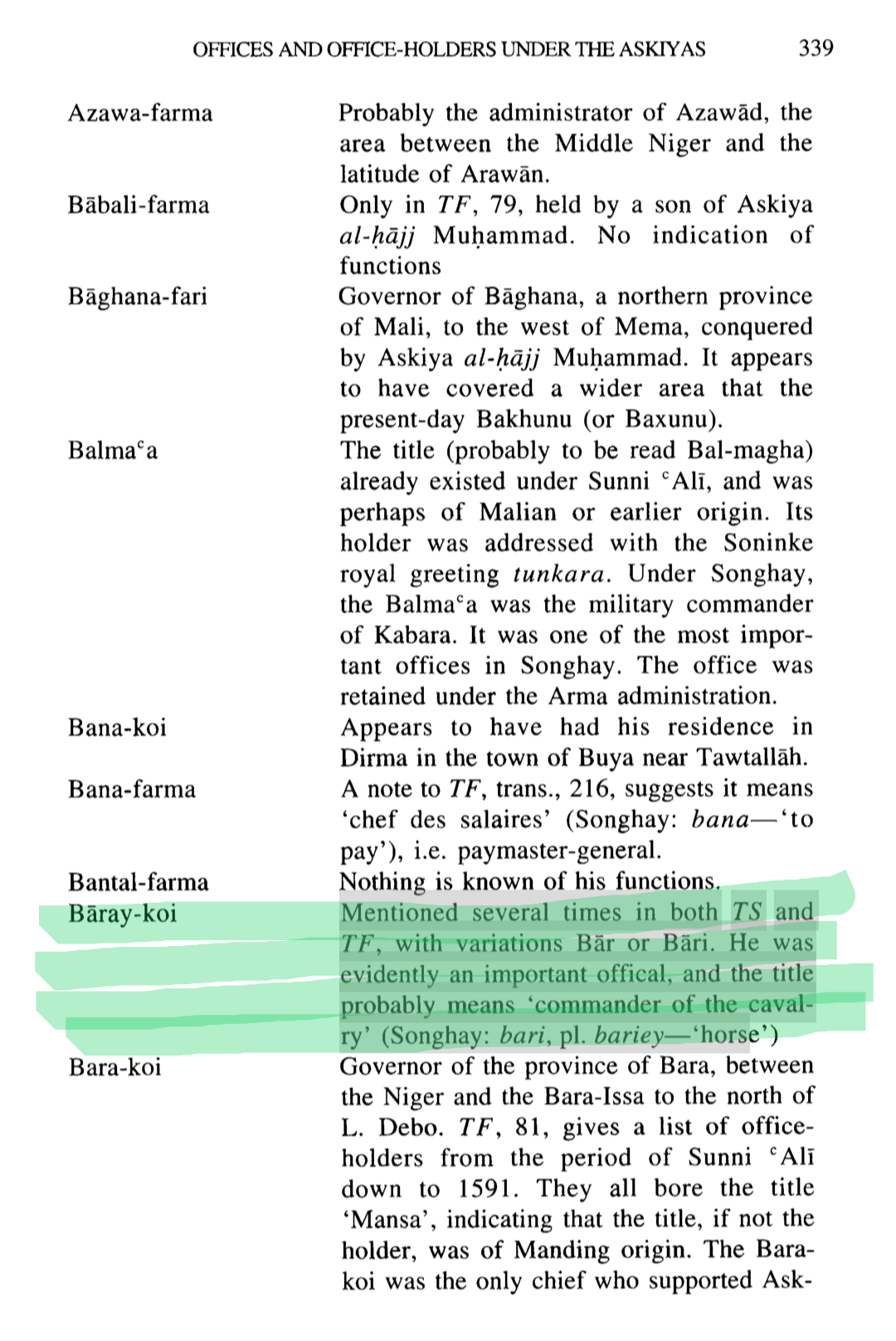
Regarding the Songhai, I really hope to see their military use of the War Bull represented as a unique unit in the game. Animal unique units are so cool!
A second UU you mean?
Yeah it’s not necessary, they are just suggestions.
I suggested Ethiopians and Somalis because there was little contact between Nubians and Ethiopians, but your idea of a regional monk is interesting too.
Tbh so far, the only common unit I’ve found between Ethiopians and Somalis are the Maya archers, with their poisoned arrows, hired by both armies in the war of Ahmad al-Ghazi. And I was disappointed to find zero evidence of the use of camels by either side. 
Well, Musofadi, from what I’ve seen, is only slightly better. The name seems to designate strong women with robust physiques, but there is nothing about their participation in the war. I found this in a comment on the AoE4 forum. But I agree with your suggestions.
There is a possibility that there were black female warriors fighting for the Almoravids in Spain according to this article and, by extension, in Ghana, but the research is in its early stages and in any case does not directly apply to Mali.
Like other info I’ve found about Africa, this is “hidden” on the web, usually in academic journals or forums. The knives I found:
• In this book by 19th century European travelers to the Bornu region, which has descriptions and some engravings of their weapons at the end: Narrative of travels and discoveries in Northern and Central Africa in the years 1822, 1823, and 1824 | Project Gutenberg.
• And in the paper on African throwing knives, which is in my doc. It’s the main source for their use in the region near Nubia — which I confess is less justifiable for them than the camel skirmisher (here representing Beja nomads). This author’s map is also in my document:
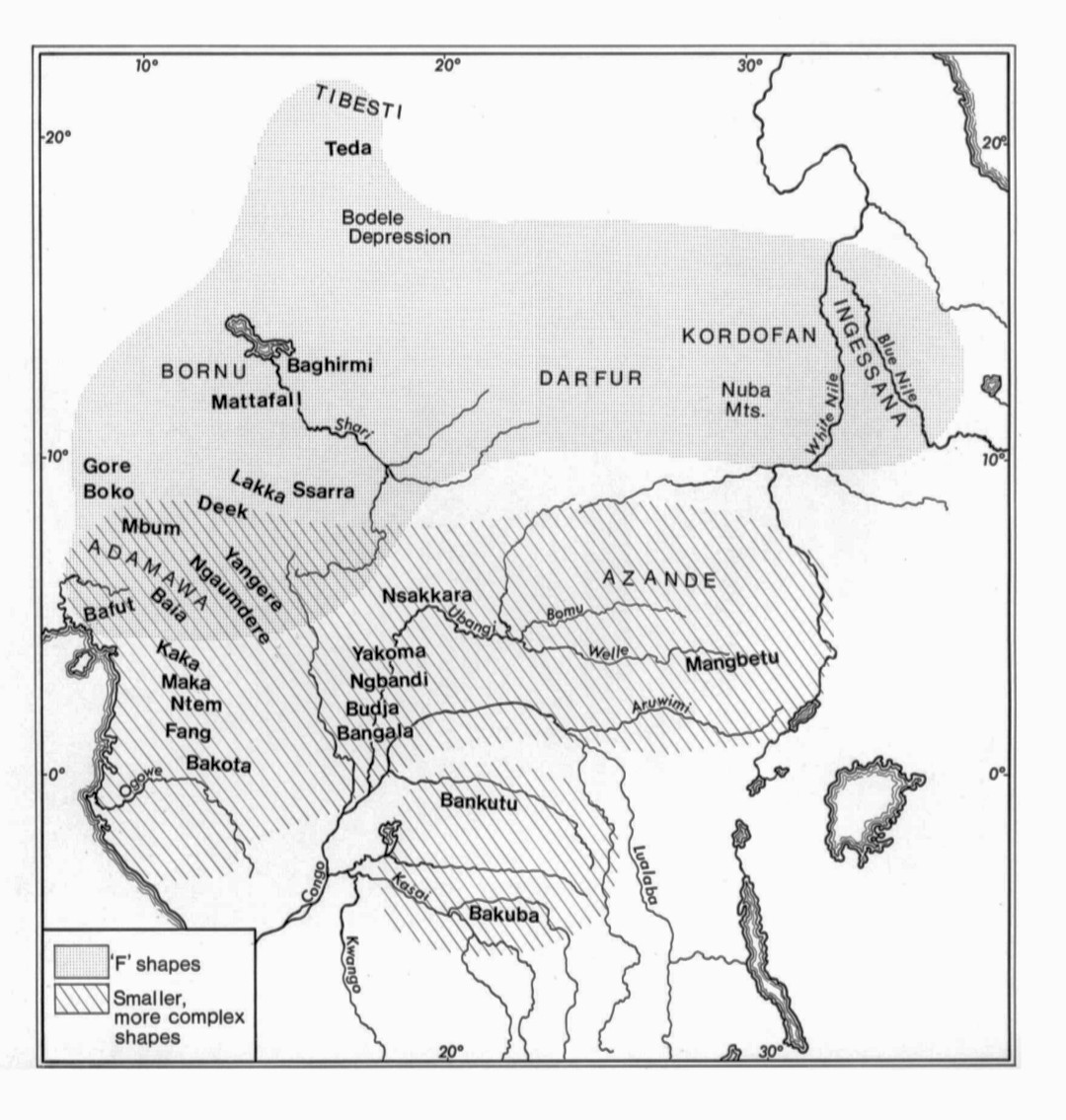
However, there is no evidence of Kongo, Mutapa, or Swahili using these knives. At least, not yet.
Sadly, there is no evidence of the use of lifidi in West Africa and Ethiopia, only in Central and East Africa — from the Hausa and Bornu to Nubia. There is only evidence of the use of chainmail and the mention of a nobleman wearing a iron cuirass, both in that same book by Hunwick above. Without archaeological research, there’s no way to know why.
I have a few guesses, tho:
(1) The heat and aridity may be more intense in West Africa due to the Earth’s rotation, which influences the winds. I suppose this because I read that mineral dust from Lake Chad has been crucial for the Amazon’s nutrition for centuries.
(2) Lack of access to the lifidi, since it seems that the padded armor was modified from imports from the Islamic world through Nubia. West Africa would be too far away and historically more connected to North Africa.
(3) Or simply lack of need. Many Arab authors speak of a huge and centuries-old trade in the famous Berber Lamt shield (the one from my camel skirmisher  ), praised as light and impenetrable, and exported even to Spain.
There’s also a very informative thread on historum.com dedicated to Mande warfare, if you guys would like to take a look.
Others were able as well, metallurgy in Africa is very old. It’s more a question of how warfare evolved in Africa: it made no sense to use plate armor in the dry heat of the savannah or the stifling humidity of the rainforests, hence the general African preference for shields. The lifidi itself (and Bornu cuirasses) was mostly used by cavalry and only donned and removed with the help of squires minutes before/after battle. Add to that the facts that
(I) cavalry arrived relatively late (~13th century),
(II) the use of poison is widespread and requires mobile defense, and
(III) there is an abundance of animal and vegetable hide options for constructing shields, and you begin to see their logic.
(Perhaps the opposite effect occurred in Europe, with the temperate climate and the limited options for animal hides, encouraging the use of metal armor? )
Finally, forgive me if I sound nitpicky and too worried with historical accuracy. It’s just that I really enjoy researching these things and I don’t want the devs to repeat the carelessness they showed with TAK and especially with 3K.