The thing is, not all conquests are colonials conquests…
1 Like
What is the criteria that makes a conquest a colonial conquest?
I mean there’s always been a western bias in this game.
Just look at the current political “bad guys”, and you can bet an eye they won’t receive a full six-scenario campaign anytime soon. It doesn’t even matter if they were the major, dominant powers in medieval times.
Likewise, less important kingdoms have already received fully-fledged civilizations just because they happen to be newly acquired “toys” of western hemisphere.
You won’t also get scenarios that show the barbaric episodes of medieval western history. But you know what - i don’t even mind. Because there’s no way to have a game represent objective truth, or objective morals…
2 Likes
When the resources of the colonised country isn’t used for the benefits of the natives. It is taken away for the profit of the coloniser country.
A country taking over another country and converting it’s population is not colonizing.
A country taking over another country replacing it’s population is colonizing.
From Google:
Colony: a country or area under the full or partial political control of another country and occupied by settlers from that country.
So… Practically every conquest ever. You kinda need settlers to keep newly aqcuired lands under control. Unless of course you just wanna sack some cities and leave.
That’s just exploitation, not colonization, and it doesn’t need colonization for it to happen.
Not necessarily. Colonization is the act of building colonies. You can go to a deserted island and build a colony, despite not genociding anyone. You can also erase entire populations, but if you don’t settle the land with “your” people, you’re not colonizing. And if you conquer lands without sending settlers afterwards, it’s also not colonizing.
3 Likes
A free expansion pack with all new civs (at least 4), maps (at least 5 or 10), campaigns, gameplay features, technologies, game modes, bug fixes galore, QoL improvements galore, graphical touches, visual effects touches, water improvements, weather additions, time of day additions, an in-game museum to honor AoE 1997/1999 (to look at old AoE1/2 concept art, behind-the-scenes footage and dev interviews, design docs, game box/manual scans, never-before-heard game audio or graphics/engine tests, interviews with the voice talent), and much more.
PS: Does this make up for some? I seem to remember a few years ago there being fan discontent when events were missed and cheat codes not gotten. I see this in Steam today:
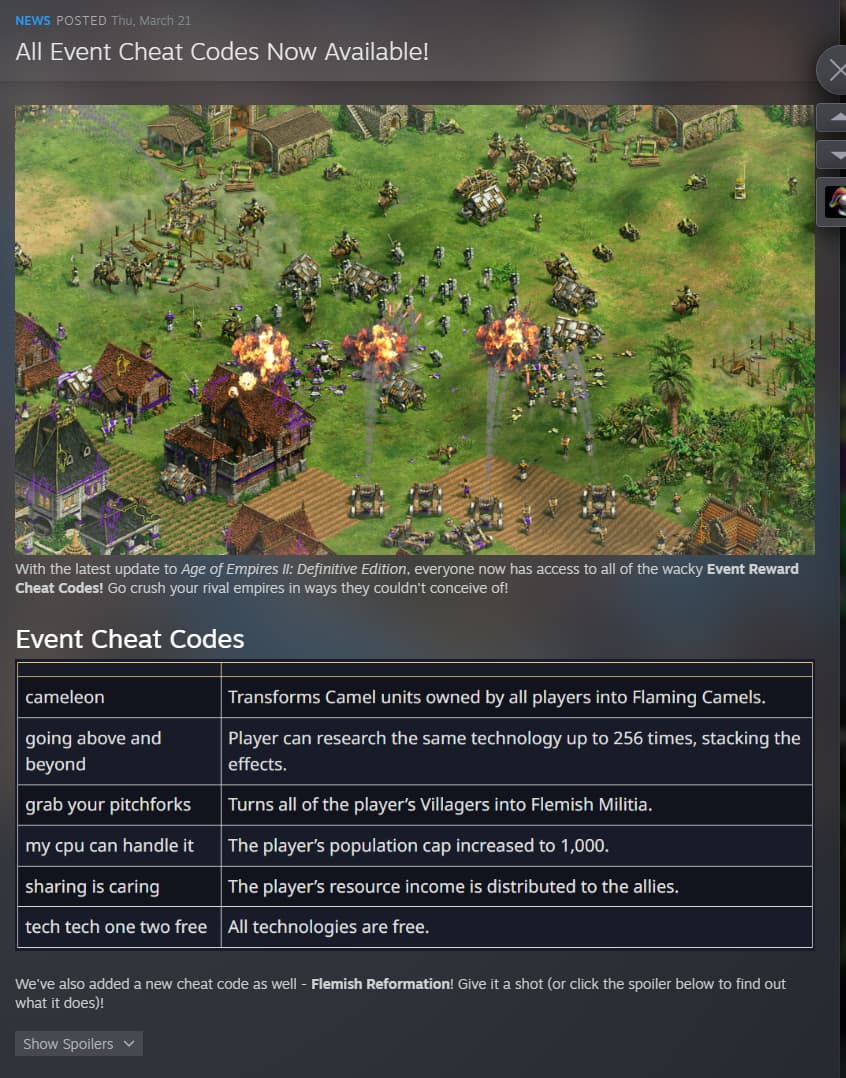
… I could have swore there were more new cheat codes than this, though, including Photon Man? Unless they opened the others up already
Yeah a couple of the older event cheats including Photon Man already were made available 2 years ago iirc.
1 Like
Hmm… By this definition, not even the European occupation of Africa and South Asia in the 19th/20th century count as colonization, so I’m not sure it’s a perfect definition. I haven’t really studied the topic, but I think there are several criterias to fulfill:
- A form of segregation between colons and locals, no matter whether it’s by law or de facto. Ultimately, the colons must hold most if not all the political power, and usually the locals can’t even be part of the adminitration.
- The dehumanisation of the local people who are treated as inferior by their very essence. The justification can be biological, spiritual or other, but no matter what, adopting the colonizer’s culture can lower the opression but not make it disappear completely. As a result, mariage or other forms of unions between colons and locals are discouraged if not outright forbidden and “mixed blood” people tend to form a new social category.
- The hierarchisation of civilisations based on supposedly objective criterias.
- The creation of an ideology to legitimise the colonisation process, making it not only acceptable but a moral imperative. See the manifest destiny, the white man’s burden or the French “mission civilisatrice”. Usually, it’s helped by the last two points.
So, every colonization is a conquest, but not every conquest is colonization, And even some conquests from Europeans outside of Europe, such as the Diadochi Kingdoms or even the Crusader States in the Middle East, aren’t actually covered by this concept (which doesn’t mean that they’re more justified or that we can’t have a negative opinion of them, I think it goes without saying but on the internet it’s usually better to be very clear on those things). On the other hand, it does indeed include the actions of some non European countries, even to this day, and I don’t think we should shy away from it even if saying that as a French person makes me seem hypocritical.
Anyway, I agree with you that it’s certainly not true that every single country/culture in history has done colonization at some point.
Note: I know that my definition doesn’t cover the Greek colonies in the Ancient Era. I actually wouldn’t categorize it as the same phenomenon, they share the same name because it was the best term we could come up with when we started invading the Americas but ultimately it evolved into a different direction.
1 Like
I know I opened up a can of worms, but we really should get back on topic.
3 Likes
This has always happened in almost any conquest.
Case and point with the Ottomans.
Well, they used to take gold and children from Wallachia and Moldavia. Doesn’t that fit the first criteria?
They tried to move in Turks but couldn’t do it due to Wallachians and Moldavians being strongly christians. To this day they are one of the most christian places in Europe. First place as far as I can remember the last statistics I used, while Poland is on the second place.
They tried and fail spectatulary to put a muslim ruler on the Wallachian throne, while they ruled Wallachia and took gold and children from it. Like “hey, you can take our gold and children, but muslims as our ruler? that’s crossing a line”.
Funny thing is that Russia managed to colonize better than the Ottomans, despite ruling Bessarabia and North Bukovina for less than 100 years, because the Romanians were more tolerant of other christians colonizing them. And yes I know it sounds weird but sometimes it is what it is.
1 Like
When you see two people have already corrected my statement with more elaboration and I have liked their explanations, then why do you have to keep pressing on the summary I provided?
Because unlike you I don’t see this as a sparing match but an interesting discussion. You don’t have to take it personal, geez.
Those criterias appear more like racism or treating someone like second class citizens. Which could be part of colonializm but I don’t think is what makes colonializm colonializm.
I can of course give the Ottomans in the Balkans as an example once again. The fact that they took Christian children as slaves and that the muslims had more rights than the christians.
But even in cases of not such a clear-cut cultural difference we can see something like this that arguably wasn’t colonization rather just oppression. For example the Romanians in Transylvania.
- Initially there was a Romanian nobility and merchant class in Transylvania. Areas like ######## Maramures and Severin were politically dominanted by Romanians.
- Then the Union of the Three Nations happened in 1438 after a failed Romanian-Hungarian peasant revolt. The 3 nations being: Hungarians, Szekely and Saxons. The point of the union of the 3 nations was that the 4th nation, the Romanians, lost their rights.
- They were not allowed to live in the cities, to have the same trial as other ethnicities, to build churches from stone and in the 19th century to have schools in their own language.
The oldest extant documents from Transylvania, dating from the 12th and 13th centuries, make passing references to both Hungarians and Vlachs.
In 1213, an army of Vlachs, Saxons and Pechenegs, led by the Count of Sibiu, Joachim Türje, attacked the Second Bulgarian Empire - Bulgarians and Cumans in the fortress of Vidin. After this, Hungarian battles in the Carpathian region were supported by Romance-speaking soldiers from Transylvania. A royal charter from 1223 related to the monastery of Kerc (now Cârța Monastery in Romania), mentions that the Vlachs owned the land before their land was seized and the monastery was founded in 1202. Similar royal charters attesting the seizing of lands from Vlachs exist for Zarand from 1318, for Bihor and Maramures from 1326 and for Turda from 1342. According to the Diploma Andreanum issued by King Andrew II of Hungary in 1224, the Transylvanian Saxons were entitled to use certain forests together with the Vlachs and Pechenegs. The first appearance of a Romanian name (Ola) in Hungary appears in a 1258 charter. The first written sources of Romanian settlements date to the 13th century; the first cited Romanian township was Olahteluk (1283) in Bihar County. The “land of Vlachs” (Terram Blacorum) appeared in Fogaras, and its area was mentioned under the name “Olachi” in 1285.
Transylvania was organized according to the estate system. Its estates were privileged groups, or universitates (the central power acknowledged some collective freedoms), with socio-economic and political power; they were also organized using ethnic criteria.
The first estate was the aristocracy (lay and ecclesiastic): ethnically heterogeneous, but undergoing homogenization around its Hungarian nucleus. The document granting privileges to the aristocracy was the Golden Bull of 1222, issued by King Andrew II. The other estates were the Saxons, Szeklers and Romanians, all with an ethno-linguistic basis. The Saxons, who had settled in southern Transylvania in the 12th and 13th centuries, were granted privileges in 1224 by the Diploma Andreanum. The Szeklers and Romanians were granted partial privileges. While the Szeklers consolidated their privileges, extending them to the entire ethnic group, the Romanians had difficulty retaining their privileges in certain areas (terrae Vlachorum or districtus Valachicales) and lost their estate rank. Nevertheless, when the king (or the voivod) summoned the general assembly of Transylvania (congregatio) during the 13th and 14th centuries it was attended by the four estates: noblemen, Saxons, Szeklers and Romanians (Universis nobilibus, Saxonibus, Syculis et Olachis in partibus Transiluanis).
In 1437 Hungarian and Romanian peasants, the petty nobility and burghers from Cluj/ Kolozsvár/ Klausenburg under the leadership of Budai Nagy Antal upraised against their feudal masters and proclaimed their own Estate (universitas hungarorum et valachorum - the Estate of Hungarians and Romanians). In order to suppress the revolt, the Transylvanian nobility, the Saxon burghers and the Székely formed the Unio Trium Nationum (The Union of the Three Nations), an alliance of mutual aid against the peasants, jointly pledging to defend their privileges against any power except that of Hungary’s king. By 1438, the rebellion was crushed. From 1438 onwards the political system was based on the Unio Trium Nationum and the society was led by these three privileged nations (Estates): the nobility (mostly Magyars), the Szeklers and the Saxon burghers. These nations, however, corresponded more to social and religious rather than ethnic divisions. Being explicitly directed against the peasants, the Union limited the number of Estates, implicitely excluding the Orthodox from political and social life in Transylvania.
Eastern Orthodox Romanians were not allowed to build up local self-government (like the Szekelys, Saxons in Transylvania, Cumans and Iazyges in Hungary), the only possibility to remain or access nobility was for them through conversion to Roman Catholicism. In order to conserve their positions some Romanian families converted to Catholicism, being subsequently magyarized (i.e. the Hunyadi/Corvinus, Bedőházi, Bilkei, Ilosvai, Drágffy, Dánfi, Rékási, Dobozi, Mutnoki, Dési, Majláth, etc. families). Some of them even reached the highest ranks of the society (Nicolaus Olahus became Archishop of Esztergom, while half Romanian regent John Hunyadi’s son - Mathias Corvinus - became king of Hungary).
Nevertheless, since the overwhelming majority of Romanians refused to convert to Roman Catholicism, in the constitutional system of the three nations there was no place left for them up to the 19th century, to be politically represented. Thus, they remained deprived of their rights and subject to specific segregation such as not being allowed to dwell or acquire houses in the cities, to build stone churches, or enjoy fair justice. Several examples of legal decisions taken by the three nations some hundred years after Unio Trium Nationum (1542-1555) are illustrative: the Romanian could not appeal to justice against Hungarians and Saxons, but the latter could turn in the Romanian (1552); the Hungarian (Hungarus) accused of robbery could be defended by the oath of the village judge and three honest men, while the Romanian (Valachus) needed the oath of the village knez, four Romanians and three Hungarians (1542); the Hungarian peasant could be punished after being accused by seven trustworthy people, while the Romanian received punishment after he was accused by three trustworthy people (1554).
Is this covered by this concept? I would say it is, although I wouldn’t call it colonization.
Well… Yes? Systemic racism is pretty much born from colonialism.
I honestly don’t know enough about the Ottoman occupation of the Balkans to confidently say that there was no colonization involved. But I’m not sure it fits the definition I gave, especially if you look at why I ruled out the Crusader states as colonial ones: If the Romanians and other Balkan people converted to Islam and adopted the Turkish culture and language, did segregation and oppression stop, or did it continue because it ran on something deeper? I guess the absence of mass conversions make it difficult to establish with certainty though. It’s also worth noting that unlike the Bulgarians, Greeks or Serbians, the Romanians were not directly under direct Ottoman rule but rather part of puppet states with different laws.
Anyway, my answer is that I don’t really know, but I think it could be argued that if the Japanese occupation of Korea is classified as colonization, so may be the Ottoman rule in Romania without it necessarily apply to every single conquest in the world.
Clearly my pleas have fallen on deaf ears. Pandora’s Box has been opened…
1 Like
I think it’s OK. You can’t start a topic, expressed your views and close it when others try to express their view.
It’s not that I don’t want other people to express their views. I just think it’s gotten off-topic for too long.
1 Like
But the topic is listening to community, this thread has people talking about their wishes for (and against) civs and what they want the devs to do.
Your comment wasn’t off-topic, but ignited a similar already-discussed topic. It’s not like this is the first time this has come up, questioned, and answered on the forums. Either way - the community on the forums largely supports DLCs outside of Europe, as DE has already had two DLCs for Europe. Middle Ages is a great opportunity to showcase civilizations from other parts of the world when Europe wasn’t as advanced as the rest of the world. Why can’t we see African civilizations at their peak?
AoE2:DE has been a fantastic game throughout its history for introducing players to other regions of the world and their history. It could do much more to help dispel myths of other regions of the world being technologically far behind Europe, when a good chunk of AoE2’s gameplay is about the Dark Age Europe went through. 11
I’d say games like AoE2 and Civilization have done wonders for introducing players to new regions they wouldn’t otherwise know nor be taught about. It’s sad to see that the DE’s DLCs, outside of Dynasties of India didn’t really continue the theme. I don’t think it’s because ‘Europe sells’, that might’ve been a factor for AoK. People will buy and support a DLC with new civs, especially if the civs are fun. The main worry has simply been whether people get fatigued by even more civs, and giving preference towards Europe right now really smells bad.
But hey, who knows what the next civ-DLC will be!
1 Like
These subjects shouldn’t be pandora’s box in the first place, as long as we talk about them reasonably. It’s exactly when they become taboo that problems begin in my opinion. If we deem a problem we don’t like as “taboo” that problem will never be talked about in the first place, which is not the way of fixing a problem or preventing it from happening in the future.
I doubt it, systematic racism was a thing before and after colonialism.
That’s how Bosniaks and Albanians converted to Islam, they used to be Christians before the Ottomans invaded the Balkans. In Romania, Bulgaria and Greece was a lack of mass conversions, but not because of lack of trying for the Ottoman. Which raises the question, is it colonialism only if succesful? or the mere fact of attempting it makes it colonialism? or at least an attempt of colonialism?
The Romanians were not directly under direct Ottoman rule only because the Ottoman, after numerous Romanian resistances to being directly ruled by muslims, deemed it much trouble to have the Romanians as a puppet state than under direct rule. It’s again not for lack of trying from the Ottomans, but because the Romanians proved more trouble than it was worth it for the Ottomans.
The main idea is that I believe the mere fact of racism, discrimination, segregation and treating a part of the population as 2nd class citizens, is not the core of what makes something colonializm. Take the Romanians being treated as second class citizens in Hungarian-ruled Transylvania. Could you call it occupation? yes, could you call it oppression? yes. But could you call it colonializm? I don’t know.
Well, Return of Rome and The Mountain Royals weren’t that bad either… I mean, they tried to give a second life to AoE 1 DE by putting it in AoE 2 DE, although by putting Rome in AoE 2 DE they caused a useless chronological debate. ..and The Mountain Royals put the Caucasus into the game and finally gave the Persians a campaign; the issue is this particular DLC, which sells you content from the workshop when they could have worked on it more and brought at least 3 new campaigns in the Far East…
I think that after 2 dlcs in Europe and 1 mixed one (Rome, Georgia, Armenia and VaV) it is most likely that they will now play dlcs in Asia and America (or in Africa if they plan to sell “Kings of West Africa” from the workshop as dlc and I see it very likely)…

Yes, I agree with everything…
Technically it was not a revival of the series, since in 2013 you had AoE Online with its dlcs; the only thing is that in 2013 it had just been announced that it would stop receiving support (prior to its closure in 2014)…2 HD and AoM EE was to try out remastering the classic trilogy and AoM (a journey that will end only now when Retold comes out) prior to the release of the fourth installment…
And in AoE 3 DE they directly spend months ignoring you and AoE 1 DE is directly dead…
Right, do you need to throw facts that way?.. You don’t need to say it, they are trying to find new ways to squeeze out AoE 2 like modern games (something like a battlepass appears on Steam, so difficult times are coming)…
Well, the devs at least try new things with the new civs (putting a lot of AoM stuff into AoE 2)…
Yes, I think that if they cut the price in half they would be able to sell the DLC better…
Yes, how far we fell… we went from great games with great expansions to mediocre games with macro payments as if it were a freemium mobile game…
I still think that Morocco can reach AoE 3 DE…they just might need to rework it more so that it doesn’t look like the Hausa…
But at that time it was ES with more equipment and perhaps financial resources…what FE has in its favor now is that it has more information either from Wikipedia or external sources…
Me neither (mainly because it is very expensive for what it really brings), instead I am going through the workshop scenarios chronologically, I have already passed what in the dlc would be Genseric, Vortigern and now I am with Ragnar and the other scenarios of the Vikings…
That’s true, things as they are…
The most likely thing is that they will change them to Ruthenians (considering that Rus had Kyiv as its capital and that Ruthenia belonged to Poland since 1434)… incidentally they could add the Serbs, Croats and Vlachs as Balkan DLC…

I’d prefer they avoid using Wikipedia for research, so we don’t have another issue like what happened with the Thirisadai. I mean, the AoE4 devs traveled to the countries they were representing in game and consulted with all kinds of experts. The AoE2 devs don’t have to go to such lengths, but all I ask is they use books and PDFs for research, even if they’re free on the internet, instead of getting trolled by Wikipedia again.
4 Likes