At least in editor. Give us a proper wooden ramp that could go over water and nicely connect (fit) to gates. Currently, there is one miniscule bridge pontoon that is ugly when used as ramp.
And, i know people will hate it, but imagine gate that has moat bridge door. That would be awesome.
Can we have the Chinese New Year mandarin orange bushes added back into the game. This will add forage bush diversity. Also the pumpkin patch farms. Maybe add the pumpkins as forage bush variations.
The water definition feature is amazing and adds so many possibilities. Could the devs make it such we can use the definition like a brush so we can have different water definitions at different parts of the map at the same time?
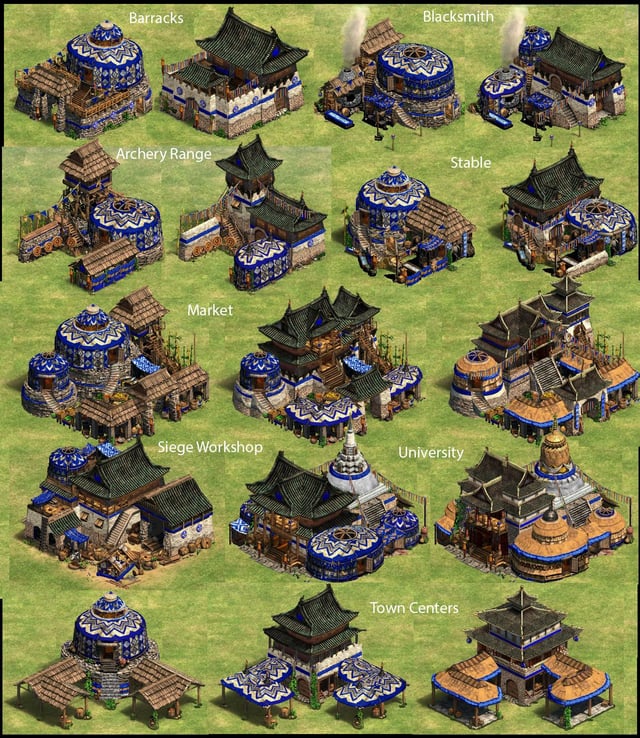
Ideally there could be one “Inner Asian” set (Mongolians, Tanguts, and Tibetans – you’d be surprised, but settled Mongolian architecture looks fairly similar to Tibetan!) that evolves from yurts into Tibetan royal architecture, and one “Western Steppe” for Huns and Cumans.
Peoples use yurts precisely because the environment and way of life are not suitable for constructing permanent brick-and-tile buildings. Once such buildings already exist, why would people still need to use yurts in such large numbers, especially right next to those brick-and-tile structures?
We all know that even nomadic peoples still use brick-and-tile buildings on certain occasions; however, in those situations they won’t make extensively use of yurts together and closely with the brick-and-tile buildings. This sense of being incongruous or out of place may be precisely why some people above responded that they do not like them.
This really is a better option. People want to see nomadic groups using their yurts more, because people are already used to seeing brick-and-tile buildings from the existing settled civs. Even if it makes their base look simple and kind fragile, it really fits people’s image of a nomadic lifestyle.
Personally, I would like the current sturdy-looking Mongol castle with a northern Chinese architectural style to be changed into a Khitan one. The Khitans had far more attempts and practical experience with settled life than the Mongols did. As for a new Mongol castle, I’d prefer it to have more of a nomadic feel, something like a simple keep paired with two or three yurts, a bit like the Cumans’ wonder.
I think that Mongols as a civ are meant to represent both the nomads and the more settled imperial era after the conquests (as reflected in the real life Karakorum). Much like the new South American architecture set evolved from wood into stone, the Inner Asian set could evolve from yurts into bricks. (Yurts in feudal age would fit Tibetans as well, even today many Tibetan subgroups lead nomadic lifestyles.)
Because the game tries to not be a facsimile of historical buildings and records, instead blends popular vernacular elements to create a unique identity that first and foremost must meet gameplay criteria such as readability and civ identintity. Mongols should look differently from Chinese and Vietnamese because they play differently, yet their buildings shouldn’t be drastically shaped differently to still be recognisable.
Besides, we already have some examples of how yurts can help bring out the nomadic identity of a civ, be it pasture , chiefs tent, or the qing village from aoe iii.
The issue is not that Mongols (and other steppe peoples) do or don’t deserve brick-and-tile buildings, but rather that there is no need to mix brick-and-tile architecture with yurts that densely at the same time. As I said, doing so is overly contrived and illogical (people in an environment capable of supporting brick-and-tile buildings would not deliberately insist on using yurts to that degree).
It could be more reasonable to avoid having every type of building be closely spaced brick-and-tile structures and yurts. Instead, some types could remain simple, yurt-like structures, while others adopt more complex brick-and-tile construction.
I do agree that if an entire architecture set were composed solely of yurts, its readability or recognizability would suffer. However, I believe that art design can consider many ways to address this issue. For example, by moderately incorporating some simple materials such as stone blocks and wooden planks to give the structures the characteristic visual identity of AoE2 buildings, without necessarily resorting to refined brick-and-tile construction with painted walls and several stories similar to the other civs.
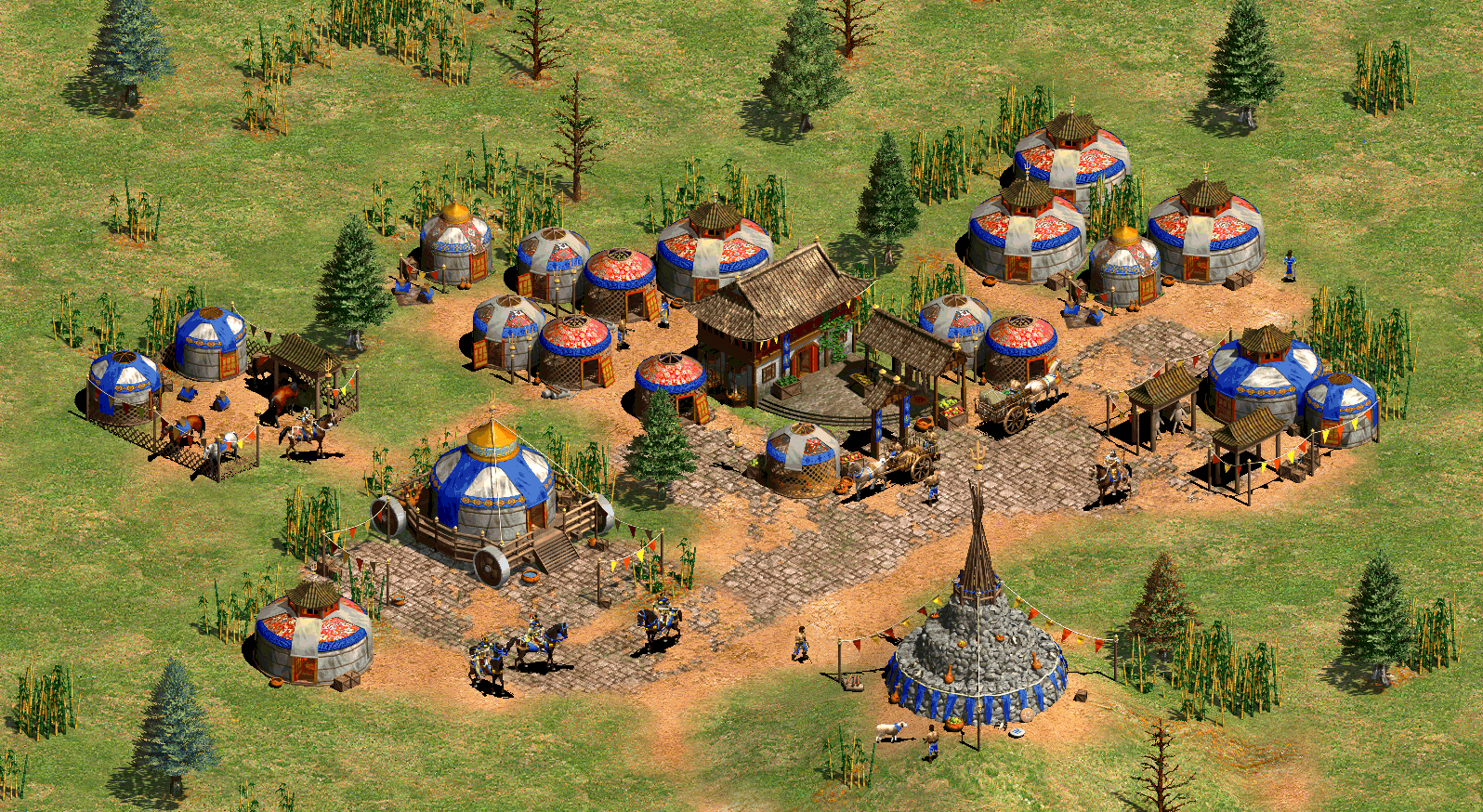
Of course. That’s why I think the second image has more of a nomadic feel.
Even if the design adopts the idea that buildings upgrade in visual with the Ages, transitioning from simple structures like yurts to more complex constructions, I still believe that only certain types of buildings could become that elaborate in the end, such as the Castle, Tower, and University. Other types of buildings only need to be upgraded to a certain extent. In particular, standard military buildings like the Barrack, Stable, and Siege Workshop should retain simple, easily relocatable structures, reflecting the high mobility of Mongol armies and the base-free nature of nomadic warriors.
The Pasture definitely is a must. Civs that use this architectural set should use Pastures to replace Farms (and Mills as well, in my opinion).
I know many people think this way, but I hold the opposite view. The introduction of the Mule Cart was meant to reflect the mountain lifestyle of the Caucasus region (or, more strictly speaking, specific areas of Georgia) where mule carts were traditionally used. They were not nomads, their use of mule carts does not represent a nomadic lifestyle.
Therefore, if we want to change the Mule Cart to represent the nomadic lifestyle of the steppe peoples, then Caucasus civs should no longer have access to it. Otherwise, allowing them to retain access would blur the definition of this ‘building’ and what it is meant to represent, and any civ with draft animals could reasonably argue that they should have access to it too.
The mobility provided by the Mule Cart really fits the mood of nomads imho. Recently I really enjoyed the “Before Attila” custom scenario, and while sadly it didn’t utilize the Mule Cart (only unit-producing huts were movable), the feeling of being constantly on the move was great.
@Mahazona
Ironically, when I shared this image in another discussion on this forum a few years ago, someone said it looked like a circus lol.
I also think this set is better, one of the reasons being that I’m really drawn to colors: the red bricks of the Slavic set, the blue vaults of the Central Asian/Persian set, and the sand-ish yellow of the African set etc. Maybe it’s anachronistic, but I wish the Western European set had those blue roofs, at least on the castle, and a new East Asian set with those green tiles.
It seems obvious the author wanted to convey the idea of gradual evolution, with extensions in permanent materials being attached around the tents, and maybe to avoid any confusion with Dark Age architecture. But I also don’t understand why it continued like that until the Imperial Age.
I suspect they are Omarr_gg who created this architectural set for the Huns and Mongols on Steam, although this image on Reddit also has similarities to the Abejin set. Maybe a collab between the two?
 That would be awesome.