no it isn’t. it’s like calling a people who called themsleves “nihon” “japanese”.
during the viking age “norse” is more narrow than “viking”
no it isn’t. it’s like calling a people who called themsleves “nihon” “japanese”.
during the viking age “norse” is more narrow than “viking”
How is it more narrow?
Also, the timeline of the game is much broader than the “viking age”.
This is actually hilarious.
in modern english “vikings” refers to all members of viking culture. be they from norway, sweden, denmark, faroer, iceland, greenland, finland, estonia etc
“norse” is often used to distinguish a subgroup of vikings. either geographically (only norwegian and swedish vikings) or religiously (only pagan ones)
see the notes on the wikipedia article, which references several interesting sources:
examples:
“Most of the earliest Viking settlers in Ireland were Norsemen, but c.850 a large Danish Host arrived”
“In 875 Danes and Norsemen were competing”
“Danish kingdom of York” and the “Norse kingdom of York”
“the antagonism between Danes and Norsemen, which is often ignored by modern writers, but underlies the whole history in this period”
Viking:
Any of the Scandinavian seafaring pirates and traders who raided and settled in many parts of northwestern Europe in the 8th–11th centuries.
Norse:
Norwegians or Scandinavians, especially in medieval times.
Certainly doesn’t seem more narrow.
where did you get this from?
To the best of my knowledge the word “viking” in modern English refers to all members of viking culture, not just the pirates. (of course different people can use the word differently, but this is how most historians seem to use it)
I just showed you that lots of historians seem to favour the first version, where it isn’t referring to all scandianvians. Even if referring to all scandianvians, it ignores the vikings in iceland, finland, estonia etc
This has been a very interesting discussion.
I’ve visted the Jorvik centre. It’s fine. It’s also tailored to children where Vikings are the mainstream pull.
Bit odd to resort to tripadvisor reviews where you’ve highlighted the term Viking. You know, for all the theme parks, museum and an American football team website (!!!), you’ve refered to for use of the term Viking, it doesn’t actually justify the name Viking for the civ - it just shows that basic pop culture knowledge of Vikings is the name Vikings.
All of the educational establishments you’ve listed do actually go into detail about the Norsemen/Danish within - they just need the basic ‘hook’ of Vikings to pull joe public in, even though most people in York (where the musum is) would actually know that Vikings = Danish considering the heritage.
I don’t mind either way. “Norse” would probably be more accurate since “Vikings” were a subset of Norse partaking in a particular activity (namely raiding), but “Viking” is undeniably more iconic and familiar.
Just modern English dictionaries.
Your source says this:
In English-language scholarship since the 19th century, Norse seafaring traders, settlers and warriors have commonly been referred to as Vikings.
And this:
In modern scholarship, Vikings is a common term for attacking Norsemen, especially in connection with raids and monastic plundering by Norsemen in the British Isles, but it was not used in this sense at the time. In Old Norse and Old English, the word simply meant ‘pirate’
So it describes Vikings as a subset of Norsemen.
yes, and then continues that since the 20th century, it refers to all members of that culture.
yeah, but “norsemen” is a very unprecise word, as it sometimes includes Danes (such as here), and in other situations doesn’t.
I hope this clears things up:
Nordic countries
Norden (Danish, Norwegian, Swedish)
Nordę (Elfdalian)
Pohjoismaat (Finnish)
Norðurlöndin (Icelandic)
Norðurlond (Faroese)
Nunat Avannarliit (Greenlandic)
Davviriikkat (Northern Sami)
Nuorttarijkka (Lule Sami)
Tave-enâmeh (Inari Sami)
Noerhtelaanten (Southern Sami)
Tâʹvvjânnam (Skolt Sami)
Norden includes Norway, Denmark, Sweden, Finland and Iceland.
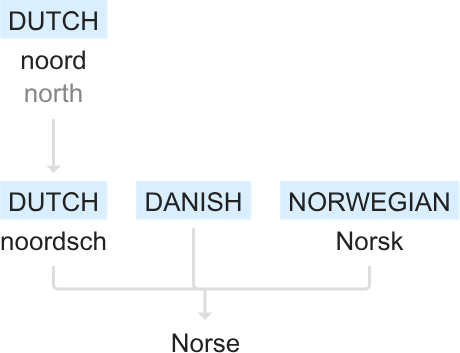
Here’s an infographic showcasing the etymology of Norse:
Norse is just another word for North, with Norsemen being “men from the North”. This is a broad description, but it does fully encompass the population making up the Vikings.
Here’s a fun fact for you:
Did you know that the words ‘egg’, ‘sky’, and ‘knife’ come from Old Norse? The interactions that the Norse people had with the Anglo-Saxons during the Viking Age actually lay the foundation for some of the most well known and often used words in the English language!
If you look closely when doing research on these words, you can see that at no point do people identify these populations as Vikings, rather they identify them as Norse or Scandinavian!
no. not exclusively. there are different uses of the word. as i showed you already
many historians seems to use the word differently. eg some seem to use “Norse” to only refer to those who believe in Norse gods (as opposed to those who had converted to chirstianity). others don’t include Danes, as they weren’t “northern” enough.
this isn’t factual.
And yet… it is!
It’s honestly been very interesting to see this develop, but I feel like we’re running in circles seeing who can interpret historical context correctly. If you genuinely believe the things you’re saying about viking being an accurate descriptor for all Norse people, it’s kind of impossible to refute that.
I mean really, there isn’t a single thing I can find to corroborate your claim.
vikings are a people, a single “job” (pirate) is not a people. you wouldn’t call the pirates of the golden age of piracy “a people”.
Basically every modern definition of the word i can find is not just about raiders and pirates, but at least includes settlers and traders. The settlements in Britain are called “viking settlements”, we talk about “viking rule” of these areas.
even this definition from 1913, acknowledges that “Viking” has become a “concise and convenient term for describing the whole civilization”, while pointing out that it’s technically incorrect.
The term ‘Viking’… came to be used more especially of those warriors who left their homes in Scandinavia and made raids on the chief European countries. This is the narrow, and technically the only correct use of the term ‘Viking,’ but in such expressions as ‘Viking civilisation,’ ‘the Viking age,’ ‘the Viking movement,’ ‘Viking influence,’ the word has come to have a wider significance and is used as a concise and convenient term for describing the whole of the civilisation, activity and influence of the Scandinavian peoples, at a particular period in their history, and to apply the term ‘Viking’ in its narrower sense to these movements would be as misleading as to write an account of the age of Elizabeth and label it ‘The Buccaneers.’
Language changes, and it’s a fact that “Vikings” in modern English does refer to the entire civilization. Just read about the Danelaw and see how frequently “Viking” is used to refer to civilians
then you clearly haven’t looked very far. Not least because I have repeatedly posted references in this very thread
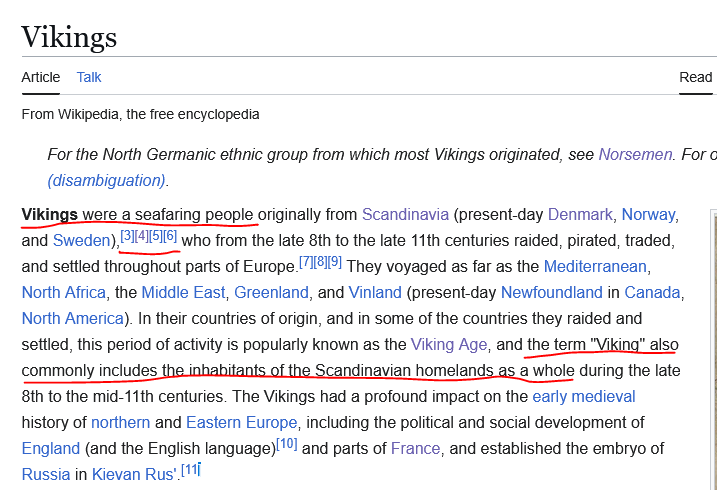
I said that because the sentence right below the picture you linked follows:
Expert sailors and navigators of their characteristic longships, Vikings established Norse settlements and governments in the British Isles, the Faroe Islands, Iceland, Greenland, Normandy, and the Baltic coast, as well as along the Dnieper and Volga trade routes across Eastern Europe where they were also known as Varangians. The Normans, Norse-Gaels, Rus, Faroese, and Icelanders emerged from these Norse colonies.
That wikipedia article uses viking and norse interchangeably at times, but defaults to Norse when talking about their heritage.
Basically, vikings describe the settlers and pirates of the era, but cease to exist as a descriptor beyond those instances. The article does not support your claim past the excerpts you’re grabbing from it.
I’m not trying to downplay the importance of Vikings, or even say that they don’t describe the people associated with them. But the idea that Viking accurately represents all people of Nordic descent is a bit hogwash mate.
the same article says:
Old Norse did not exert any great influence on the Slavic languages in the Viking settlements of Eastern Europe.
And you haven’t provided any rebuttal to the fact that the article describes the Vikings as “a people”. How is that in any way compatible with your claim that only the narrow definition of “Viking” is valid, ie that only the pirates and raiders are vikings?
Of course that’s nonsense. I am not claiming that. I don’t think a modern Ukrainian who has Viking ancestors should be calling themselves “Viking”.
What I am claiming is that “Viking” is a common way to refer to all people who were part of viking culture, be they farmers in Scandinavia, pirates in the Baltic and North Seas, explorers in Iceland, Greenland and the New World or Settlers in England and France (not an exhaustive list).
Of course people who insist that “Viking” only refers to the pirates exist (as you seem to be an example of those).
And it is also undeniable that some historians distinguish between Norse and Danish vikings, meaning that renaming Vikings to Danes might be counter-productive, when trying to be more historically accurate or inclusive.
Are you therefore saying that they should all be represented under a single faction name and banner in AoE IV?
I don’t want to put words in your mouth, but to me it seems like you’re heading that way. Or is it just a history lesson? Not meant negatively - you’ll find most people who care about this issue also care about history even when specifics are debatable.
Hear me out: variant$.
i think if there is only one faction, naming them “Vikings” makes the most sense (ignoring the issue that that limits them to a more narrow time-frame for now).
If they go for variants they could distinguish between “Norse” and “Danes” (Rus would be another candidate if they weren’t already in the game)
Fair enough. I don’t really have a horse in the race either way, but I think the diversity of what we call Vikings is exactly why others prefer specificity, especially given how much our understanding of these cultures has improved over time.
(obviously, I understand the marketing / cultural appeal of Vikings, too - it’s just that I think there are valid arguments both ways)