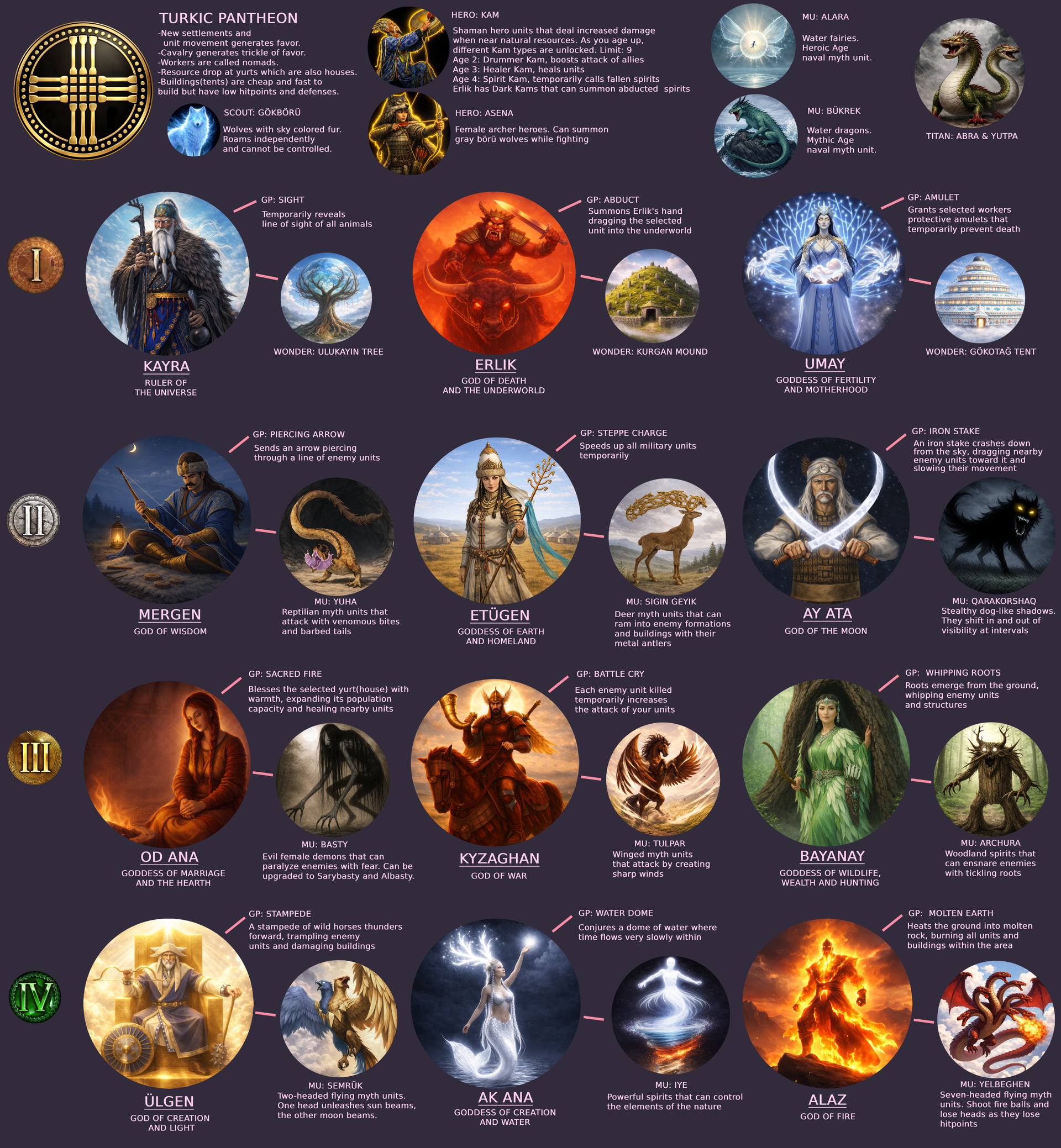
I know most of the people are looking for Celtic or Mesopotamian pantheon but I just wanted to see how a nomadic Turkic pantheon would look like in Age of Mythology. Here is a very long read for those who are interested in thoughts and lore behind:
OVERVIEW
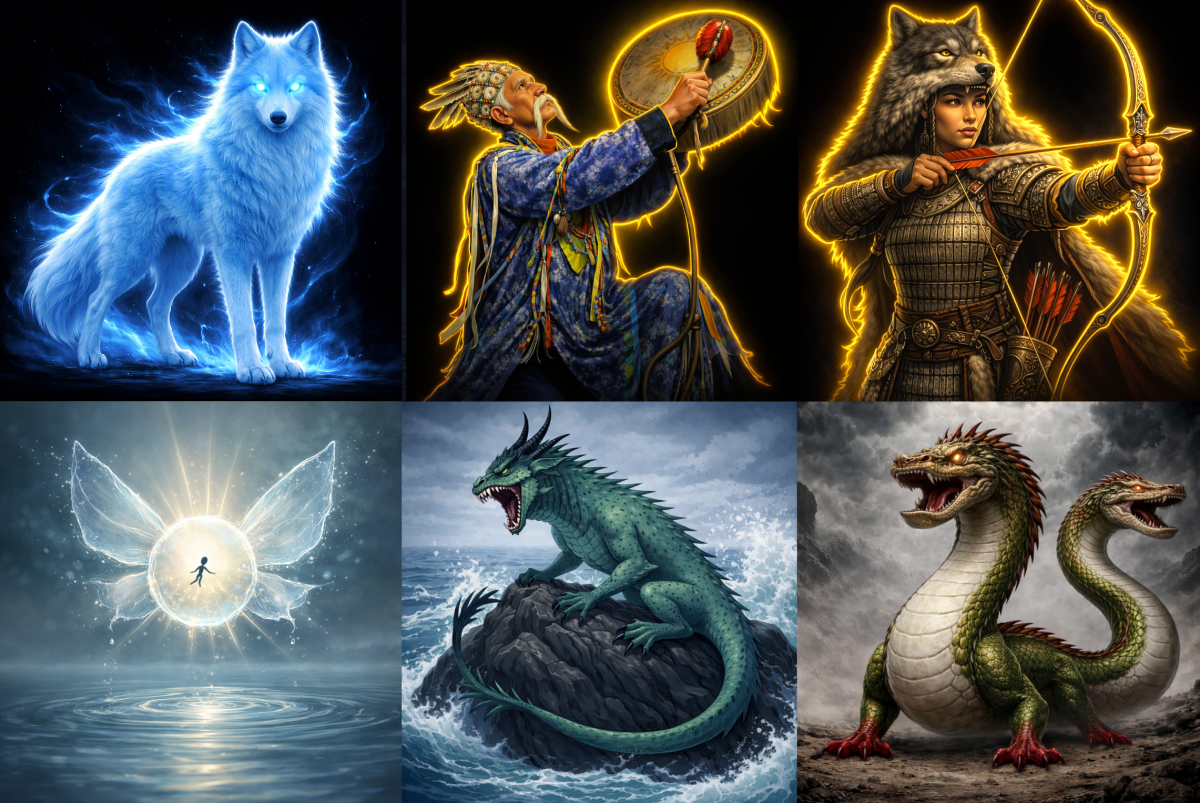
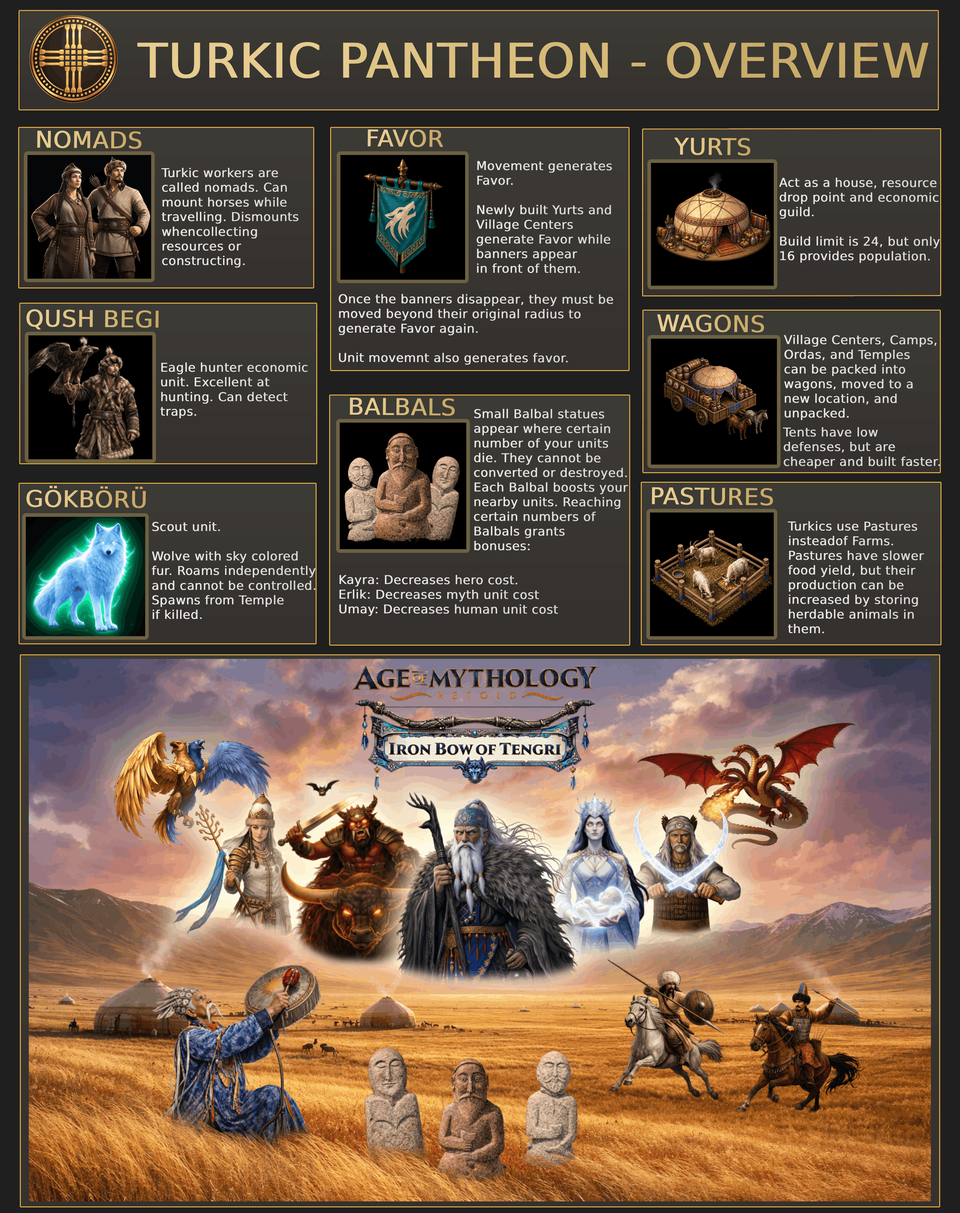
For the scout unit, I chose Gökbörü (sky wolf). This creature is said to appear every 100 years, and they cannot be tamed. To make it distinct from scouts of other pantheons, I incorporated this idea into its design. It roams the map independently while sharing its line of sight with you. It cannot be trained. If killed, it reappears after some time.
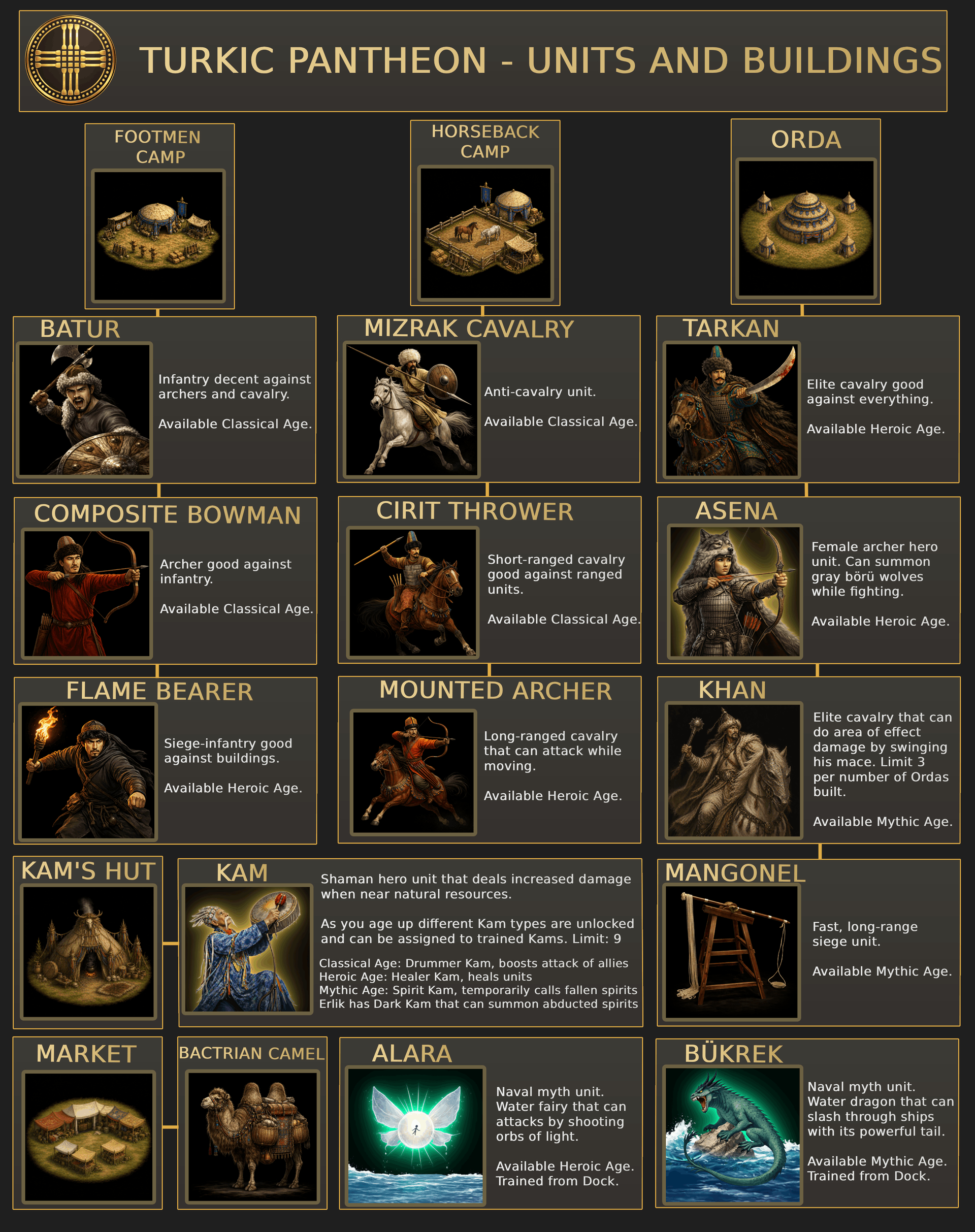
Shamans are a very important part of Turkic culture. They are called Kam, and they served as spiritual healers and intermediaries between humans and spirits. They used drums to enter trances, heal the sick, and guide spirits. In the Archaic Age, you have regular Kams with no additional powers. As you advance through the ages, new Kam types are unlocked and can be assigned to your existing ones. You can only have up to 9 Kams at a time, so you must be strategic in how you assign them. Age 2: Drummer Kam boosts attack of allies, Age 3: Healer Kam heals units, Age 4: Spirit Kam, temporarily calls fallen spirits to fight.
Asena is revered as a mother figure in Turkic mythology. The legend of Asena tells of a young boy who survived a battle. A female wolf finds the injured child and nurses him back to health. Then together they gave birth to a clan. In-game, Asenas are female warriors with a wolf spirit. They can summon börü wolves (gray wolves distinct from Gökbörü) to fight alongside them.
Heroic naval myth unit: Alara, a water fairy from Turkic mythology, is said to originate from Lake Baikal and to be formed from the love tears of a thousand women. She is depicted as a beautiful girl with butterfly-like wings made of light, residing near water sources. In-game, she appears as an orb of light with a small fairy silhouette inside. Her wings take a butterfly shape made of water, and she attacks by shooting orbs of light.
Mythic naval myth unit: Bükrek is a wingless dragon with a lizard-like appearance that dwells in the seas. In this design, it can slash through ships with its powerful tail.
Titan: Abra & Yutpa are giant, dragon-like underworld serpents in Turkic mythology that inhabit the Great Underground Sea, serving and protecting the underworld ruler, Erlik. They are depicted with copper-colored eyes, four red feet, green thighs, white chests, and flat jaws shaped like boats. In this design, they are merged into a single being.
The major god choices are Kayra, Erlik, and Umay, all of whom are central figures in Turkic mythology. Ülgen is another prominent deity who could have been included as a major god. However, he is instead reserved for the Mythic Age, similar to Osiris.
KAYRA - ARCHAIC AGE
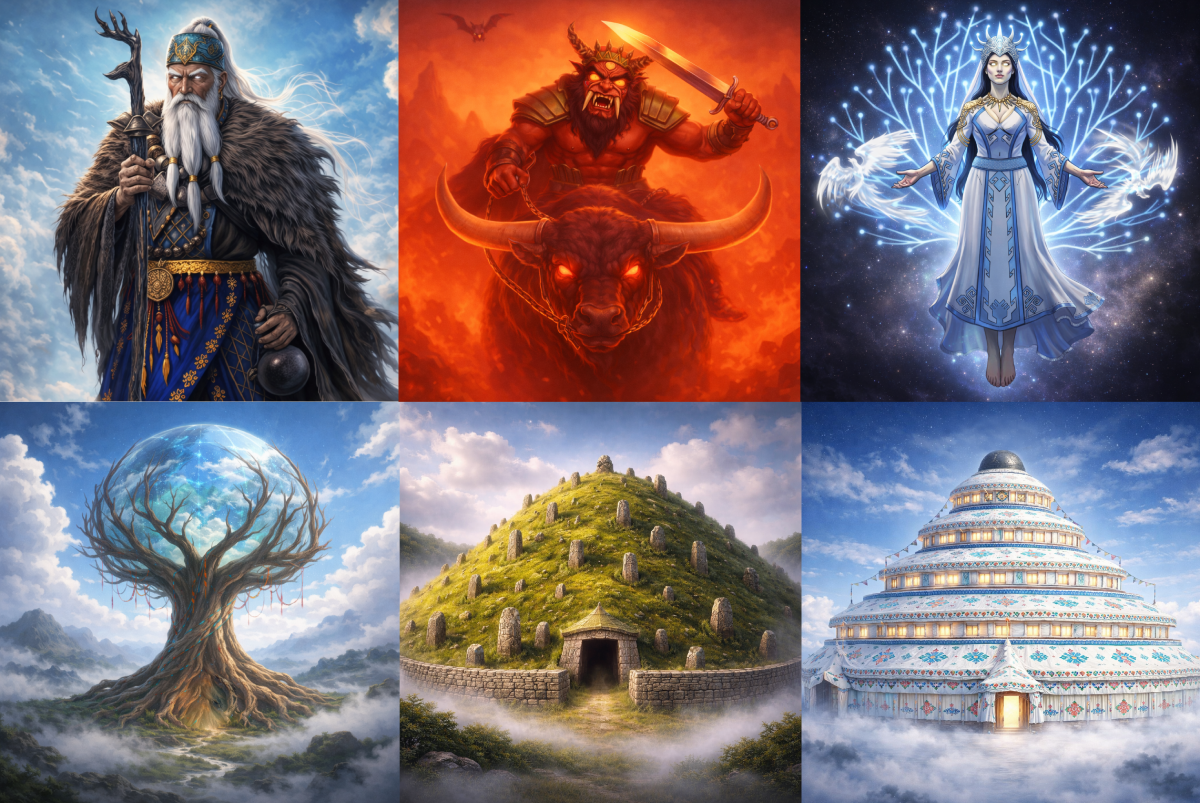
Kayra is a supreme creator deity in Turkic and Altai mythology, regarded as the ruler of the universe and the highest god of creation. He is the son of Gök Tengri (the Sky God). He created other gods and is the father of all including Ülgen, Erlik and Umay. His Wonder is the Ulukayin Tree, the Tree of Life, which he planted. The nine tribes are said to originate from this tree’s nine branches.
God Power: Sight – Temporarily reveals the line of sight of all animals.
Sight is a deleted god power from the game. It fits well with Kayra, functioning as a more widespread but less precise version of Vision and Spy. Could be very useful early game.
ERLIK - ARCHAIC AGE
Erlik is the god of evil and darkness, the lord of the underworld (Tamag), and the judge of the dead. From his realm, he brings death, plague, and evil spirits to torment humans and claim their souls. Seeking equality with his brother Ülgen, he created his own domain but was cast down to the ninth layer of the earth, becoming the ruler of the underworld. His Wonder is a Kurgan, a burial mound topped with balbal stone stelae that represents the ancestors.
God Power: Abduct – Summons Erlik’s hand to drag a selected unit into the underworld.
This power can be seen as a variation of Bolt, but is more cruel and fitting to Erlik as the victim is taken into the underworld.
UMAY - ARCHAIC AGE
Umay is the goddess of fertility and the protector of women and children. It is believed that a baby’s smile during sleep shows that Umay is nearby, while crying means that she has left. Her Wonder is a Gök Otağ (Sky Tent), a made up structure designed to fit the pantheon’s aesthetic.
God Power: Amulet – Grants selected workers protective amulets that temporarily prevent death.
This power reflects Umay’s protective nature. Wearing amulets to ward off evil is very common in shamanistic Turkic culture. Affected workers are left with at least 1 HP instead of dying, making this especially useful during unexpected raids.
MERGEN - CLASSICAL AGE
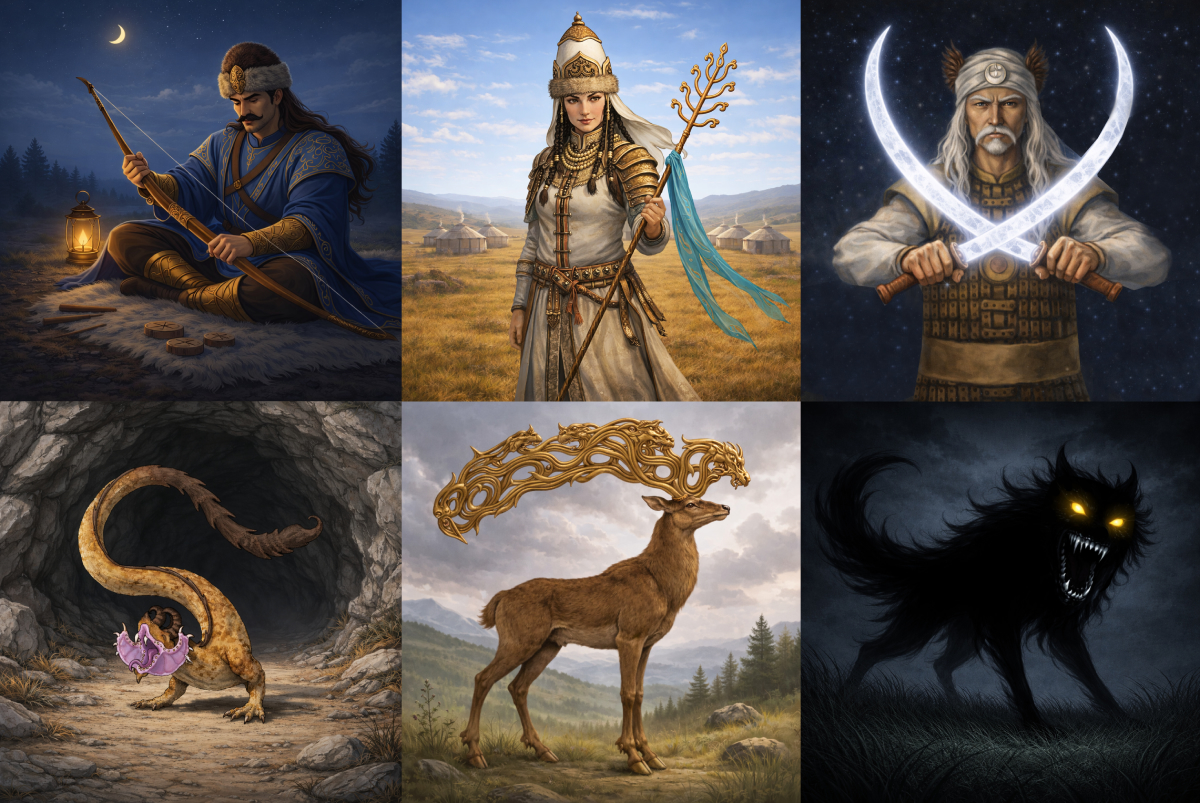
Mergen is the brother of Kyzaghan and Ülgen. He is the god of wisdom, intelligence, thought, and precision. He is known as a master archer whose arrows never miss.
God Power: Guided Arrows – Selected archers gain perfect accuracy and improved piercing.
This god power perfectly encapsulates Mergen’s precision and mastery of archery.
Myth Unit: Yuha - Reptilian myth units that attack with venomous bites and barbed tails
According to Turkic folklore, a Yuxa emerges when an ordinary snake reaches the age of 100 years, undergoing a profound metamorphosis into a majestic being. They are often described as dragon-like reptiles with two legs and a barbed tail, possessing a venomous bite.
ETÜGEN - CLASSICAL AGE
Etügen is the goddess of earth and homeland. It is believed that her name may have originated from Ötüken, the holy mountain of the earth and fertility.
God Power: Steppe Charge - Speeds up all military units temporarily
This is actually Great Journey GP from TOTD. Very fitting considering the favor generation method.
Myth Unit: Sigin Geyik - Deer myth units that can ram into enemy formations with their metal antlers
In Turkic shamanism, the deer is regarded as the steed of the shaman, capable of traveling between worlds and dimensions and also serves as a spirit guide. The Sığın Geyik is believed to be the sacred deer that guided the Turks to Ergenekon, often depicted with nine antlers.
AY ATA - CLASSICAL AGE
Ay Ata or Ay Dede (moon father) is a moon god, and he has been living in sixth floor of the sky with Kün Ana (sun mother), the sun goddess. The Turkic people trusted the magic influence of the Moon. He was their sole night lantern. The celebrations of malicious spirits occurred mostly at night. The rituals and trances of witches and demons were always timed according to the phases of the Moon.
God Power: Iron Stake - An iron stake crashes down from the sky, dragging nearby enemy units toward it and slowing their movement
This god power comes from the concept that Turkic people calling the North Star as Demirkazik (iron stake), as all other stars revolve around it.
Myth Unit: Qaraqorshaq - Stealthy dog-like shadows.They shift in and out of visibility at intervals
They are animal-like mythical creatures that conceals itself in shadowy locales such as deep holes, abandoned dwellings, or cave mouths, ambushing and devouring those who venture too close. In-game, they appear as fast, shadowy figures that blink in and out of vision, enabling ambush tactics.
OD ANA - HEROIC AGE
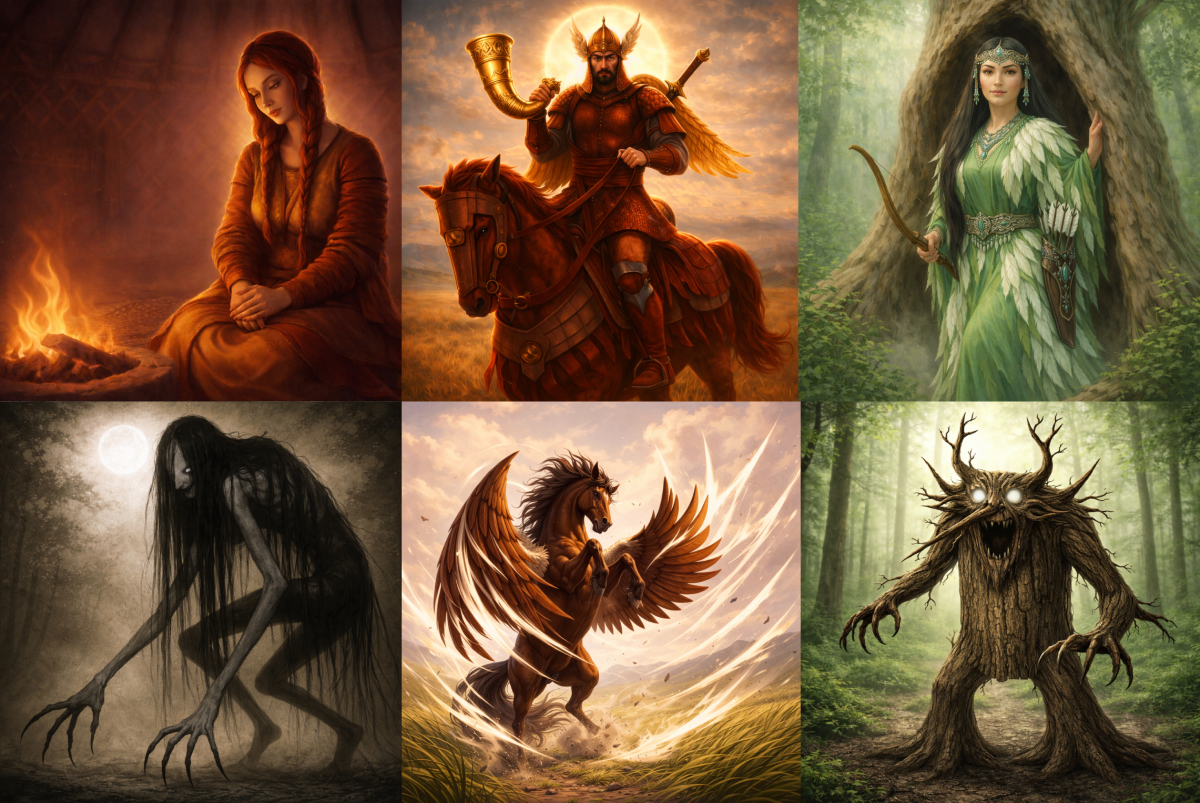
Od Ana (Fire Mother) is the goddess of fire, marriage, the hearth, and warmth. According to legend, the chief god Tengri orders three sacred fires to be kindled within the human soul, while Od Ana brings these fires down to Earth and places them into the world. In Turkic tradition, this is reflected in “cemre”, the belief that warmth descends each year into the air, water, and earth, marking the transition toward spring.
God Power: Sacred Fire - Blesses the selected yurt (house) with warmth, expanding its population capacity and healing nearby units
Myth Unit: Basty - Evil female demons that can paralyze enemies with fear. Can be upgraded to Sarybasty and Albasty.
The name basty comes from basmak (to press). It refers to a female demon believed to appear at night pressing on the chest of a sleeper, an explanation for sleep paralysis. Sarybasty (yellow basty) was associated with epilepsy and Albasty (red basty) was described as a tall, pale-skinned, malevolent being that also sucks blood.
KYZAGHAN - HEROIC AGE
Kyzaghan is the god of war and the brother of Mergen and Ülgen. He is often depicted with a sword, a horn, and a red horse, and is believed to aid commanders in battle.
God Power: Battle Cry - Each enemy unit killed temporarily increases the attack of your units
Turkic battle cries (uran) were unique to each tribe and passed down through generations to invoke unity and strength. In-game, I imagine battle cry being heard and a tribal war song being played on the battlefield when this god power is cast.
Myth Unit: Tulpar - Winged myth units that attack by creating sharp winds
I wanted this pantheon to have horse myth unit as horses are very important aspect of their culture. Very similar to Pegasus as both are winged horses but this one is not a flying myth unit, setting it apart. Instead, it uses its wings to create powerful gusts of wind to strike enemies.
BAYANAY - HEROIC AGE
She is the Turkic goddess of wildlife, wealth, and hunting. She is believed to dwell within ancient trees, abandoned huts, or dark caves. She descends into the human world only during spring and remains until autumn. As a guardian of nature, she protects hunters and ensures successful hunts.
God Power: Whipping roots - Roots emerge from the ground, whipping enemy units and structures
Myth Unit: Archura - Woodland spirits that can ensnare enemies with tickling roots
Archura usually appears as a man, but he is able to change his size from that of a blade of grass to a very tall tree. They protect the animals and birds in the forest and tell them when to migrate. They are also trickster mischievous beings tickling their victims to death.
ÜLGEN - MYTHIC AGE
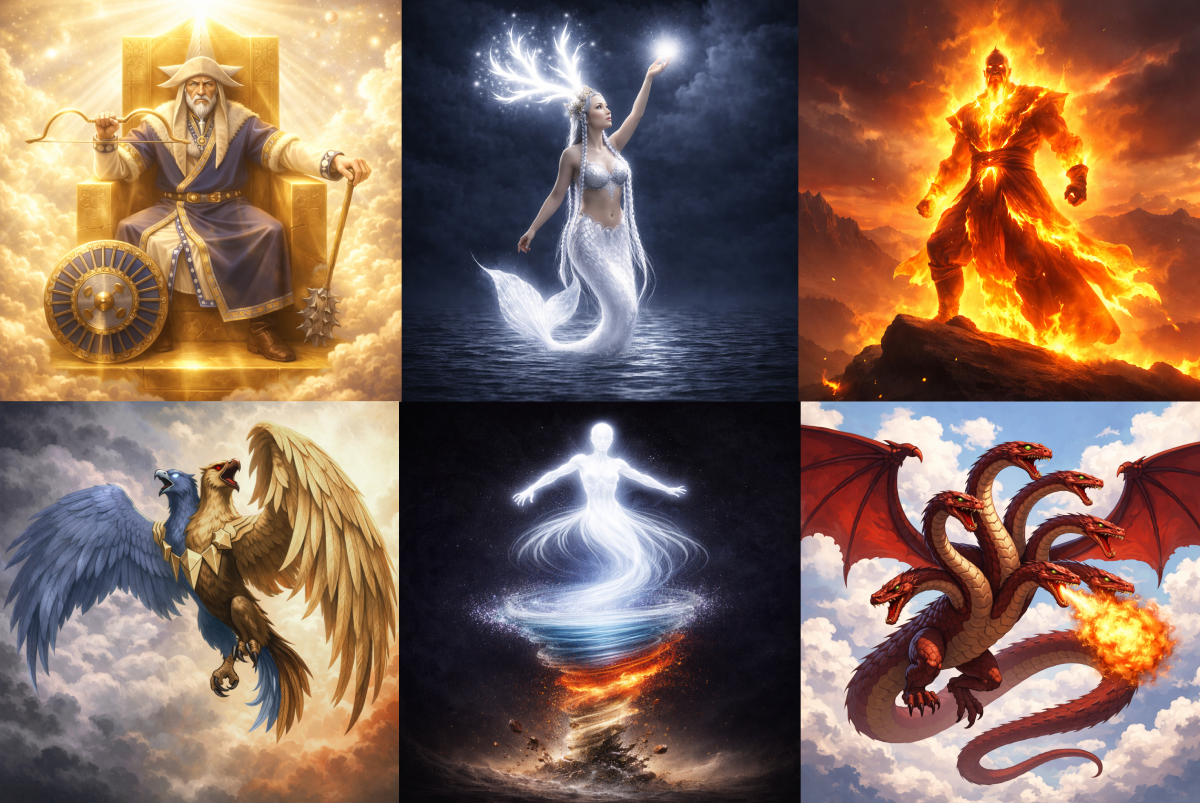
Ülgen is the sky deity and creator god, representing goodness, abundance, and light. He is the chief protector of humanity against Erlik. He lives on a golden mountain, in a palace with golden gates, upon a golden throne. He created the earth and living beings. He controls atmospheric events, such as thunder and rain, and is often equated with the celestial objects and sky.
God Power: Stampede - A stampede of wild horses thunders forward, trampling enemy units and damaging buildings
A destructive god power inspired by the wild horses of the steppe. Thunderous horses also align well with Ülgen’s power.
Myth Unit: Semrük - Two-headed flying myth units. One head unleashes sun beams, the other moon beams.
Suspended between Heaven and Earth, the two eagles began circling one another in rhythm with the motion of the cosmos. In time, they merged into a single being with two heads, one turned toward the east, the other toward the west. Semrük represents the Sun with its right wing and the Moon with its left wing. It shows the contrast and duality that provides the universal balance such as light and darkness, goodness and evil, night and day.
AK ANA - MYTHIC AGE
Ak Ana (white mother) is the primordial creator and goddess of water in Turkic mythology. According to the legend, in the beginning everything was covered by water. The god Ülgen transformed into a bird and flied over the waters, yet he could not find a place to land. Thereupon, Kayra instructed Ülgen to alight upon a stone emerging from the sea. Once Ülgen landed on this stone, he realized that the earth and the sky must be created, yet he did not know how to accomplish this. Ak Ana emerged from the eternal waters, revealed to Ülgen how to bring about creation, and she dived back into the waters. She is said to move between the waters and the skies, bringing divine inspiration for creation. Often depicted with a fish tail and white antlers.
God Power: Water Dome - Conjures a dome of water where time flows very slowly within
A versatile god power that can be used either to delay an incoming raid to get prepared or to slow down enemy recovery after you attack
Myth Unit: Iye - Powerful spirits that can control the elements of the nature
The term means owner, master, lord, possessor in Turkic languages. According to Tengrism, God created the Iye spirits and gave them dominion over a specific place. There are different types of iyes: su iyesi controls water, Od iyesi controls fire, Yer iyesi controls earth and Yel iyesi controls wind. In-game, Iye is depicted as a combination of these, controlling all four elements(similar to Avatar).
ALAZ - MYTHIC AGE
God of fire, often visualized as an old man dressed in flames. Unlike Od Ana, could be related to the destructive power of fire. He is triggered when angered causing widespread fires on earth or turning protective fires into harmful ones.
God Power: Molten Earth - Heats the ground into molten rock, burning all units and buildings within the area
The inspiration of this god power comes from the epic of Ergenekon. This legend tells of a great crisis faced by the ancient Turks. After a devastating military defeat, they sought refuge in the legendary Ergenekon valley, where they remained trapped for four centuries. Their escape came when a blacksmith forged a path to freedom by melting the surrounding mountain.
Myth Unit: Yelbeghen - Seven-headed flying myth units. Shoot fire balls and lose heads as they lose hitpoints
Yelbeghen is a seven-headed dragon that breaths fire. In Turkic legends, this highly intelligent creature repeatedly attempts to devour the Sun and Moon, causing temporary darkness(solar and lunar eclipses). The benevolent god Ülgen intervenes by shooting arrows at Yelbeghen, forcing it to release its prey and restoring light to the sky. In-game this unit can be seen as a reverse Hydra, starting out very powerful and gets weaker as it fights and lose hitpoints.
As someone who wants Mesopotamian and Slavic (and then Celtic) Pantheons in the game, Turkic had been on my radar a bit but I wasn’t sure how feasible it would be. I don’t necessarily agree with all the mechanics and such in this and some stuff would need to be quantified more but this has some very good bones and is quite intriguing. I think this at least shows a Turkic pantheon would be feasible and give some solid ideas for myth units and such. Nice work!
Turkics with no Tengri?
I must say, with the possibility of any Civ being added (and I’m assuming a couple more xpacks at least) its really opened my eyes more to different mythologies. I’m enjoying the unique perspectives fans are brining from all over the world 
Apart from modern religions like Christianity, I find these fan articles facinating.
Tengri is above all, it’s too primary and primordial that I think it wouldn’t fit as a god selection. It’s also still worshipped monotheistically, while the rest remain as a mythology.
A lot of civs already in the game have primordial gods in their rosters (Ra, Gaia, Oranos, the Norse titan), so I don’t see the problem in adding him
I think those are more at the level of Kayra. Tengri is above that, an all-encompassing concept. Kayra on the other hand, is the creator of all other gods and acts as a bridge between the absolute abstract nature of Tengri and the creations.
Ymir (who the Norse titan is supposedly based on) is literally the world itself (due to which I’m bothered by the campaign calling him “a lesser titan”).
Don’t forget about mammoths!
This could be a cool God Power
If a nomadic pantheon will be added I hope that it will be like the Mongols of AoE4 :
Hero : Khan
Unit : Mangudaï who shoot while moving, Keshik as heavy cavalry, Tarkan as anti building cavalry
Traction trebuchet as siege unit.
Many units of cavalry but only two footed (one melee and one ranged like the Lakota of AoE3)
Mobile building and Yurt as universal drop of point.
Pasture as food building
No wall
I think Kams (shamans) are more appropriate for hero units. They served as spiritual healers and intermediaries between humans and spirits. They used drums to enter trances, heal the sick, and guide spirits. I have a concept for them. In the Archaic Age, you have regular Kams with no additional powers. As you advance through the ages, new Kam types are unlocked and can be assigned to your existing ones. You can only have up to 9 Kams at a time, so you must be strategic in how you assign them. Age 2: Drummer Kam boosts attack of allies, Age 3: Healer Kam heals units, Age 4: Spirit Kam, temporarily calls fallen spirits to fight. Erlik has Dark Kams that can call abducted spirits to fight.
Also Asenas, female wolf spirits can work as ranged heroes.
Pastures replacing farms, mobile buildings and yurts I agree. Also Qush Begi villager type that is very good at hunting. Khan would be a powerful cavalry that only one can be trained from each Orda (fortress type building).
I am working on human units and buildings and I’ll post them soon
Why not make the hunter the scout unit? He could have an ability where he uses his eagle to scout for him.
I also like the idea of having a nomadic civ without any Infantry at all. Foot Archers yes but no Infantry.
Idea:
Archery Range:
- II: Archer (good vs. Infantry)
- III: Skirmisher (good vs. Archers)
- III: Cavalry Archer (good vs. Cavalry)
Stable:
- II: Light Cavalry (good vs. Archers)
- II: Bactrian Camel Rider (good vs. Cavalry)
- III: Cataphract (good vs. Infantry)
“Fortress”:
- III: Tarkan (good vs. Buildings and most human units)
- III: Hero Archer (good vs. Myth Units)
- IV: Mangonel (good vs. Buildings)
- IV: Khan (Buffs nearby units)
They can be used for scouting, that’s why they have trap detection. The idea behind them being an economic unit good at something (like Norse’s dwarves) is that they were essentially hunters used eagles to hunt, and Turkics don’t have farms, they have pastures that generate food slower so they need an economic unit to compensate for this.
I thought about sending eagle to scout too but it is too similar to Pioneers. Gökbörü scout mechanic aligns well with Turkic mythology and it is unique. They said to appear every 100 years, and they are kind of wolves that cannot be tamed.
Since they introduced a non existing unit for Aztecs to have one cavalry, I think having Batur as a single infantry is not that bad. They had infantry in battle although they were cavalry-heavy. Flame Bearer is just a siege unit, which they also had to burn buildings as siege.
I think it would be logical and interesting to have the hunter be the main scout. It forces you to decide if you want to scout more or use them for hunting. Similar to Ra having to choose if he wants to use the Priest for scouting or for empowering a building.
The wolf could just be a normal myth unit.
There’s one thing that has been bothering me for a while. Did you generate those images with AI or did you grab them from the internet?
I have no problem if it’s the latter, but AI in general is a no-go for me.
Of course they are AI generated.
Like 90% of civ concepts are fully of AI generated images and probably also AI generated text. People have outsourced thinking to AI now.