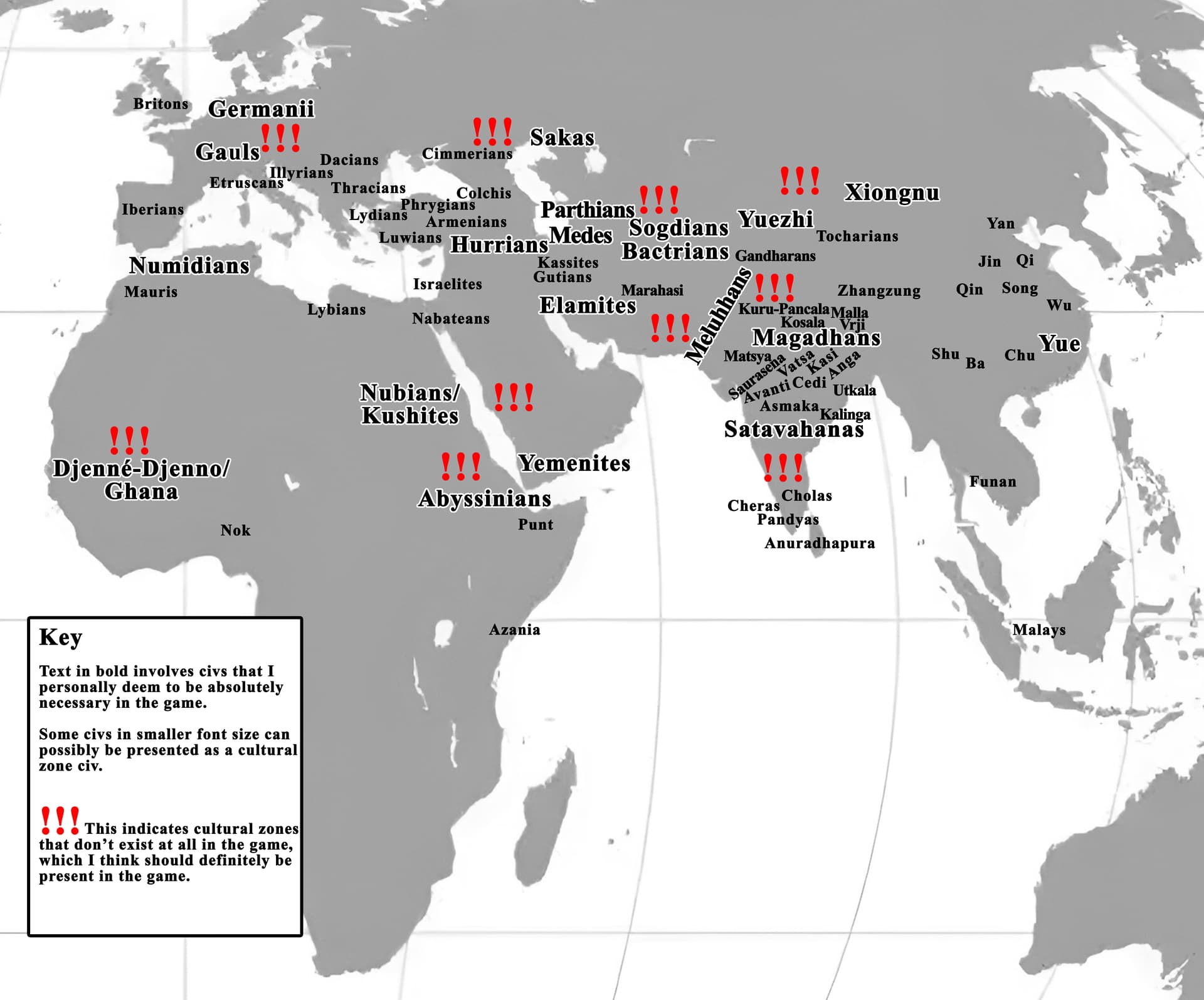
My map, my rules 
Looking at the main AOE titles, that seems to be an unwritten rule, I can’t think of any exception.
My map, my rules
Looking at the main AOE titles, that seems to be an unwritten rule, I can’t think of any exception.
I don’t think chain of contacts and diplomatic or even trade relations should necessarily count. Neither China nor the European states during the Middle Ages had the logistical means to end up in a situation where they would fight each other on land, and that’s what Age of Empires is primarilly about. A situation doesn’t mean to be realistic to happen in game.
That makes no sense at all. A lot of civilisations that are in the game (or you want to add to the game) are Indo Europeans.
It’s just the same people but in early Bronze Age.
Too much of an umbrella. This civilisation already makes little sense in the Middle Age but in an ancient setting it makes even less sense.
We don’t know who they were so they can’t be a civilisation.
They were likely made up of people from many different cultures so they are not a civilisation in any sense.
They just appeared out of no were, attacked a few places and then just disappeared.
I think they are Persian enough to just be Persians.
The other choices are all good.
They were a people from modern-day Turkmenistan subjugated the the Persians, that overthrew the Seleucids before being themselves overthrown by the Persian Sassanids (after many costly wars to Rome). Ingame they’d have a higher focus on cataphracts and horse archers (being famous for the parthian shot) than the Persians, a heavier version of the usual steppe horse archer + light cav, while the Persians would be more balanced between infantry and cavalry.
So, just like the Gauls and Britons, they are separated for gameplay reasons.
Another reason, this time personal : when first playing The Conqueror 20+ years ago, I looked at the new Parthian Tactics tech and asked : “who are the Parthians ? They are not ingame”.
I think ‘Indian’ is being used here in the sense the ancient Greeks (e.g. Herodotus) meant it, i.e. people from around/just beyond the Indus. Hence their dot on the map is over the Indus, rather than over what is now India. Perhaps it’s a confusing name, though, since it conflicts with the modern usage.
The existing Persian civ design is kind of necessarily weird, since the Persians actually used pretty much everything in the tech tree, but you can’t really have a civ with everything. I find the elephant focus quite odd too.
Indeed I had in mind both the Indus Valley civ, and the Indians that Alexander faced.
Jack of all trades, master of none. I assume the elephants focus was because out of all the original civs, they had the easiest access to asian elephants, that were bigger than the small species of elephants that Carthage had (and Carthage was only added in the expansion). Similar to why they had the only elephant in AOE2 until The Forgotten.
Like Minoans and Greeks they are completely different people that just happened to inhabit the same area in different times.
Split it into Indus Valley Civilisation and Arian Imdians.
Then we can add the Dravidians to fill in the gap in southern India.
Those 3 civilisations could share an architecture set.
The Kushan empire was a fascinating development of Greco-Bactrian culture synthesis.
(Even though more recent archaeological finds have largely falsified the old theory that the empire was founded by the Yuezhi steppe nomads who were driven south by the Xiongnu.)
There can be 16 South Asian ones, at least.
Anga
Assaka
Avanti
Chedi
Gandhara
Kashi
Kamboja
Kosala
Kuru
Magadha
Malla
Matsya
Panchala
Surasena
Vatsa
And now you are just listing the 16 Mahajanapadas of ancient India! 
If we do that, we can add in Five Hegemons and Seven Warring States of Iron Age China.
To be clear, even at the most generous, I don’t think all of these divisions need to be civs, just as all of the 16 Mahajanapadas don’t need to be. What matters is meaningful geographical & cultural distinctions that translates to interesting gameplay.
Let’s split the greek city states while we’re at it ! The Athenians, Spartans, Thebans, Syracusans, Massilians, Byzantines, Ephesians, Halicarnassians… And don’t get me started on the Gauls 
Where is corinth?
Word limit.
For a start, an AoE1 civ always needs: 1) an economic and military profile that inspires its gameplay identity; 2) a list of leaders.
Here are the civ lists from modern incarnations of the classic 1980 Civilization board game, namely Mega Civilization (2015) / Western Empires (2019) / Eastern Empires (2021), with civs not in AoE1 bolded. The games are played on maps of the Mediterranean and West Asia, so civs are chosen based on non-overlapping territories.
WESTERN EMPIRES:
Iberians
Celts
Carthagians
Romans
Minoans
Hellenes
Egyptians
Hattians
Assyrians
EASTERN EMPIRES:
Nubians
Babylonians
Sabaeans
Persians
Parthians
Kushans
Indus Valley Civilization
Mauryans
Dravidians
Some comments:
Hattians: too early and have to be represented by their geographic successor in AoE1.
Sabaeans: covering Arabian Peninsula here. I agree with @Temudhun that for Arabian representation, Yemeni and Nabataeans are more viable choices.
“Mauryans”: Maurya was a dynasty name, and only one of several states of Magadha. As other posters commented, the civ is better named Magadhans, Magadhas or Magadhis, depending on how you form the demonym.
IVC: lacking records of leader names is a hurdle. May have to be represented by another South Asian civ.
Use a Y for the Hittytes to bypass our beloved censor bot  (likewise, a C to write the Chang)
A board game indeed needs non-overlapping territory, it’s less of a problem for AOE2.
Another map of the thread concept from r/aoe2
I like the map’s clarity on several regions.
Riding on the map above, here’s a serious take on dividing the Iron Age China based on geographical and cultural features, highlighting their “selling points”.
Old civ:
Shang: (or Shang-Song) Stays the same. The first Chinese civilization to have surviving written texts, cruel and mystical, the Maya and Aztecs of China. Represents the “Central Plains” region, modern Henan Province. The Song of Five Hegemons period were direct descendants.
New civs:
Zhou: (or Zhou-Qin) Represents mountainous regions west and northwest of Central Plains, modern Shaanxi and Shanxi, the pragmatic Romans of China. From the west, the Zhou rose and replaced Shang as the ruling dynasty of China. In northwest, the Jin of Five Hegemons was one of the strongest powers, until usurpers divided it into three splinters. Finally, 800 years after the Zhou revolution, the Qin would conquer all China, again from the west.
Yan: (or Yan-Zhao) Represents the plains north of the Central Plains, modern Hebei Province, the Warring States kingdoms of Zhao (the northmost splinter of Jin) and Yan. In fighting with the newly advent steppe nomads, Zhao adopted the cavalry archer tactics of its enemies; Yan fought desperate last stands against Qin. Hardy and heroic, the Germans of China.
Qi: (or Qi-Lu) Represents the northeastern Shandong peninsula. Lu was home to Confucius. Qi profited from sea trade, and founded the academy that fostered China’s first intellectual development. The Greeks of China.
Wu: (or Wu-Yue) Represents Wu and Yue on the southeastern coast, rich in waterways, different from the north in culture and languages, the Vikings of China. Can double as the Wu of Three Kingdoms period.
Chu: (or Chu-Han) Represents the Chu civilization of southern lakes, passionate and romantic, the only power that could rival Qin in Warring States, the Celts of China. Also doubles as the Han empire, heirs to the culture of Chu, rising from the ashes of the short-lived Qin empire.
Shu: (or Ba-Shu) Represents Ba and Shu in the southwestern Sichuan (Szechuan) basin. A fertile and secluded region that held an enigmatic civilization as old as Shang. Viet tradition credits a Shu prince fleeing the conquest of Qin with founding Au Lac, the first unified state in Vietnamese history. Can double as the Shu of Three Kingdoms period.
I think an India, China and Western Europe themed DLC would probably be the best combination of DLC.
The 3 Kingdoms period is very popular in East Asia, not just China.
AoE could capitalise on that popularity.
And even in the West this setting is slowly starting to become more popular.
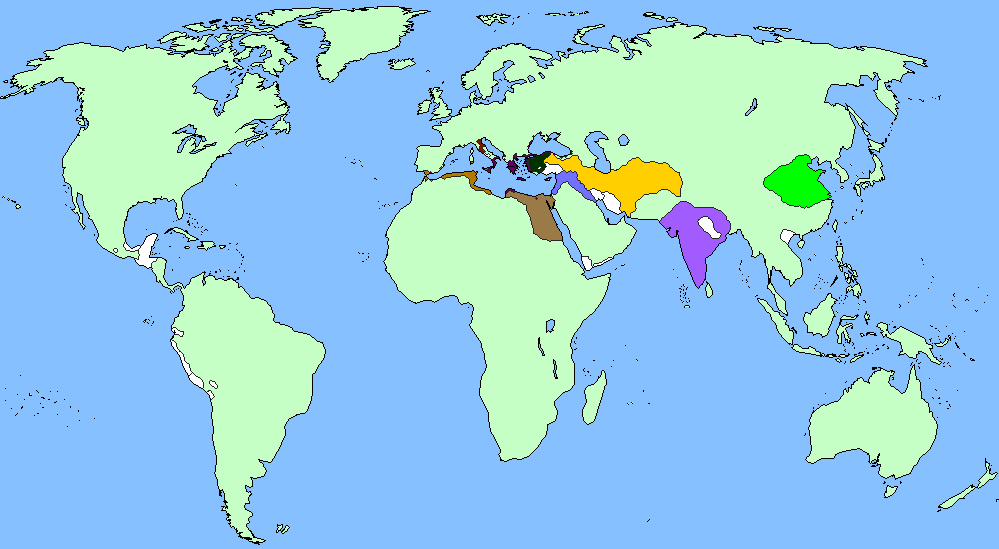
World Map
Red: Romans
Light Brown: Carthage
Dark Purple: Greeks
Dark Brown: Egyptians
Dark Green: Hatti
Dark Cyan: Babylonians/Assyrians
Gold: Persians
Light Purple: Mauryans
Light Green: Shang
The Maya are from much earlier: you have the pre-classic Maya (2000 BCE-200 BCE)…
Because of the campaigns and chronological gaps that AoE 1 still has: between the years 1000 and 734 BCE (here you can put the rise of Israelite Kingdom)…then you have blanks between 612 and 405 BCE (here you can put the Greco -Persians Wars: ie Thermophylae and Salamis); 401 and 334 BCE (here you can put an Alexander the Great campaign); 334 and 290 BCE (here comes the Pyrrhus campaign); 171 and 75 BCE (here you can put a Viriatus and Gaius Marius -uncle of Julius Caesar- campaigns), 31 BC and 69 AD and then until 178 (here comes Trajan’s campaign), 180 until 262 (all the crisis from the 3rd century and the romance of the three kingdoms) and finally from 271 and 373 (practically the entire Tetrarchy and the Constantine dynasty)…
Regardless of who adding indian factions will need a new building set which is pretty unlikely unless the dlc is a success.
I mean, any new civ or update is unlikely unless the dlc is a success.