This note is to share some my opinions of Chinese Revolution.
Conservative Idea:
The following a consevative design of Chinses Revolution.
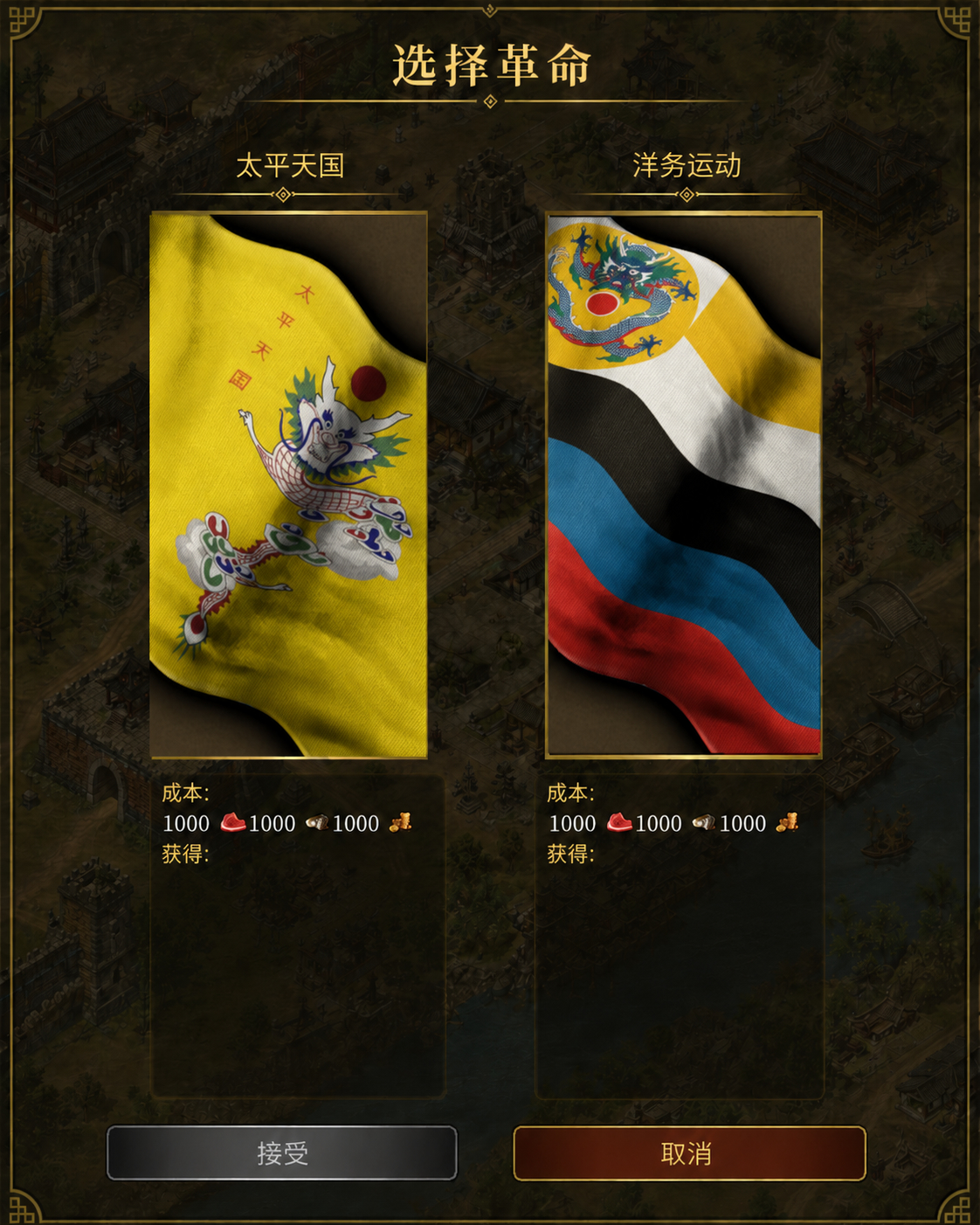
Taiping Heavenly Kingdom vs Western Affairs Movement
The Taiping Heavenly Kingdom(1851 to 1864)
led one of the largest peasant uprisings in Chinese history—and possibly in world history. The Taiping Rebellion caused the deaths of tens of millions of people and devastated the richest parts of China. The Taiping armies consisted largely of highly motivated and relatively disciplined peasants. Many of their soldiers were armed with muskets and other firearms. They also had several capable commanders and, at one point, came close to threatening the survival of the Qing dynasty.
There are many interesting possibilities for a Taiping shipment deck, although I have not fully worked them out yet. There is also a great deal of historical material that could be used as inspiration.
In gameplay terms, the Taiping Revolution could turn Villagers into Musketeers or other infantry units, somewhat like the Brazilian Revolution. It could become a full military revolution focused on mass infantry, religious fanaticism, and rapid mobilization.
Western Affairs Movement (1861–1895)
The Self-Strengthening Movement, also known as the Western Affairs Movement, was a reform movement led by the Qing government between approximately 1861 and 1895.
During this period, the Qing government and regional officials established factories, arsenals, coal mines, shipyards, modern schools, and naval bases. China also began producing domestic copies of foreign firearms, artillery, warships, and machine guns.
In gameplay terms, this option could represent an industrial and military modernization path rather than a complete overthrow of the Qing dynasty.
The existing Banner or traditional army units could be replaced or upgraded into regional armies such as the Huai Army, Chu Army, Xiang Army, and Gan Army. Historically, these forces were organized by famous Qing officials and commanders such as Li Hongzhang, Zuo Zongtang, and Zeng Guofan.
These commanders created their own regional armies to help the Qing dynasty suppress the Taiping Rebellion and other uprisings. Afterward, they became somewhat similar to regional warlords, although they generally remained loyal to the imperial court.
The Beiyang Fleet could also appear as a major naval shipment or as a powerful warship upgrade.
Here is the flags:
Taiping banner is from wikipedia’
For the Self-Strengthening Movement, I used the Qing Imperial Navy flag because the creation of a modern Chinese navy was one of the movement’s most important achievements.
More Experimental Ideas
Because the Qing dynasty was founded by the Manchus, a minority people from northeastern Asia, it faced many rebellions among the majority Han Chinese population.
A number of these rebels claimed that they wanted to restore the Ming dynasty, which had ruled China before the Qing. Therefore, a more experimental idea would be to add Revolution factions based on the Ming–Qing transition period.
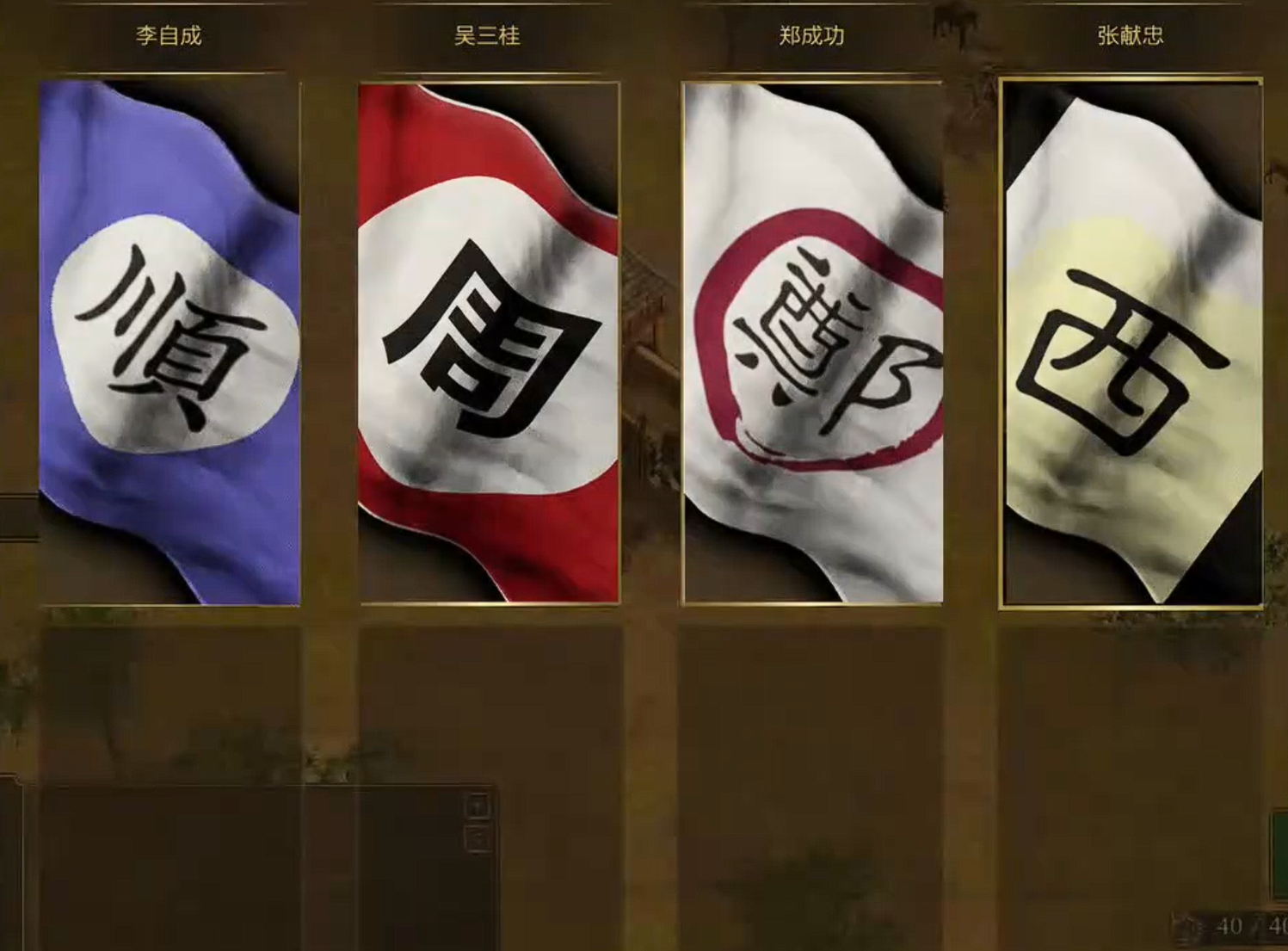
Shun Dynasty
The Shun dynasty was founded by Li Zicheng, a rebel leader who commanded a massive peasant uprising against the Ming dynasty.
His forces captured Beijing in 1644, leading the last Ming emperor, the Chongzhen Emperor Zhu Youjian, to commit suicide as the city fell.
However, after the Manchus entered China, Li Zicheng’s forces fought against them and were defeated. Li Zicheng later died, and the Shun regime quickly collapsed.
Many surviving Shun soldiers eventually joined Ming loyalist forces. They continued to support surviving Ming princes and resisted the Qing dynasty for decades.
In gameplay terms, Shun could be another full military Revolution in which most or all Villagers are converted into infantry units. Its shipment deck could focus on mass armies, cheap units, rapid recruitment, and peasant mobilization.
Zhou Dynasty
The Zhou dynasty was declared by Wu Sangui, one of the last major Ming commanders and warlords.
Wu Sangui had previously fought against the Manchus, but after the fall of the Ming capital, he chose to cooperate with them. He helped the Qing conquer much of China, suppress several Ming loyalist movements, and capture the last major Ming claimant.
However, late in his life, Wu Sangui rebelled against the Qing dynasty. His uprising became part of the Revolt of the Three Feudatories, and he called hisself of the emperor of Zhou. His revolt lasted for eight years and seriously threatened the Qing Empire.
A Zhou shipment deck could focus on cavalry, fortifications, and powerful military commanders. Wu Sangui had commanded some of the last elite cavalry forces of the Ming dynasty, including the famous Guanning Cavalry.
This Revolution could therefore provide strong cavalry units, defensive buildings(about today’s Yunnan province), Fort shipments, and bonuses for fighting near captured territory.
Ming, or the Zheng Regime
This faction would be based on Zheng Chenggong, better known outside China as Koxinga.
His father, Zheng Zhilong, was a powerful pirate, merchant, and naval commander who eventually surrendered to the Qing. Zheng Chenggong, however, remained loyal to the Ming cause.
After losing his remaining bases on the Chinese mainland, Zheng Chenggong sailed to Taiwan and expelled the Dutch from the island. His descendants continued to rule Taiwan as a Ming loyalist regime for several decades.
This faction could have a navy-focused shipment deck, with powerful warships, marines, coastal defenses, mercenaries, and economic bonuses based on maritime trade.
The Iron Troops already present in the game could also be connected to Zheng Chenggong’s faction.
Xi Dynasty
The Xi dynasty was founded by Zhang Xianzhong, a brutal peasant rebel and warlord. His forces fought against the Ming dynasty and killed many members of the Ming imperial family.
However, after Zhang Xianzhong’s death, many of his surviving commanders joined the Ming loyalist cause, much like the remaining forces of Li Zicheng.
These commanders united with the Southern Ming and defeated Qing armies several times. Zhang Xianzhong’s four adopted sons became important generals, administrators, and economic organizers.
They helped the Yongli Emperor Zhu Youlang, the last major Southern Ming claimant, continue resisting the Qing for many years.
The Xi shipment deck could therefore focus on infantry and economic development. It could combine large armies of inexpensive infantry with strong economic shipments, regional administration bonuses, and several powerful hero or commander units.
Taiping Heavenly Kingdom and the Self-Strengthening Movement could be the industial age revolutionary options.
The Shun, Zhou, Zheng, and Xi factions could the fortress age revolution.