This is a claim that needs to be approached from a quantitative perspective rather than presenting a “perception” without supporting data. To demonstrate this, I will show the following graphs, which illustrate damage received over time and army cost-efficiency.
For these calculations, we consider the scenario where the unit with the longer range fires first, and we account for the time it takes for the unit receiving the initial damage to start exchanging fire, based on its movement speed and the difference in range between the two units.
1. Base Matchup: Piechur vs. Standard European Skirmisher
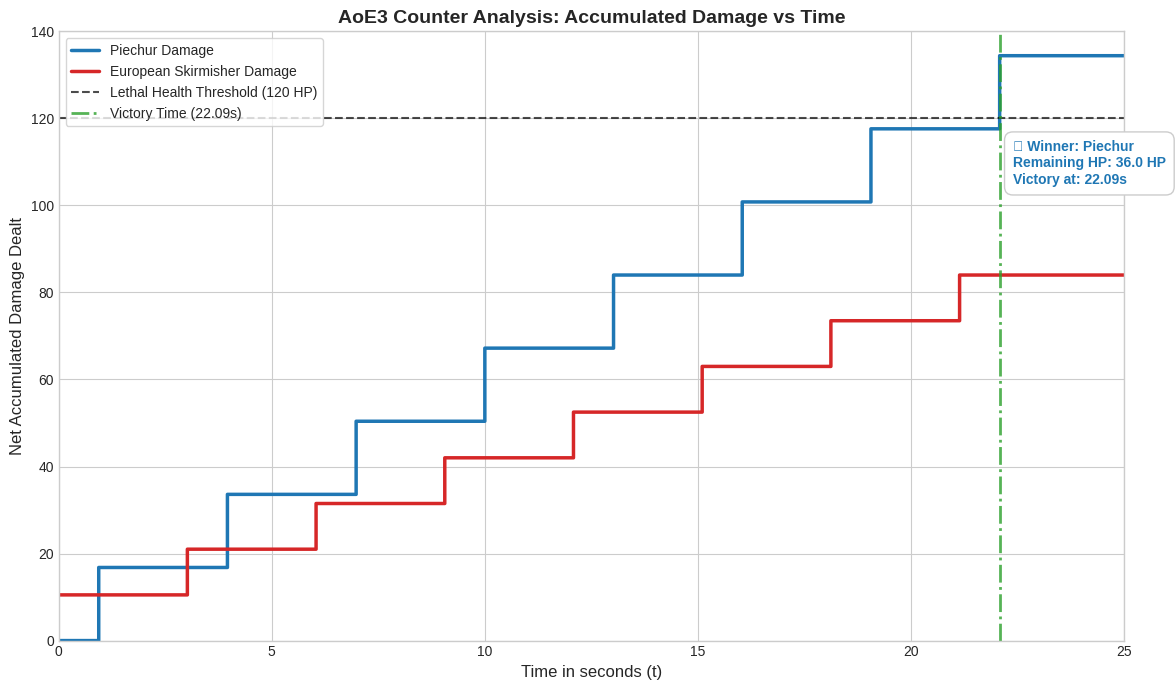
In the first graph, we compare the unupgraded Piechur against a standard European Skirmisher.
Mechanics: The European Skirmisher holds a range advantage (20m vs. 16m) and gets the first shot. Moving at 4.25 m/s, the Piechur closes the 4m range gap in approximately 0.94 seconds to begin firing back.
Result: Despite taking initial damage, the Piechur’s superior base anti-infantry output (24 net damage vs. 10.5 net damage per shot after 30% resistance) allows it to turn the tide quickly. The Piechur reaches the 120 HP lethal threshold faster, defeating the standard Skirmisher decisively in a 1v1 duel.
2. Fully Upgraded Matchups: Imperial Piechur vs. High-Tier Skirmishers
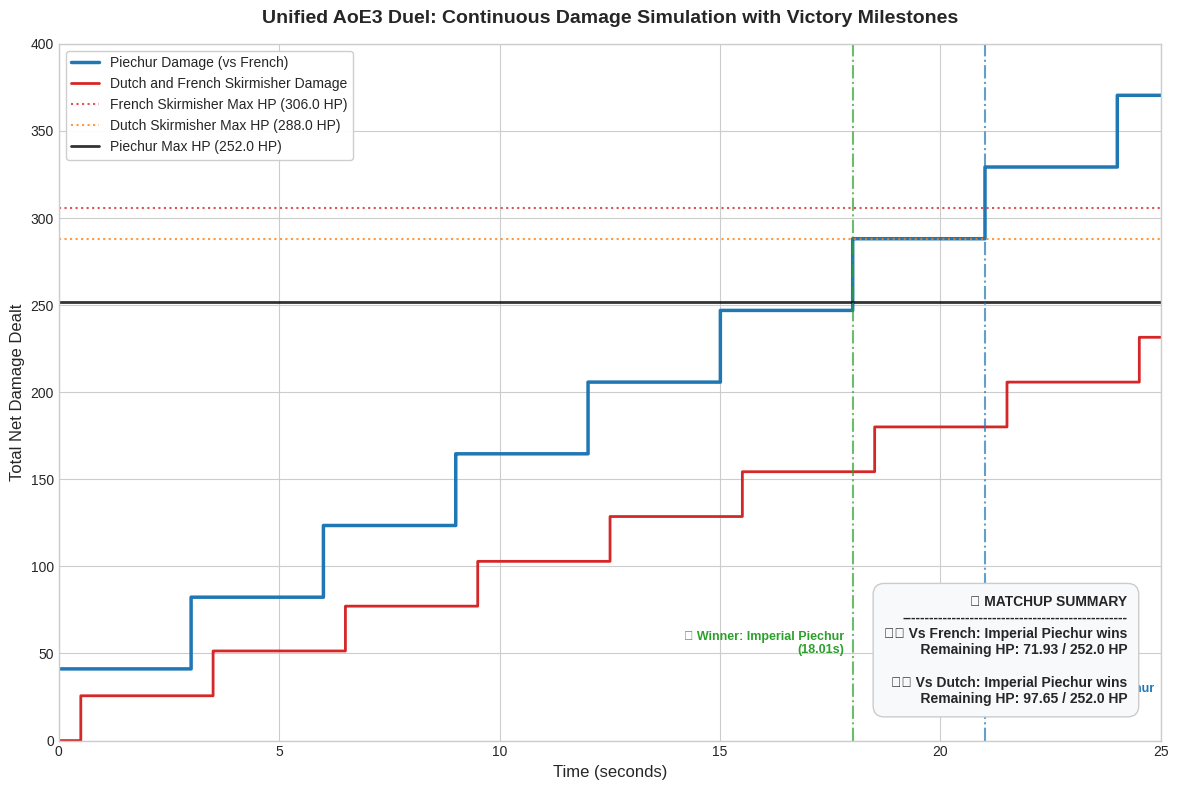
In the second set of graphs, we look at the Piechur with all of its Imperial upgrades (22m range, 252 HP, 58.8 base damage) against elite late-game skirmishers: the French Skirmisher (306 HP, highest health pool) and the Dutch Skirmisher (288 HP, representing average elite performance).
Case A (vs. French Skirmisher): Even with maximum French upgrades, the Piechur’s range advantage (22m vs. 20m) forces the French Skirmisher to close the gap first.
Case B (vs. Dutch Skirmisher): In a similar setup, the Piechur completely overwhelms the Dutch Skirmisher.
3. Macro-Economy & Mass Engagement (10,000 Resource Investment)
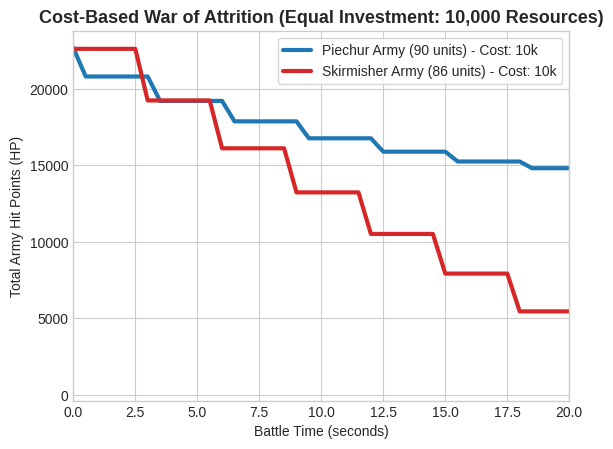
In the third graph, we evaluate resource efficiency by tracking how an equal investment (10,000 resources) depletes during a mass army engagement.
Force Composition: At 110 resources per unit (70F/40G), 10,000 resources yield 90 Piechurs (22,680 total HP). At 115 resources per unit (50F/65G), the same investment yields 86 French Skirmishers (26,316 total HP).
Result: Due to higher unit density and damage output per resource spent, the Piechur army completely wipes out the opponent in around 15 seconds. The Piechur force retains approximately 6,000 resources worth of military value (60% of the initial investment), leaving the Skirmisher player at a 100% resource loss.
It is important to note that scaling 1v1 duel parameters into mass engagements introduces emergent game-engine behaviors that standard deterministic models simplify:
Overkill Damage: The in-game AI pathfinding and focus-fire mechanics often cause multiple units to shoot at a single low-HP target simultaneously, resulting in significant “wasted” damage during each burst.
Collision & Pathfinding Bottlenecks: Unit collision boxes and movement delays mean that not all units in a massed army begin firing at the exact same instant, slightly reducing the theoretical Rate of Fire (RoF).
Decaying DPS: Firepower decreases step-by-step as individual soldiers fall rather than being depleted as a single unified health pool.
While a full Monte Carlo simulation—modeling individual targeting logic, overkill rates, and spatial collision—would be required to capture the exact stochastic variance of a real match, this macro-economic model provides a reliable deterministic baseline.
Even when accounting for target overkill and movement-related noise, the Piechur’s high raw damage efficiency per resource leaves a sufficiently large margin to remain highly effective in realistic army-scale engagements.