My thought was Africa would come in 2027, so i’m still hoping for that, though I am suprised with the Vikings DLC. it does still kinda fit my idea of overarching themes, just that instead of all of 2026 being Americas it seems it was only the first half of 2026, then the second half has been Scandinavia. Hopefully that means Africa can be an overarching theme in 2027.
6 Likes
Even in Europe there would be better things to add rather than splitting Vikings.
They could have added Al-Andalus and other Iberian civs as new DLC or Balkans civs DLC for example. But adding more Vikings was not good imo.
6 Likes
I’m ok with them doing this Viking DLC eventually (I’ve been wanting Saxons in particular for awhile) but your two callouts are exactly the only two things I see as any level of priority for Europe, and Andalusia civ (which i’d rather they package with an Africa DLC. I can see an argument for adding Aragonese but that seems like more needless civ-splitting, and I don’t see any other Iberian groups to be added aside) and a Balkans DLC. Those two are IMO priorities, a British Isles DLC and a Barbarian invasion DLC with Vandals, Saxons, and Lombards were two ideas i’d say would be nice to eventually have but pretty far down the line (I might have to rework my Barbarian invasion idea now that Saxons are here with this DLC, or may just scrap it entirely). anything past that in Europe for me will pretty much always get a best-case response of “Ok…cool whatever I guess” and it goes down from there.
1 Like
Vandals and Lombards algonside a Roman campaign is still enough for a DLC
2 Likes
I mean last time they added a European civ was in 2022/23 with Romans, Armenians and Georgians and all of them not completely European for different reasons. In between you had an east Asian and South American themed DLCs.
2 Likes
Yeah so? Last time they added African was in 2015 LOL
2 Likes
Yes, now it would be time to add more Africa in general (and in the entire saga, more civs in AoE 2,3 and 4 and Yoruba in AoM)…
If we are going to argue for more historical realism in Age of Empires II, then we also have to acknowledge that the medieval world was not technologically uniform.
Different regions developed different systems based on their environment, resources, population density, trade networks, political structures, and historical circumstances. Europe, the Middle East, East Asia, and parts of South Asia developed especially dense traditions of metallurgy, heavy cavalry, armored warfare, siege engineering, large-scale fortifications, and professional military institutions. Many of the iconic AoE2 units—knights, heavily armored cavalry, trebuchets, gunpowder weapons, and certain infantry systems—come from these historical traditions.
Sub-Saharan African societies developed along different paths. That does not mean they lacked complex societies or historical achievements, but their strengths were often expressed differently. Many regions did not develop the same widespread traditions of heavy armor, large-scale stone fortifications, or European-style military systems due to different conditions and historical circumstances.
Their architecture, for example, was often based around different materials and techniques. West African civilizations frequently used earth, mudbrick, and other locally available materials rather than the stone castles, cathedrals, and fortified cities common in medieval Europe. It is not about whether one style should be considered inferior—it represents a different adaptation to environment, resources, and societal development.
The same applies to warfare. Many Sub-Saharan African states had their own military strengths: cavalry traditions in suitable regions, skilled infantry, archery, trade-based wealth, organized administration, and regional methods of warfare. They should be represented through those identities rather than simply being given the same military technology tree as European civilizations.
At the same time, AoE2 has always been a balance between historical inspiration and gameplay. If we demanded complete historical accuracy, then many existing civilizations would also require major changes. The game already gives civilizations technologies, units, and combinations that are abstractions created for gameplay and balance.
So yes, I support adding more African civilizations. Songhai, Kanem-Bornu, Swahili, Somali, Nubian, Kongo, Shona/Zimbabwean, and others could all bring unique historical identities. But adding civilizations should be based on historical significance, distinct culture, military identity, economy, and gameplay potential—not modern population numbers or continental quotas.
The goal should be diversity through accurate representation of different historical paths, not forcing every civilization into the same technological and military mold.
I also think many discussions become unnecessarily polarized because some people assume they have a monopoly on interpreting historical representation, while also speaking as if they represent everyone who cares about history. If we are genuinely arguing for historical accuracy and better representation, then different interpretations and proposals should be considered.
For example, many people argue that the current Saracens are sufficient to represent an enormous geographical area stretching across Arabia, Egypt, the Levant, and Mesopotamia. I disagree. My proposed solution is not based on splitting dynasties—it is based on different cultural regions, economies, societies, and military traditions.
A possible Islamic-world division could be:
- Arabians/Arabs — representing the Arabian Peninsula and the various Arab tribal and imperial traditions that originated there.
- Mashriqis — meaning “the East,” representing the eastern Islamic world, including regions such as the Levant, Mesopotamia, and surrounding areas, with their own political and military traditions.
- Egyptians — representing the Nile civilization, from Fatimid and Ayyubid Egypt to the Mamluk military system. Egypt had its own unique population, economy, and military structures.
- Andalusians — representing Muslim Iberia, with a distinct frontier society shaped by interaction with Christian Iberian kingdoms.
- Maghrebis — a reworked version of the current Berbers, representing the western Islamic world of North Africa: Morocco, Algeria, Tunisia, and related cultures.
This is not the same as creating dynastic civilizations. Otherwise, we would have to rename European civilizations as Capetians, Carolingians, Plantagenets, Habsburgs, Valois, and countless other dynastic names. AoE2 civilizations are generally meant to represent broader cultural, regional, and historical identities—not individual ruling houses.
The same principle should apply everywhere: choose civilizations because they represent distinct peoples, societies, military traditions, and historical experiences. That is how you create a richer and more historically interesting Age of Empires II.
Cracy theory:
I researched a lot and also here are very often the same 10 African civs requested to be added.
Kanembornu, Hausa, Songhai, Swahili, Zimbabwe, Somalis, Nubians, Gahna, Benin, Kongo
Now this is a lot, but all of them would add something to the game. There could be 3 regular or 2 big DLCs (like the conquerors or 3 kingdoms) but what if the devs are waiting for the 10th anniversary of aoe2 DE in 2029 to add 10 civs at once and complete africa at once?
I know it’s a stretch, but one can dream.
1 Like
Sounds like a balancing nightmare tbh
Nobody is questioning that but you said “yet another euro DLC” when the last euro DLC was (barely) in 2023, if you consider the Caucasus Asia (as it’s often considered) you need to go back to 2021 to have a proper Euro DLC since you can’t really tell me Ror was an Euro DLC.
Just trying to speak some truth among the usual double standards and half truths.
3 Likes
The tricky question is what do you do with Africans south of the desert? You can argue horses for Benin and Yoruba due to trade out pacing Tsetse death infliction but anything South of that: Kongo, Mbundu, Zimbabwe, Swahili, Malagasy, and so on… you would need a new scout at bare minimum
2 Likes
I agree. They would be civs without horses like the American civs.
Maybe even a civ bonus against horses that reflects tsetse flies.
One issue I had was also the basis for castle and wonder design. Unfortunately these civs didn’t build a lot of monuments like Europeans, Asians and meso Americans did. But I guess the devs can find something creative for that.
That’s why I would firstly go only with kanembornu, Hausa and Songhai as a DLC. They had horses, contact to malis, berbers, Arabs and each other and also build forts that could be bases for castles. They also had interconnected history between echa other so that the 3 campaigns could be connected like with Poland, bohemia and Lithuania.
After that, nubia, somalis and Benin would still be relatively easy when it comes to the civ design.
For the South, it needs new regional units.
That’s the fun thing. Because unlike American civs you don’t need to compensate for missing gunpowder necessarily either. Some of them, perhaps many were direct benefactors of the Oriental trade routes, they knew of horses and blasting powder and blasting powder doesn’t exactly have an allergy to bug bites.
1 Like
They literally built huge stone fortresses and had plentiful equal partnerships with European civs you are so obsessed with.
This isn’t Age of Germany…
7 Likes
To follow this point: Zimbabwean Great Enclosured walls would make Byzantium walls look like Gothic palisades defenses
1 Like
Unless those civs are recruiting tsetse flies as soldiers in their armies i’m not sure i’m in favor of this one lol. I get the idea but i’m not sure occurances of nature should factor in to civ bonuses in that way
1 Like
I dont say we cant have it, i just say it is a Stretch and counter immersive.
We already have stone-slingers from the incas that habe similar stats as hand canoneers. Imagine throwing stones as deadly as steel bullets accelerated with gunpowder.
Why? Because the devs somehow have to make incas compete woth byzantines and portugese. I just opt for some realism
@DynasticPlanet5 That’s true. But, to be honest, I don’t see any other civs besides Kongo and Zimbabwe integrating aoe2, so it would only be two more “eagle civs”. I haven’t found any specific battles for the Swahili (maybe someone can share if they know of any), and the Mbundu and Malagasy have their peak after the game’s period, respectively the 17th century (under Queen Nzinga) and the 19th century (under Ranavalona and Radama I).
@PersiasRerising I found some buildings that could serve as Wonders and I’m working on the architecture of some of these civilizations. You can see them in my doc. In the case of the Zimbabweans, they didn’t actually build castles; Kongo did build a stone palace in the Portuguese style, although images of it haven’t survived; the Sahelian and Nubian civs, however, had fortifications, although not entirely of stone as it would be unfeasible due to the climate.
And yeah Songhai and the Hausa could have reasonably connected campaigns. Kanta Kotal, the guy who transformed Kebbi from a city into a kingdom, fought alongside and later against Askia Muhammad. This same Kanta killed Idris Alooma’s grandfather, Idris Katagarmabe, and was killed by Idris’s great-uncle, Muhammad. Although Idris himself didn’t fight against Kebbi, he clashed with Kano in one of his hundreds of battles. The Somalis and Nubians also have easier campaign options because they are more connected as well.
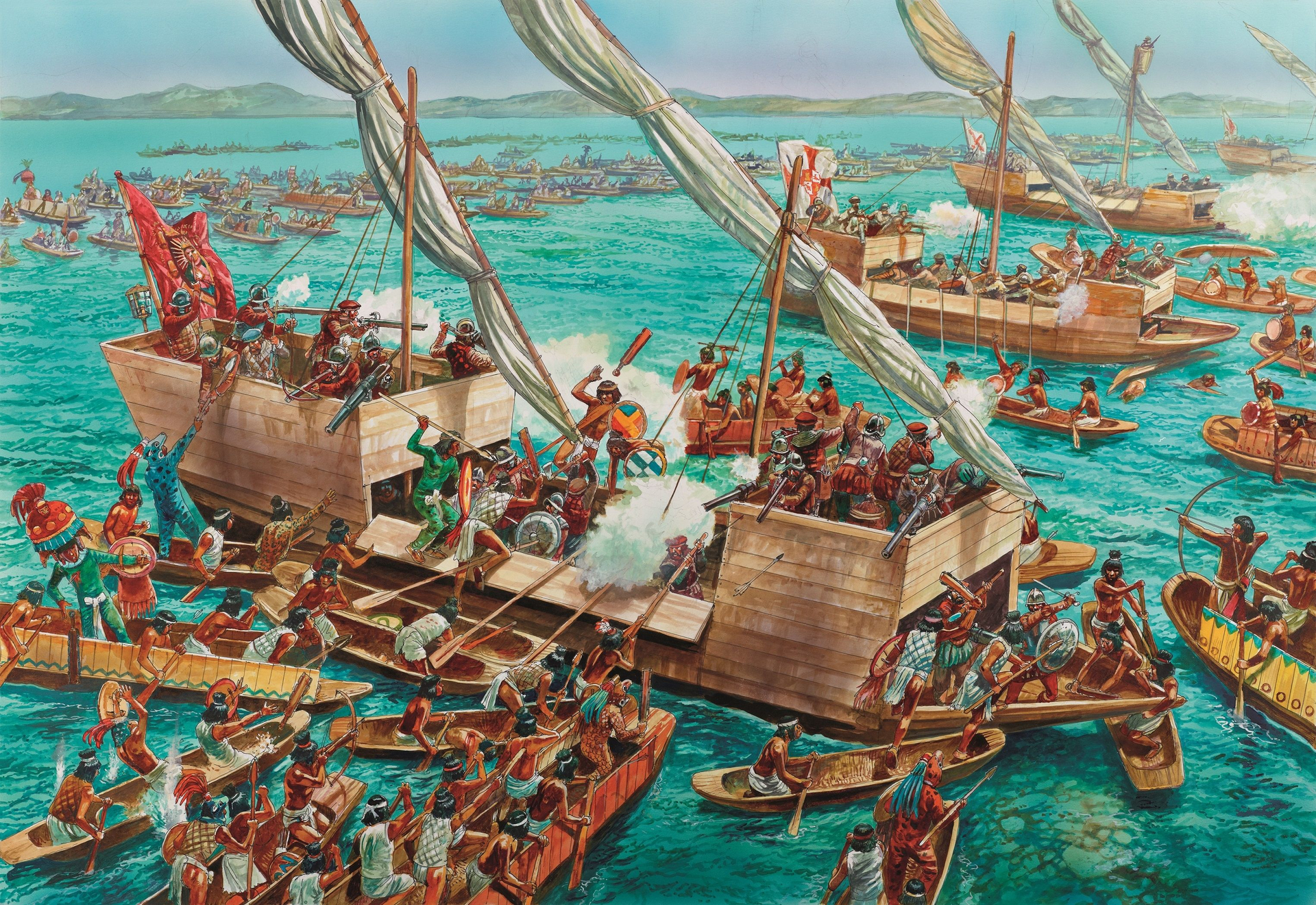
@BibelLesenGibtLeben You’re right that there must be some reasonable plausibility to the combat. Although I must say that the Amerindians would have adapted to warfare if they had had the time, but this was denied to them by the epidemiological factor. You can even see in accounts after the fall of Tenochtitlán, for example, Aztecs transforming their spears into pikes by fitting the swords of the Spaniards into them, making traps for the cavalry, and adding “shields” to their canoes to repel gunfire (as in the image below).
In the case of the Africans, they had a variety of metal blades in addition to throwing knives (which could sever limbs) and also made heavy use of poison in their arrows and javelins, the most odious weapon in Portuguese accounts.
I also wouldn’t underestimate the lethality of the sling. It’s no coincidence that the slingers of the Balearic Islands became famous and that the sling was used until World War I. Here’s an excerpt from Charles Darwin about the bolas of the Argentinian indigenous peoples (source):
The size and weight of the balls varies according to the purpose for which they are made: when of stone, although not larger than an apple, they are sent with such force as sometimes to break the leg even of a horse. I have seen the balls made of wood, and as large as a turnip, for the sake of catching these animals without injuring them. The balls are sometimes made of iron, and these can be hurled to the greatest distance.
@Velk413 I agree with you on that. There is already poison as a biological weapon to be used. In fact, the game doesn’t demonstrate this difference, but the poisons used by the Tupi and other South American peoples were generally to cause paralysis in the victim, and the fatal blow came from another weapon. In Africa, however, all poison was deadly.
For example, the 19th-century European traveler to Bornu, Major Dixon Denham, recounts that, in the disastrous Battle of Musfea in which he participated with soldiers from Bornu and Mandara, the allied Arab cavalry died quickly from hundreds of poisoned arrows fired by the Fulani enemies, and that their guide, Boo-Khaloom, sent by the Pasha of Tripoli to protect him, died from an arrow wound to the foot! He reports that the bodies of the dead immediately swelled and turned black, and that 30 horses that had been wounded but seemed to have recovered died instantly after drinking water, with blood gushing from their nostrils and mouths (the same occurred with the dead soldiers). The irony is that the Arabs thought that it was enough to fire their muskets—of poor quality and little gunpowder, admittedly—and the enemies would flee at the mere sound and smoke, but the opposite happened. The next Denham spent the days later fearing death because an arrow had grazed him.
The source of the episode is in his book here.
3 Likes
I dont think this is an issue now,we have civi without any story ingame.