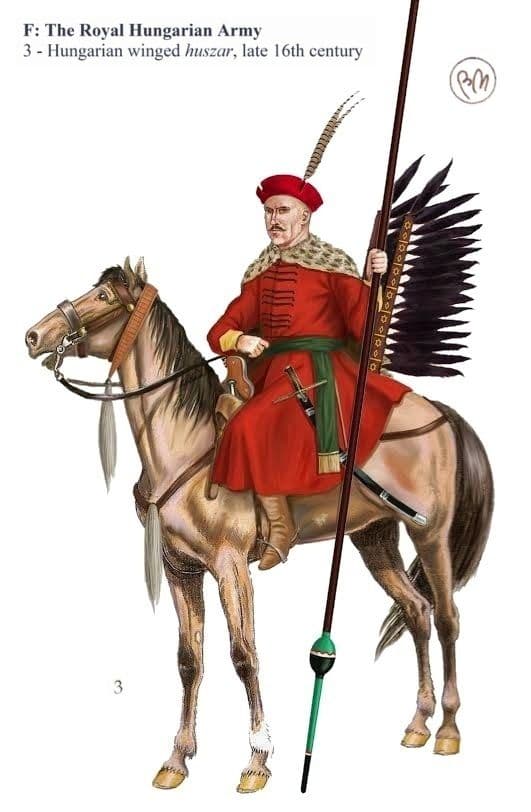
The problem with the magyar huszars that in age 2 hd they didn’t have wings (and it made sense) but for definitive edition they slapped the wings on because apperently hussars and wings cant exist without each other according to some people on the forum and age 2 devs. It was just a stupid change that didnt exist neither in hd nor in hungarian history. So what really annoying is they messed up something they done right already in hd.
3 Likes
I like they are giving more unique weapons to uu’s we already have too much axe and shield guys for uu.
Next uu designs should have mounted xbows maces 2 handed swords and other cool looking weapons.
1 Like
This was debatable in the past but now that the Poles were added it’s finally high time to remove the wings from Magyar and regular Hussars.
Agreed.
1 Like
There is no problem with the magyar hussar.
It is fine as it is.
3 Likes
It’s fine to you? If a Magyar Hussar appears to be a Polish one? To each their own I guess.
1 Like
The wings are drastically different and magyar hussar carries a big pole. Hard to confuse them.
3 Likes
And I don’t even know why this should be a “problem”. I have different understanding of a problem.
There are real problems in the game which could be fixed. Like the new arabia…
1 Like
Also ottomans had cavalry with wings…
4 Likes
Not that I have heard of. Obviously one will find wings on all kinds of fanart nowadays. However confirmed, historical sources are the only thing to be taken into consideration.
Just type “Winged Cavalry” into google and all your results will be about Polish Hussaria.
wikipedia:
“Hussars of the Polish Commonwealth were also famous for the huge wings worn on their backs or attached to the saddles of their horses. Several theories attempt to explain the meaning of the wings. According to some, they were designed to foil attacks by Tatar Lasso; another theory maintains that the sound of vibrating feathers attached to the wings made a strange sound that frightened enemy horses during the charge. However, recent experiments performed by Polish historians in 2001 did not support any of these theories and the phenomenon remains unexplained. They might have simply intended as a dinctive feature. The wings were probably worn only during parades and not during combat, but this explanation is also disputed. Because Poland has a large population of devout Catholics, it seems possible the wings and uniforms were meant to resemble St. Michael the Archangel.”
2 Likes
[[1]](file:///C:/Users/Robyn/Documents/Blog/Oct%2011%20-%20Confusion%20and%20ambiguity%20of%20hybrid%20identities.docx#_ftnref1) For just one example which berates previous publications from different nationalist points of view, see József Zachar, The Hungarian Hussar: An Illustrated History (Budapest: Corvina, 2000). See also Richard Brzezinski and Velimir Vuksic, Polish Winged Hussar, 1576-1775 (Oxford: Osprey, 2006). A quick look at the Wikipedia for the term “Hussar” gives a glimpse of the emotional controversy, as do numerous blogs. For a more scholarly take on the topic, though with a focus on seventeenth and eighteenth century manifestations of the Hussar and still not entirely devoid of a nationalistic spin (can a discussion of these winged horsemen ever really be?) see Thomas DaCosta Kaufmann, “Definition and Self-Definition in Polish Culture and Art 1572-1764,” in Land of the Winged Horsemen: Art in Poland 1572-1764, ed. Jan K. Ostrowski (Alexandria, VA: Art Services International, 1999), 15-25.
[[2]](file:///C:/Users/Robyn/Documents/Blog/Oct%2011%20-%20Confusion%20and%20ambiguity%20of%20hybrid%20identities.docx#_ftnref2) Occasionally Lorck’s figure is pulled from its costume book context and inscriptions and referred to as of one political or ethnic group or another. Such is the case in Alexandrine St. Clair, “A Forgotten Record of Turkish Exotica,” The Metropolitan Museum of Art Bulletin 27 (1969): 413, where the image is called a “Polish mercenary or delly.” In another case, while discussing the plumes on their helmets, two of Lorck’s figures were pulled by Charlotte Jirousek and called a Sipahi (mounted Ottoman soldier) and Grenzer (mounted Austrian border guard). The figure she refers to as a Grenzer carries one of the angled shields. See Charlotte Jirousek, “Ottoman influences in Western dress,” in Ottoman Costumes: From Textile to Identity, ed. Suraiya Faroqhi and Christoph K. Nauman (Istanbul: Eren, 2004), 246 and her figures on 293.
[[3]](file:///C:/Users/Robyn/Documents/Blog/Oct%2011%20-%20Confusion%20and%20ambiguity%20of%20hybrid%20identities.docx#_ftnref3) I was first alerted to this problem by Pierre Terjanian, curator of Arms and Armor at the Philadelphia Museum of Art. Literature on the history of painted shields is scant. Vladimír Denksein published a number of articles and short volumes on the painted wooden shield but confined his interests to the pavise style rectangular shape popular in central Europe in the fifteenth century. His works remain the authority on painted shields and their decorated surfaces. For an example of his works, see Vladimír Denkstein, Pavesen böhmischen Typs im Historischen Museum der Stadt Wien (Brno, 1964). For an article more specific to the angled shaped shield, though not as reliable from a scholarly point of view, see J. Bielz, “Die Hermannstädter Tartschen,” Mitteilungen aus dem Baron Bruken-thalischen Museum, Sibiu, 3 (1915): 32-40.
[[4]](file:///C:/Users/Robyn/Documents/Blog/Oct%2011%20-%20Confusion%20and%20ambiguity%20of%20hybrid%20identities.docx#_ftnref4) Most major collections of arms and armor contain at least one example of such shields. One from each end of the spectrum hangs in the Kretzschmar von Kienbusch Galleries of the Philadelphia Museum of Art (accession numbers 1977-167-755 and 1977-167-756).
[[5]](file:///C:/Users/Robyn/Documents/Blog/Oct%2011%20-%20Confusion%20and%20ambiguity%20of%20hybrid%20identities.docx#_ftnref5) János Kalmár, Régi magyar fegyverek (Budapest: Natura, 1971). The origin of the light cavalryman of Central Europe is a hotly debated topic filled with nationalistic rants from South Slavic, Hungarian, and Polish scholars, and I do not aim to choose a side in the debate.
[[6]](file:///C:/Users/Robyn/Documents/Blog/Oct%2011%20-%20Confusion%20and%20ambiguity%20of%20hybrid%20identities.docx#_ftnref6) In an interesting article that questions the use of heraldry in the Ottoman Empire, Aleksandar Matkovski makes important connections between the European perception of Ottoman “coats of arms” and their real Balkan (or Central and Eastern European) counterparts. This, upon further exploration into the tricky world of heraldry, could lead to some more concrete evidence and conclusions about the shields in question. See Aleksandar Matkovski, “Les Blasons Représentant L’Empire Ottoman en Europe,” in International Congress of Turkish Art. IVème Congrès International D’art Turc: Aix-En-Provence, 10-15 Septembre 1971 (Aix-en-Provence: Éditions de l’Université de Provence, 1976), 123-143.
[[7]](file:///C:/Users/Robyn/Documents/Blog/Oct%2011%20-%20Confusion%20and%20ambiguity%20of%20hybrid%20identities.docx#_ftnref7) According to Kalmar 1971, 312, this image comes from a 1514 printing of Sigismund Von Herberstein’s Rerum Moscoviticarum Comentarii [Notes upon Russia], however this book was not published until 1549. In looking through the versions of Herbstein’s publication that were available to me, I discovered a stylistically similar image on the edge of a map. See Sigismund Von Herberstein, Rerum Moscoviticarum Comentarii (Basle, 1571), 5 (unnumbered folio). Though the image here is different in subject matter, further research may lead to the original image. For a brief discussion of the accuracy of Herbstein’s images see J. L. Nevinson, “Siegmund von Herberstein: Notes on 16th Century Dress,” Zeitschrift der Gesellschaft fuer historische Waffen- und Kostum-Kunde 1, new series (1959): 86-93.
[[8]](file:///C:/Users/Robyn/Documents/Blog/Oct%2011%20-%20Confusion%20and%20ambiguity%20of%20hybrid%20identities.docx#_ftnref8) Tibor S. Kovács, Huszár-Fegyverek a 15.-17. Században (Budapest: Martin Optiz Kiadó, 2010), 255-263.
[[9]](file:///C:/Users/Robyn/Documents/Blog/Oct%2011%20-%20Confusion%20and%20ambiguity%20of%20hybrid%20identities.docx#_ftnref9) Shields such as the one shown were often included in rooms devoted to Turkish curiosities. See Ernst Petrasch, ed., Die Karlsruher Türkenbeute: die “Türckische Kammer” des Markgrafen Ludwig Wilhelm von Baden-Baden : die “Türckischen Curiositaeten” der Markgrafen von Baden-Durlach (München: Hirmer, 1991), in which the shield shown is catalogue no. 118.
[[10]](file:///C:/Users/Robyn/Documents/Blog/Oct%2011%20-%20Confusion%20and%20ambiguity%20of%20hybrid%20identities.docx#_ftnref10) Nurham Atasoy, “1558 Tarihli “Süleymanname” ve Macar Nakkaş Pervane,“ Sanat tarihi yilligi 3 (1970): 167-196.
[[11]](file:///C:/Users/Robyn/Documents/Blog/Oct%2011%20-%20Confusion%20and%20ambiguity%20of%20hybrid%20identities.docx#_ftnref11) Corresponding text (1646 edition): “Ein Soldat des Morae Begi oder Regenten der Statt Modone“ [A soldier of Morae Begi of the regent of the state of Modon (Modoni, a Venetian colony on the Peloponnesian Peninsula conquered by the Ottomans in 1498)].
[[12]](file:///C:/Users/Robyn/Documents/Blog/Oct%2011%20-%20Confusion%20and%20ambiguity%20of%20hybrid%20identities.docx#_ftnref12) For examples of these hybrid pseudo-Oriental armors see a the Hungarian zischagge helmets painted with ornamental patterns inspired by their Ottoman counterparts in the Kunsthistorisches Museum Waffensammlung, Vienna (inv. A878) and in the Magyar Nemzeti Múzeum [Hungarian National Museum], (inv. 55.3540). The one in the MNM is published in the catalogue of an exhibition on the last queen of Hungary before the Ottoman period, Bob van den Boogert and Jacqueline Kerkhoff, eds., Maria van Hongarije: koningin tussen keizers en kunstenaars 1505-1558 (Zwolle: Waanders, 1993), 82, cat. no. 65.
[[13]](file:///C:/Users/Robyn/Documents/Blog/Oct%2011%20-%20Confusion%20and%20ambiguity%20of%20hybrid%20identities.docx#_ftnref13) Jirousek 1995, 29.
[[14]](file:///C:/Users/Robyn/Documents/Blog/Oct%2011%20-%20Confusion%20and%20ambiguity%20of%20hybrid%20identities.docx#_ftnref14) For just one example see St. Clair 1969, 413-414.
Just the short list of source of that article… For sure
What’s your next answer? Fake news? Lügenpresse?
3 Likes
Are you feeling okay?
2 Likes
Yeah I’m fine, thanks.
1 Like
Sounding a little frustrated to me. Take care.
2 Likes
Well, I just copy the sources back in, to stay inside the discussion. If you don’t accept reason I think it’s your personal problem. Not mine.
Seems like wings were widely used, not only in poland.
Case closed.
2 Likes
First provide the source of this supposed “Hungarian winged huszar”. They look like fan arts.
You saying “case closed” doesn’t close a case at which more people voted in favor of this change than against it. 
2 Likes
After playing the new DLC it just feel even more wierder that the Magyar Huszar and the original Hussar have wings when we now have a Hussar named the Winged Hussar.
3 Likes
IMO, it just feels weird that the regular Hussar has wings, I actually like the wings of the Magyar Huszar, but those wings has been in the game for so long that would be rare to remove them
You can always count on mods for this if you like (I remember seeing a mod that removes the wings for the Hussar but I couldn’t find it anymore)
2 Likes
I must agree. Especially for Magyar ones.
2 Likes
yep. remove all wings from husars except th winged hussars
3 Likes