Sengoku jidai was an awesome period. But it just rubs me the wrong way thinking about a civ say the Egyptians just being mowed down by ancient gatling guns and muskets and being blown apart by cannon fire.
I do think the Japanese civ should based on whatever period that was before guns, muskets, cannons, etc… were used.
The depiction of warriors dressed in “samurai”-esque armor has even been seen dating back to the 11th century. Note that the Vikings were still active during the 11th century.
Therefore, I think the Japanese civ should be based on the same period as the Danes (Norse) even though both civilizations have history dating back thousands and thousands of years.
Gatling guns didn’t exist during the Sengoku Jidai, neither in Japan nor anywhere else in the world. I think you may be mistaking it for the Boshin war. Arquebuses were used during the Sengoku period, but they were introduced halfway through and you could absolutely represent the civ as it was before this date. As for basing it on the 11th century… The katana date from the 14th, so I don’t see it happening.
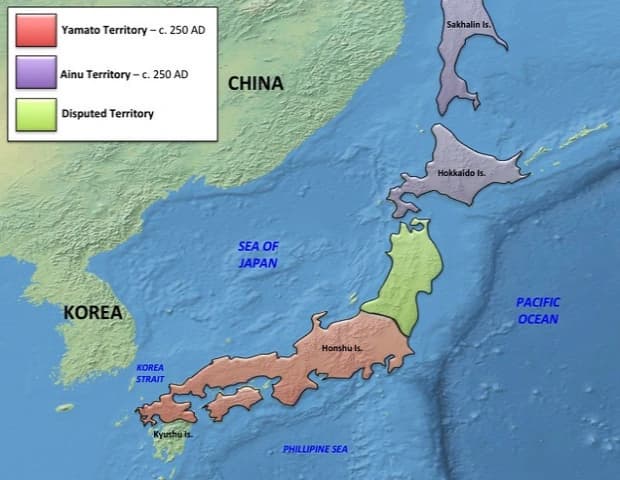
Of course, or lastly they can set the Japanese civ in the Yamato period (250-750) and lastly, the mythical era is in the Sengoku period (and is similar to the Japanese of AoE 4) (794-1616)…
The Yamato period of Japanese culture is also called the age of the great tombs because of the appearance in these centuries of great tombs and tomb clusters, presumably for the burial of rulers and other elites. The name Yamato comes from the region of Japan that was the home of the first clan to consolidate rule over most of the islands. During the Yamato period, Japan accelerated its advance in technology by adopting the cultivation of rice, improving its pottery, developing iron working, building social ############ and accomplishing a political, economic, and cultural consolidation of the islands. ”
—excerpt from the Age of Empires manual
Yamato is the name of a Japanese dynasty incl. Yamatai (circa 184 AD~250 AD?) and Later Yamatai (circa 250 AD~689 AD), that was located in Ancient Japan with the capital city probably in the Yamato Province. The Yamato are the ancestors of modern Japanese people and were the first people to conquer and unify all of Japan.
While conventionally assigned to the period 250–710, including both the Kofun period (c. 250–538) and the Asuka period (538–710), the actual start of Yamato rule is disputed. The Yamato court’s supremacy was challenged during the Kofun period by other polities centered in various parts of Japan. What is certain is that Yamato clans had major advantages over their neighbouring clans in the 6th century. This period is divided by the relocation of the capital to Asuka, in modern Nara Prefecture. However, the Kofun period is an archaeological period while the Asuka period is a historical period. Therefore, many think of this as an old division and this concept of period division is no longer applicable.
At the era of Prince Shōtoku in the early 7th century, a new constitution was prescribed for Japan based on the Chinese model. After the fall of Baekje (660 AD), the Yamato government sent envoys directly to the Chinese court, from which they obtained a great wealth of philosophical and social structure. In addition to ethics and government, they also adopted the Chinese calendar and many of its religious practices, including Confucianism and Taoism (Japanese: Onmyo).
Japanese mythology is a collection of traditional stories, folktales, and beliefs that emerged in the islands of the Japanese archipelago. Shinto traditions are the cornerstones of Japanese mythology.[1] The history of thousands of years of contact with Chinese and Indian myths are also key influences in Japanese religious belief.[1][2][3]
Japanese myths are tied to the topography of the archipelago as well as agriculturally-based folk religion, and the Shinto pantheon holds uncountable kami(“god(s)” or “spirits”).[1] This article will discuss cosmogony, important deities, modern interpretations, cultural significance, and the influence of these myths.
Two important sources for Japanese myths, as they are recognized today, are the Kojiki and the Nihon Shoki.[4][5] The Kojiki, or “Record of Ancient Matters,” is the oldest surviving account of Japan’s myths, legends, and history.[6] Additionally, the Shintōshū describes the origins of Japanese deities from a Buddhist perspective.[7]
One notable feature of Japanese mythology is its explanation of the origin of the Imperial Family, which has been used historically to deify to the imperial line.
Japanese myths are passed down through oral tradition, through literary sources (including traditional art), and through archaeological sources.[1][5] For much of Japan’s history, communities were mostly isolated, which allowed for local legends and myths to grow around unique features of the geographic location where the people who told the stories lived.[1]
The Kojiki and the Nihon Shoki, completed in A.D. 712 and A.D. 720 respectively, had the two most referenced and oldest sources of Japanese mythology and pre-history.[5][1] Written in the Eighth century, under the Yamato state, the two collections relate the cosmogony and mythic origins of the Japanese archipelago, its people, and the imperial family.[8][5] It is based on the records of the Kojiki and Nihon Shoki that the imperial family claims direct descent from the sun goddess Amaterasu and her grandson Emperor Temmu enlisted the help of Hiyeda no Are who committed to memory the history of Japan as it was recorded in two collections that are thought by historians to have existed before the Kojiki and Nihongi.[1] Under Empress Gemmei’s rule, Hideya no Are’s memory of the history of the Japanese archipelago and its mythological origins were recorded in spite of Emperor Temmu’s death before its completion.[1] As a result of Hideya no Are’s account, the Kojiki was finally completed, transcribed in kanji characters, during Empress Genshō’s time as sovereign.[1] The Yamato state also produced fudoki and Man’yōshū, two more of the oldest surviving texts that relate the historical and mythical origins of Japan’s people, culture, and the imperial family.[8]
Motoori Norinaga, an Edo-period Japanese scholar, interpreted Kojiki and his commentary, annotations, and use of alternate sources to supplement his interpretations are studied by scholars today because of their influence on the current understanding of Japanese myths.[5]
Archaeologists studying the history of the Japanese Archipelago separate the prehistoric history into three eras based on attributes of the discoveries associated with each era.[3] The Jōmun period marks the first cases of pottery found on the archipelago, followed by the Yayoi period and the Kofun period.[3] The Yayoi district of the Japanese capital Tokyo, is the namesake of the Yayoi period because archaeologists discovered pottery associated with the time period there.[3]
Contact with Korean civilization in the latter part of the Yayoi period influenced the culture of the Japanese Archipelago greatly, as evidenced by the discovery of artifacts that archaeologists associate with various cultural streams from Korea, and northeast Asia.[3] Finally, Kofun period artifacts, ranging from A.D. 250 to A.D. 600, are the archaeological sources of what historians know about the Yamato kingdom — the same Yamato state that was responsible for the two most prominent literary sources of Japanese myth, the Kojiki and Nihon Shoki.
In Age of Empires IV, the Japanese civilization spans the late 8th century CE to the early 17th century CE. Collapse of imperial power has separated the Japanese into small kingdoms, ruled by warlords, to ultimately be re-unified by a bloody civil war. During this period the Daimyo employed the Samurai to defend their territories by paying them with goods, such as land and food.
I think samurais with katanas will be safe. One good thing about AoM or mythological games in general is that they don’t really have to be too historically accurate. They can pull or use any units from any “period” as long as it is prior to muskets / arquebus / what have you.
The Monkey King of the Chinese Civ is also from the Tang Dynasty (the period in which “Journey to the West” takes place) or the Ming Dynasty (the period in which the novel was actually written).
If there are mythological elements, there is no need to limit the source to ancient times.
Yes, AoM if you want is more flexible with the historical chronology, with the inclusion of the Chinese they moved the chronology to the Ming Dynasty (1368-1644)…if they include Aztecs, Slavs and Yoruba, AoM would become a much more game “medievalized” than set in ancient times…that is, any polytheistic mythology between 3000 BC and 1600 AD can enter the game…
With the popularity of the Witcher books/games/TV show it would probably sell pretty well.
AoM was made 20 years ago and you can see that in a lot of choices.
Units being based on things we saw in movies in the 90s and stuff.
The game also clearly released before the Troy movie, or else the Greek units would likely be more Mycenaean looking instead of Macedonian.
I think they can still make another Norse/Egypt/Greek mythology with gods that aren’t covered. From what I know Norse mythology still has a lot to cover.
Which is something that upsets a lot of people.
They just added Greeks 2.0 instead of a new mythology.
Almost everyone would prefer something entirely new over more of the same. And there are a lot of untouched mythologies than can be added before it’s worth looking back at the old ones.
Well if they add one major god plus one minor god for each age, it would make 3 more myth creatures for every race. Would also make things more exciting and it would cover more without adding another too similar race.
Also sorry i wrote less instead of leshy.
You know this big tree-skull monster from the Witcher games and the series first season?
Yeah, apropriating and transforming myths was quite common at the time and since the Greek mythology appeared later than the Near East ones (or at least was transcripted into written form later), it’s pretty obvious how much they copied from them. It puts into perspective the mockeries directed at the Romans for taking so much from the Greeks, right?
It is because of the Alexandrian Empire and the Hellenistic period…many myths and cultures from the Middle East (Egypt, Babylon and Persia) thus arrived in Greece and from there to Rome when the Roman Republic arrived in these areas…
Not exactly. Hesiod’s work was greatly influenced by Anatolian and Mesopotamian myths and in return greatly influenced Greek mythology as a whole even though he is less often credited than Homer. The dude lived ## ### ####### centuries BC, long before Alexander and the diadochi. So you really can’t pinpoint it to the Hellenistic period.