Its not my history channel, the history channel made a piece about sea mermaids one time so no its definately not my history channel
The Swedish did much less than the Danes, in the Middle Ages, and so did the Norwegians.
During the Medieval period, the foremost active Scandinavian people in the world stage, were the Danes. Even the Norse colonization of Britain was called the Danelaw.
2 Likes
Difference Between Norse and Viking
Norse vs Viking
“Viking” and “Norse” both refer to the Germanic people living in Scandinavia at the time of the Viking Age. These two words are used interchangeably. The difference lies in the occupation or work of the person. Both refer to the same people, that is, people belonging to Scandinavia or who lived in Scandinavia or settled in other parts of the word by traveling. Sometimes they were called Norse traders. These traders were full-time traders whereas Vikings were actually considered warriors who were lead by Jarl, the second son of a chieftain during peacetime, or people of noble birth. Vikings were never warriors full time. They were farmers, and when the situation presented itself, they fought like warriors.
Norse
“Norse” not only refers to the Norsemen of Scandinavia, it also refers to the language called the Norse language. Old Norse was a North Germanic language developed from the Proto-Norse language and spoken from AD 800 to AD 1300. From Old Norse developed East Norse which is modern Danish and Swedish and West Norse languages like modern Norwegian, Icelandic and Faroese.
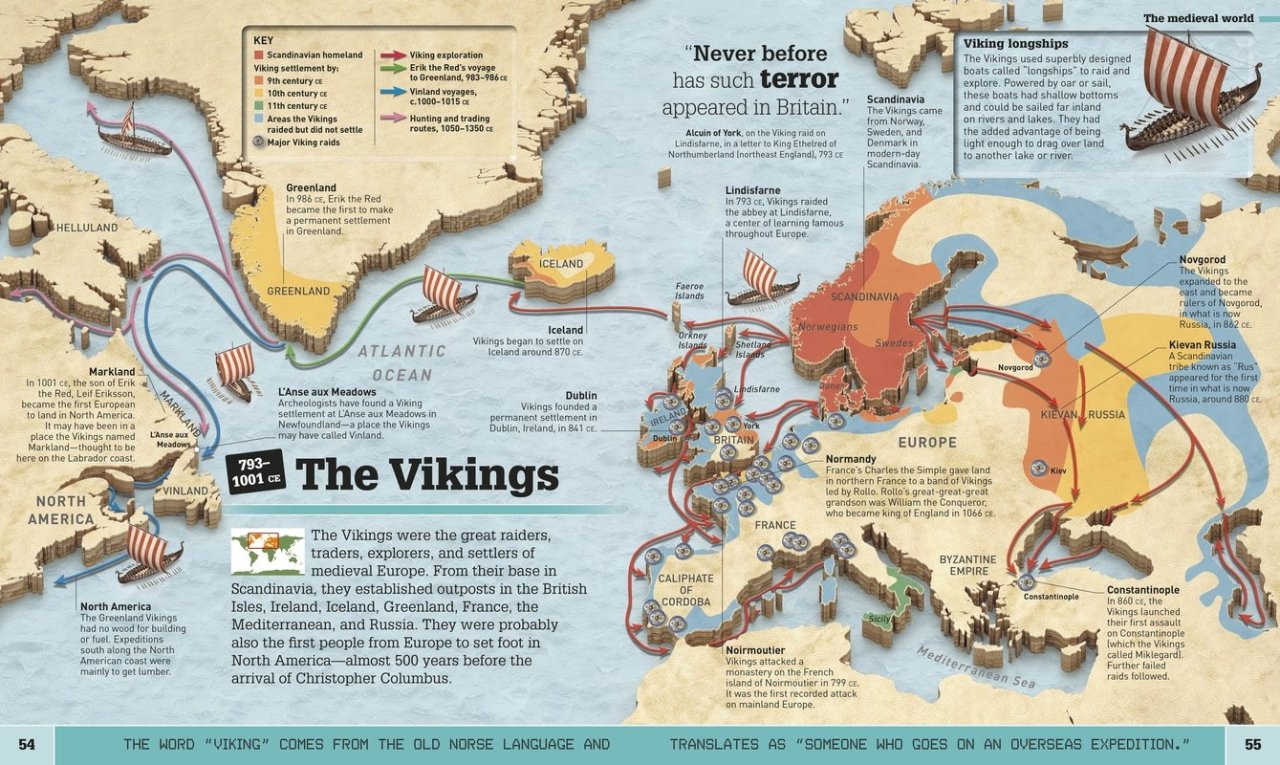
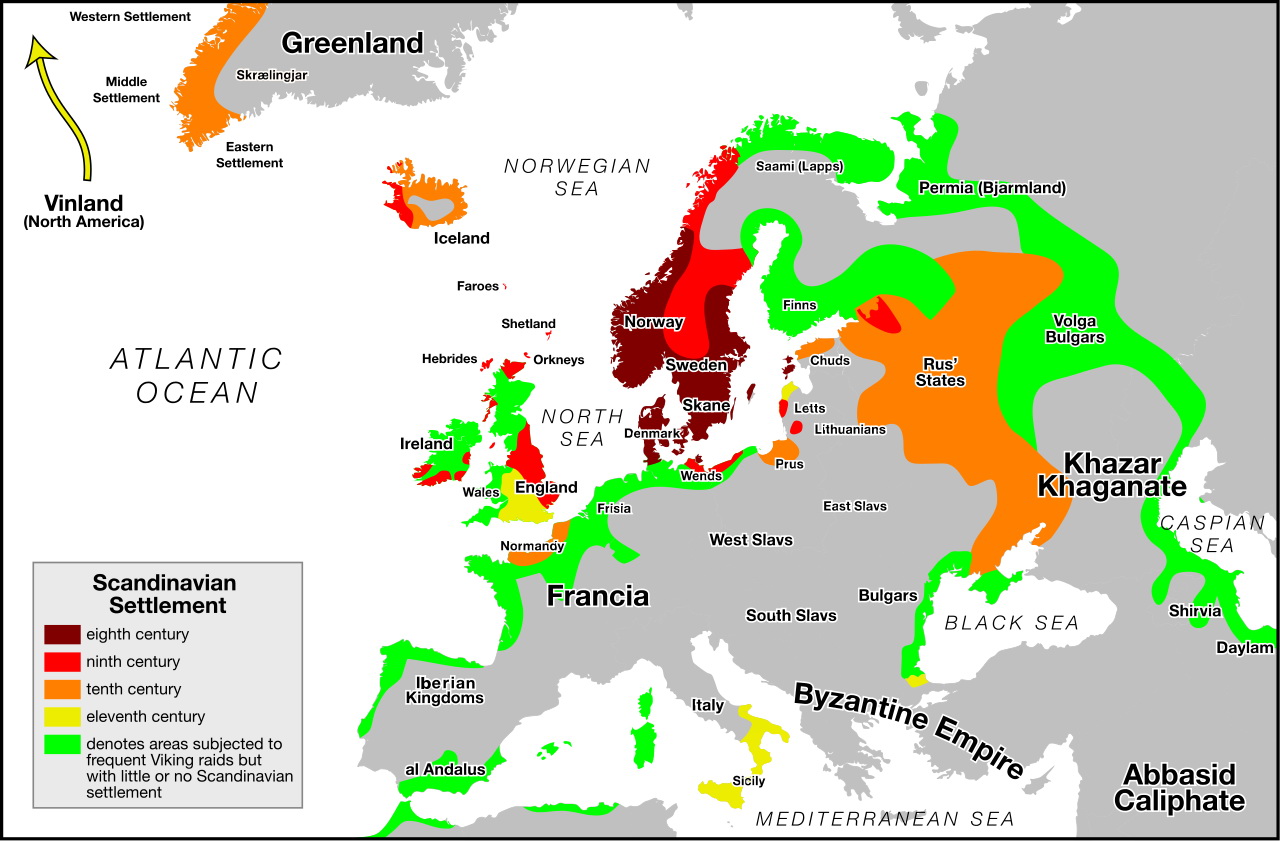
In history, “Norse” refers to Norse mythology, art, paganism, Norse activity in the British Isles, and Norsemen. This article deals with the differences there might be between the Norsemen and the Viking people. Norsemen lived in Scandinavia during the Viking age or in the Middle Ages. They spoke Old Norse and practiced a pagan religion. During the Viking Age, they expanded to countries like Iceland, North America, and Greenland and also conquered parts of Ireland, France, and Britain. The reason for their expansion was developing skills in warfare, trade, and crafts. They were the first people to form the Russian State so that they could control the trade routes as far as Constantinople, Baltic Sea, and Arabia. This shows that they were traders and took advantage of all and any situation for expanding their trade.
The modern descendants of Norsemen are now called Scandinavians who adopted Christianity in a large scale after it emerged in Scandinavia. The Norsemen also wrote many literary books which give insights into their culture and history.
Vikings
Vikings in modern times are mythical Germanic people who acted as noble savages, but the truth is Vikings were Norse merchants, explorers, sometimes pirates and warriors who used to travel by their long boats to distant parts of the world for trade as well as conquering parts of Europe, Asia, and North America in order to expand and settle. The expansion took place mainly in the Viking Age during which the Vikings were powerful and were led by Jarl in times of war.
Summary:
“Norse” and “Viking” refer to the same Germanic people who settled in Scandinavia during the Viking Age who spoke Old Norse. “Norse” refers to Norsemen who were full-time traders, and Vikings refers to people who were actually farmers but were part-time warriors led by people of noble birth.
Read more: Difference Between Norse and Viking | Difference Between Difference Between Norse and Viking | Difference Between | Norse vs Viking
3 Likes
It’s fun to discuss history with other enthusiasts, but remember the context here is how history informs the development of a video game. Developers are tasked with navigating the confluence of many competing interests — history, gameplay, fan expectations, etc. while true historians confirm that actual Vikings did not have horned helmets, from the context of creating a game, there’s still an argument that players associate horned helmets with Vikings and even if giving the units in that civ a horned helmet hurts the game from a historical perspective it does help the game in a readability or gameplay perspective. I don’t know the correct answer in this example, but the point is that there may not be one. Or there may be several contradicting correct answers that the devs get to choose where this game will fall on the spectrum of realism v. characterization.
1 Like
“All Danes, Norwegians, Swedes were not pirates”
no but theese people were known as Vikings during the Viking age.
1 Like
yeah you are looking at it from a nationalistic point of view. Scandinavians at this time shared the same language, culture, gods and way of life. The nation state is a much later invention.
Not even that is true. There are only a couple of mentions of the word Viking in medieval literature. Which leads historians to believe that most Scandinavian conquerors, traders and raiders were not commonly called Vikings. And that most people at that time weren’t even familiar with the word.
2 Likes
And again . Should be English, HRE, and France being all named Franks, because for the Byzantines, Slavs, and muslim words they were all Franks from their point of view ?
Should be the Berber, Fatimids, Almoravids being called “Saracens” because Spanish call them like that.
Should be Byzantines being called Greeks because they were called like that by all western europe.
If you really liked Viking Age and their civilization, you should like than the accurate meaning of víkingr from the point of view of norse speakers appears in the game.
2 Likes
to be fair, even the games like Assassin’s Creed, which really ■■■■■■ hard the accuracy about norsemen didn’t give them horned helmets  I think it’s something which will rarely happen again today.
3 Likes
Yeah though it still would help quickly identify a unit from a distance, such as in an rts game. So I could imagine it’s justification in certain games.
Again, that’s just an example and not a statement that I do or do not think it would work in AoE4. It seems to work in other Age games.
1 Like
This game goes up to the 1500s, and all the civs they have chosen are nation-based. This is why you have Abbasids and Rus, instead of Arabs and Slavs.
In AoE4, they are going for national groups, not umbrella cultures.
1 Like
I think the big round shields in their hands should be enough to identify them as Norse.
2 Likes
indeed, indeed, I hope they will focus on the identification with the shields anyway
Edit : Ops someone wrote faster
1 Like
The Roundshield, the big Axes, and the Chainmail tunnics ought to do it.
1 Like
You mentioned a slippery slope argument earlier regarding the line to be drawn when worrying about the details. It is a valid concern and that line will always be difficult to discern.
If people stop calling the Vikings Vikings, then it could result in endless people obsessing over calling the Byzantines “Eastern Romans”. That would not be cool.
All details are not equally important and can require a case-by-case perspective to ascertain relevance. When it comes to the names of entire civilizations, I think people should resist the urge to detail-obsess unless good pragmatic arguments are given to warrant ignoring names and conventions that have been adopted through generations via the natural progression of language.
yeah you should read more you dont have to link anything to me
A simple question, should we call Vikings with modern terms or how they were called back there?
People did call them in Middle Ages Vikings, not Scandinavians.
Also they were on old paintings depicted with horns.
1 Like
It’s funny than poeple are obsessing over calling Byzantines : “Eastern Romans”, because Eastern Romans is a modern convention as Byzantines.
Yeah, it’s a tricky case, but for me different from the viking case.
Again aoe 4 is way more detailled on the ages and aesthetic the game cover. And the last age of carracks, gunpowder, etc …will really not match with a “Viking civilization”, when viking age was ended at this point, and they were christian kingdoms
An evolution similar to the english which change from anglo-saxon aesthetic and language to angland, would be probably envisaged for Danes (for exemple).
When Historians are using Byzantine term just because … it’s really efficient. You directly understand than we are speaking about the Roman Empire after the fall of Rome, the ones with their capital of constantinople, hagia sofia, cataphracts, fire ships … It’s not misleading at all, and don’t mismatch with the progression of the game, imo
3 Likes
I mean it is nowadays pretty much a scientific consensus that Vikings are only a small insignificant part of the Scandinavian culture and that the name is referring to the pirates and people that went abroad to raid during that time.
I believe that if the game tries to be more historically accurate than its predecessors that it could also help to clear up these historical misconceptions.
But that is just my opinion. I am also a bit biased as I am Scandinavian.
3 Likes
You think the Rus during this time were a nation state? Even today they are a federation.