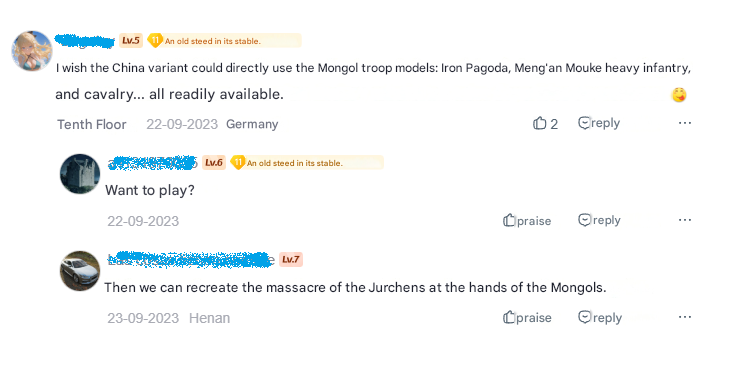
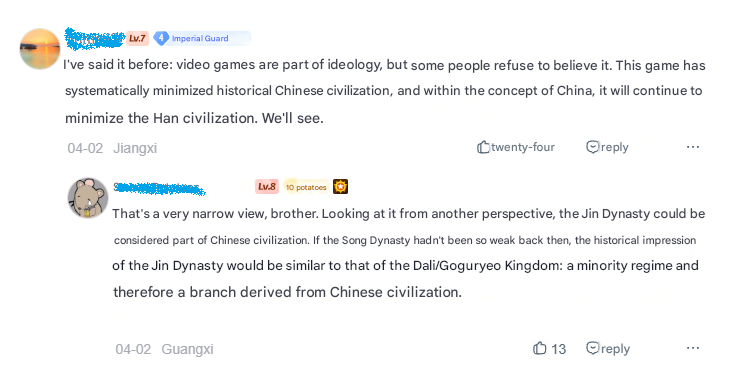
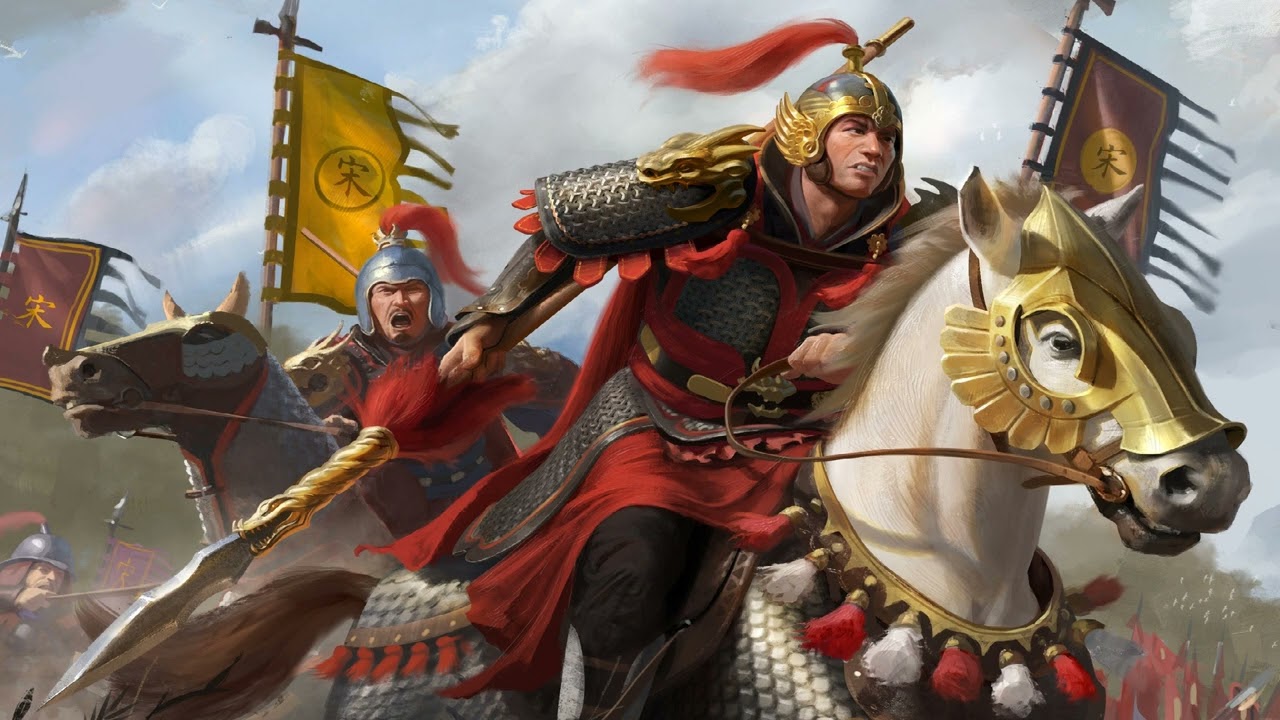
First, if the Jin Dynasty were added as a completely new civilization, that would be totally understandable. The Jin was founded by the Jurchen, and before they took over northern China, the Song Dynasty at that time was mainly Han Chinese and saw the Jurchen as foreigners. The two sides fought for years. That’s a fact.
But it’s also completely reasonable for the game developers to make the Jin a Chinese variant civilization. Why? Because after the Jin took over northern China, they quickly began full‑scale sinicization – they used the civil exam system, employed Han officials, and wore Han clothes. By the middle and late Jin period, ordinary people could hardly tell the difference between Jurchen and Han in daily life. The Jin’s identification with “China” is very clear. Starting from Emperor Xizong of Jin, the Jin forced the Southern Song to submit and call themselves vassals, and from then on, the Jin called themselves “China”.
Now, the actual reply to the original post: OP, there are quite a few problems with what you said. Let me break it down.
1. Origins: Manchus and Koreans are not the same at all, and their types of civilization are completely different.
The ancestors of the Manchus are the Sushen–Jurchen line, a hunting / pastoral civilization. They lived in the forests and grasslands of the northeast, surviving by riding, archery, hunting, and herding. The ancestors of Koreans are the Samhan of the southern part of the peninsula, an agricultural civilization that grew rice. These are two completely different ways of life and forms of civilization. To give an example: just like the Germanic nomadic tribes and the Mediterranean farming city‑states in European history – can you say they come from the same origin?
You mentioned Goguryeo. Goguryeo was a multi‑ethnic state with Fuyu, Mohe (Manchu ancestors), and some old Joseon people. Most of Goguryeo’s historical remains are inside China. Chinese scholars have done serious, extensive research, and the mainstream view is that Goguryeo was a local regime in Northeast China’s history. Its main population was different from the later Korean people, but that doesn’t mean “Goguryeo belongs to China” or “belongs to Korea” – that’s too simple. It was an independent, complex ancient civilization. Anyway, the different groups inside Goguryeo don’t mean “Manchus and Koreans share the same origin”. Just because a state had multiple ethnicities doesn’t mean those ethnicities are all one family.
2. Manchu–Han relations did not start with Hong Taiji, nor are they shorter than Manchu–Mongol relations – in fact, they go back much earlier.
The Jurchen had contact with central China long before the Jin Dynasty. As early as the Tang Dynasty, the Mohe (direct ancestors of the Jurchen) had frequent contact with the Tang. The Balhae Kingdom (698–926 AD) was founded mainly by the Mohe, but it fully copied Tang institutions and was called the “Flourishing Eastern Land”. Its official documents, political system, and city layouts were all highly sinicized. Even earlier, in the Northern Dynasties period, the Wuji and Mohe paid tribute to the central plains dynasties. So, the Jurchen and the Han have been interacting for at least 1,300 years.
The Jin Dynasty was just the peak of this relationship. After the Jin took over northern China, they became even more sinicized: Emperor Xizong and Emperor Zhangzong of Jin called themselves “China” and called the Southern Song “the Southern Country”. The Manchu–Mongol intermarriage was a political alliance made by Nurhaci and Hong Taiji in the late Ming, barely 400 years ago. Which relationship is deeper and longer‑lasting? The answer is obvious. In 1626, the very year Hong Taiji took the throne, he issued an edict saying “Manchu and Han people are one body”, and demanded that legal cases and corvée duties be treated equally – that’s not the start of the relationship, it’s a sign of the relationship deepening.
3. “Moreover, the middle age Manchurian history documents are well-reserved in Korea; on the other hand, chinese know almost nothing about Manchurian history.”???
This is a typical exaggeration. The Qing Dynasty itself was a Chinese dynasty ruled by Manchus, so the historical legacy is huge. The First Historical Archives of China alone hold 2 million Manchu documents. There is also the journal Manchu Language Research in China, and the Manchu Studies Institute at Heilongjiang University (a national “endangered discipline” project). What Korea has are mainly the Yanxinglu and Imsagi – travel diaries of Korean envoys. Valuable, but they’re foreigners’ trip reports. Saying “Chinese know almost nothing” is like saying a foreigner’s travel blog is more authoritative than the country’s own archives – ridiculous.
4. “Chinese always say: ‘Manchus are nothing but savages without culture.’”???
That’s a stereotype. Chinese history education clearly introduces Manchu script, clothing, performing arts, and the Qing Dynasty’s contributions. Historically, the Manchus invaded Korea and forced it to become a vassal. The Korean civil and military officials wept bitterly, and afterwards secretly continued to use the Ming Chongzhen reign title. For that matter, Korean envoys in their diaries before the 18th century also called the Manchus “barbarians” – so by your logic, do Koreans also look down on the Manchus?
5. “For the Manchurian history, the international world has its own view and research.”
There’s no single “international view”. Scholars from different countries have different opinions, based on different sources. The research done by Chinese scholars, based on a large amount of archaeology and documents, is also serious scholarship. If you keep using “the international world” to pressure people, but you don’t say which country, which scholar, or which book – that’s not arguing, that’s just hot air.
Personal note
When I was in college, I loved East Asian history. I discussed Goguryeo, Jurchen, Balhae and other issues with scholars from Heilongjiang University, Jilin University, and Yanbian University. When it comes to documents, I’m wide awake.
I really hate it when people use narrow nationalism to blow their own country’s history out of proportion. Hearing someone say “Jurchen and Koreans are more similar” – that’s something I’ve never heard before, so I have to say a few things:
First, Korea has long called itself “Little China”. Its culture has been hugely influenced by central China – the civil exam system, Confucianism, and Chinese characters were used for over a thousand years. Before Hangul was invented, all official documents were written in Chinese characters.
Second, look at the cultural contradiction in South Korea today. On one hand, you want to abolish Chinese characters and cut ties with Chinese culture; on the other hand, when you talk about history or make historical dramas, you can’t get away from China (I have to say, your deliberate ugly portrayal of Chinese people in those dramas is really cheap and embarrassing). Meanwhile, how many Chinese historical dramas even mention Korea? Let’s take the Imjin War (1592–1598) – the Ming Dynasty sent troops to save Korea and helped repel the Japanese invasion. That was a “life‑saving grace” for Korea. South Korea has made over a hundred movies and dramas about this war, and Admiral Yi Sun‑shin is glorified like a god. Yet, in Chinese historical records, this war gets very little space. That shows you how important it was in the eyes of the central plain dynasty – a vassal state’s survival crisis wasn’t worth writing about much. But Korean records remember it deeply, which shows how much the Korean peninsula depended on the central plain dynasty.
Third, you often say online that “China stole Korean culture”. That’s a classic inversion of nationalism – forcibly reversing a long‑term one‑way flow of influence. Who invented writing? Who started the civil exam system? Who gave Korea its name? Who granted the official robes for Korean officials? If you trace all these things back to their source, the foundation of Korean cultural identity would have to be rebuilt.
History is not a little girl you can dress up any way you want. If you can read Chinese, I suggest you read more history books and fewer internet memes.